Chanel Grand Shopping Tote Guide: Sizes, Prices and Pre-Owned Buying
The GST in Brief
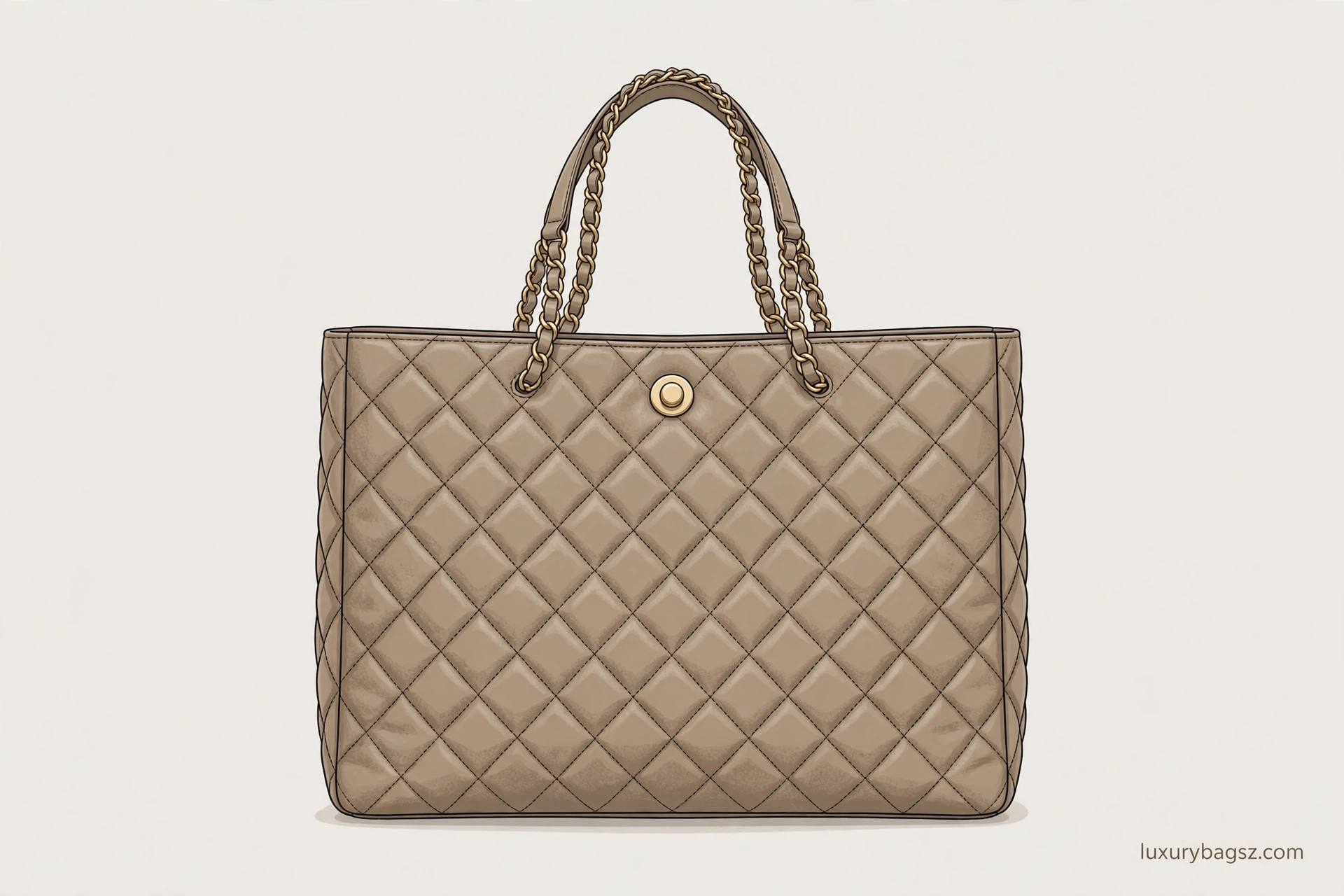
The Chanel Grand Shopping Tote, known to every resale buyer as the GST, is the large quilted work tote Chanel launched in 2004, reissued in 2010, and discontinued in 2015. It is pre-owned only now, and that single fact shapes everything about buying one: there are no boutique prices, no current sizes, and no new stock, whatever a seller claims.
The GST is a big, open, structured tote with a centre zip divider, a CC turn-lock, and chain-and-leather handles. It fits a 10-inch tablet or small laptop, a full wallet, sunglasses, phone, keys, cosmetics, a slim water bottle or umbrella, and A4 documents. Black caviar leather with gold hardware is the most popular combination, and it is also the easiest to resell.
Buy it if you want a roomy, durable, recognisably Chanel work tote at a fraction of a new Classic Flap's price. Do not buy it if you need a light bag, a secure top zip, or a bag that still carries a boutique warranty and current parts support.
Key Takeaways
- The GST launched in 2004, was reissued in 2010, and was discontinued in 2015 — it is pre-owned only, and any "brand new from a boutique" claim is false.
- Three sizes exist: PST (petite), GST (grand) and GST XL; sellers mislabel them, so check measurements, not titles.
- 2015 retail was about $2,900 for the GST; early-2026 resale for excellent black caviar runs about $2,200–$2,400.
- A full set (box, dust bag, card, booklet) is worth roughly 10–15% more than a bag alone.
- The serial sticker must match the card, and the code era must match the bag's claimed age.
- Caviar is the common, durable leather; lambskin GSTs are rarer and need more careful handling.
- Check bottom corners, strap bends, the CC turn-lock and the fabric lining before you pay.
What the GST Is
The Grand Shopping Tote is Chanel's large, everyday work tote from the 2000s and early 2010s. It is quilted, structured, and open at the top, with a CC turn-lock on the front and a centre zip divider inside that splits the interior into three compartments. It was designed to carry a working day, not an evening out, and it still does that job better than most current Chanel totes.
The name causes confusion. "GST" is used loosely for all three sizes, and some sellers call any large Chanel tote a GST. The true GST family has three sizes — PST, GST and GST XL — and the sizes section gives the measurements that separate them. If a listing gives no measurements, treat the size claim as unverified.
History: 2004 Launch, 2010 Reissue, 2015 Discontinuation
One guide gives the cleanest timeline: the GST launched in 2004, was reissued in 2010, and was discontinued in 2015. The original carries style code A20995, while the reissue carries A50995, and that code difference is the fastest way to tell which version you are looking at.
The end date needs a disagreement stated plainly. One guide says the last production was 2014, with the bag phased out in 2015. Another guide's framing says discontinued in 2015. A short snippet elsewhere saying 2013 was not verified in a full read, so this guide does not use it. The practical point is the same under either date: no GST has been made for about a decade, and every GST on the market is pre-owned.
Sizes: PST, GST and GST XL
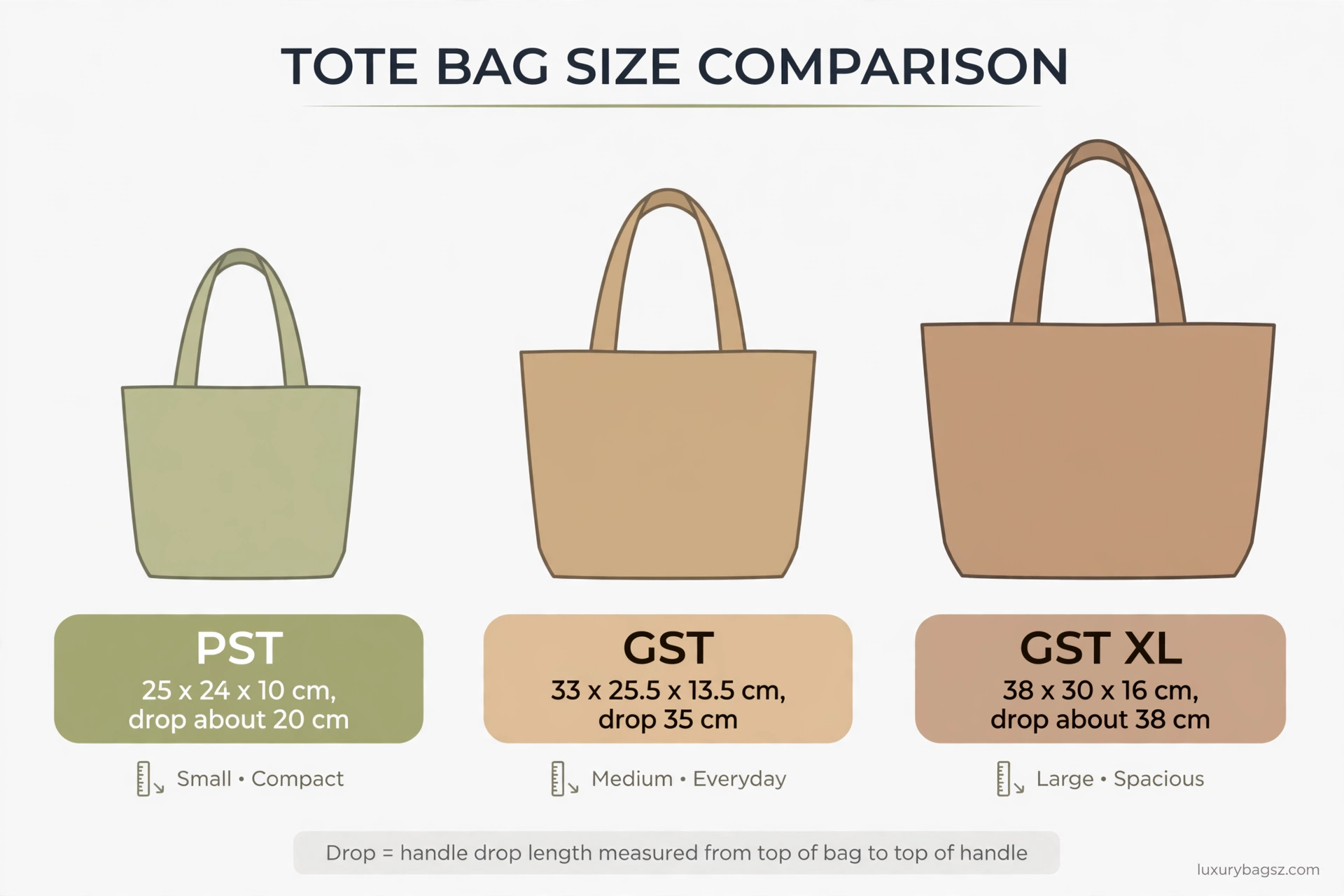
Size is where GST buying goes wrong most often, because sellers mislabel sizes and buyers trust titles. Measure, or demand measurements, and compare with this table from a full competitor read.
| Size | Dimensions (cm, approx.) | Dimensions (inches, approx.) | Handle drop |
|---|---|---|---|
| PST (Petite Shopping Tote) | 25 x 24 x 10 | 10 x 9.5 x 4 | about 20 cm |
| GST (Grand Shopping Tote) | 33 x 25.5 x 13.5 | 13 x 9.5 x 5 | 35 cm / 9.5 inches |
| GST XL | 38 x 30 x 16 | 15 x 12 x 6.5 | about 38 cm |
The PST is a small day bag, not a work tote. The GST is the classic work size. The GST XL is very large and suits taller buyers or heavy carriers best. If a bag's measurements match none of these rows, question the listing before questioning your tape measure.
Shape, Structure and Hardware
The GST is a structured tote, not a slouchy one. It holds its shape when set down, which is part of its work-tote appeal, but it also means dents and corner wear show more clearly than on a soft bag. The quilting is the classic Chanel diamond pattern, and the front carries the interlocking CC turn-lock.
Hardware comes in gold or silver only. There is no ruthenium GST in the guides, so a GST claimed to have dark gunmetal hardware deserves questions. The handles combine chain and leather, which spreads the weight better than an all-leather handle but can leave chain imprints on the flap edge over time if the bag is stored with the handles folded in.
What Fits Inside
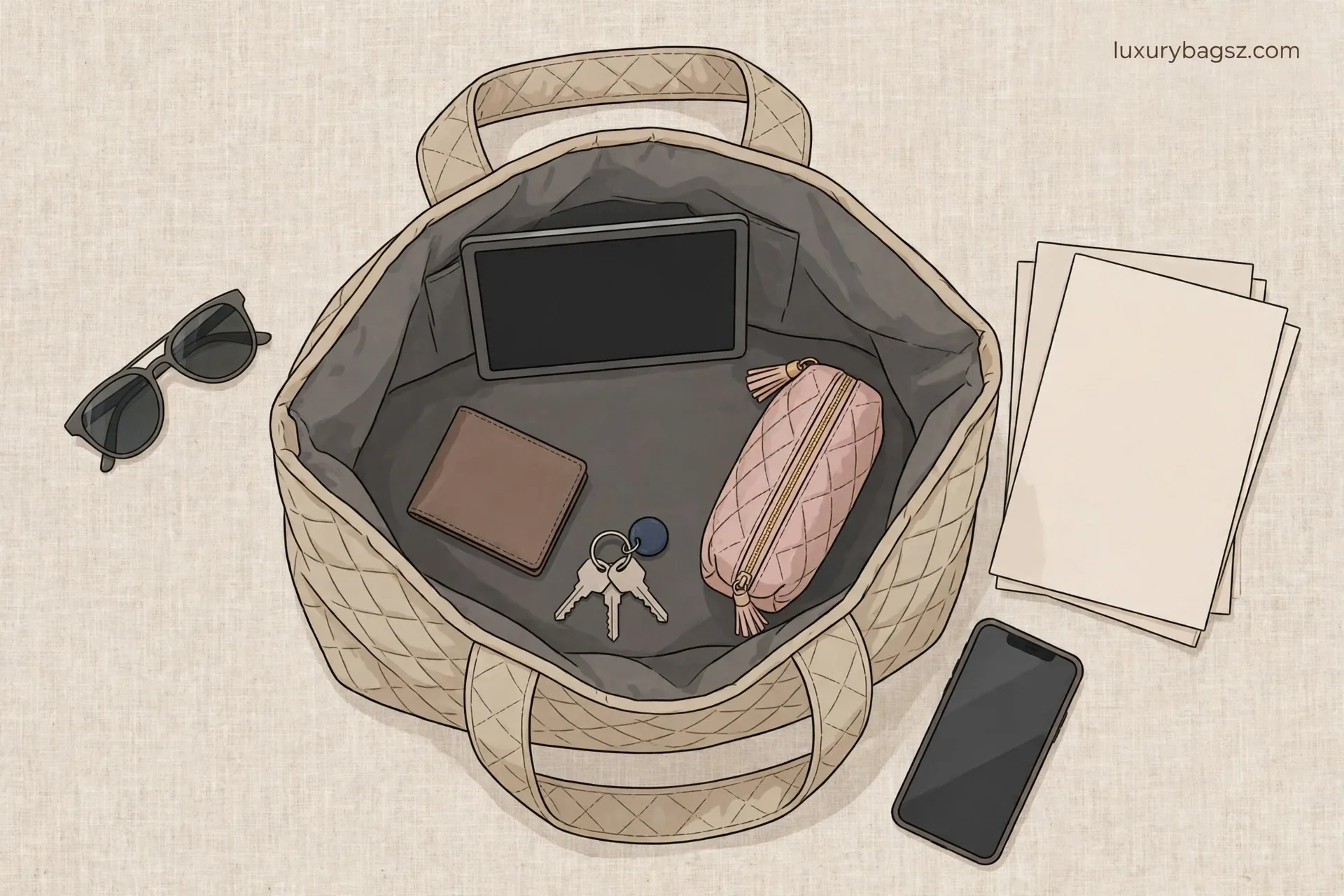
Capacity is the GST's reason to exist, and it beats most current Chanel bags on usable space. The main GST fits a 10-inch tablet or small laptop, a full wallet, sunglasses in a case, a phone, keys, a small cosmetics pouch, a slim water bottle or a folding umbrella, and A4 documents laid flat.
The centre zip divider is the key to using that space well. It splits the interior into three compartments, so documents can sit on one side, personal items on the other, and small valuables in the zipped middle. The front slip pocket holds a phone or a travel card, and the back zip pocket holds items you want separate from the main compartment. Try the bag loaded before you buy if you can: a GST's weight changes dramatically between empty and fully packed, and no verified empty or full weights were found in the opened guides, so this guide gives none.
GST vs Current Chanel Totes and Rivals
Competitor guides compare the GST with rivals only thinly, so here is the honest comparison. Against the Chanel Deauville, the GST is more structured and more formal, while the Deauville is softer, lighter and more casual, with a fabric feel that suits holidays better than offices. Against the Chanel Cerf, the GST is more recognisably Chanel, while the Cerf is plainer and less obviously branded.
Against the Louis Vuitton Neverfull, the GST is heavier and more structured, with a more secure-feeling interior thanks to its divider, while the Neverfull is lighter, roomier at the top, and easier to fold away. Our full Classic Flap vs Boy bag comparison shows how Chanel's formal and modern shapes differ, and the same logic applies here: the GST is the formal workhorse, not the lightweight casual choice. Buy the GST for structure and presence; buy a lighter tote if weight matters more than shape.
Prices: 2015 Retail and Early-2026 Resale
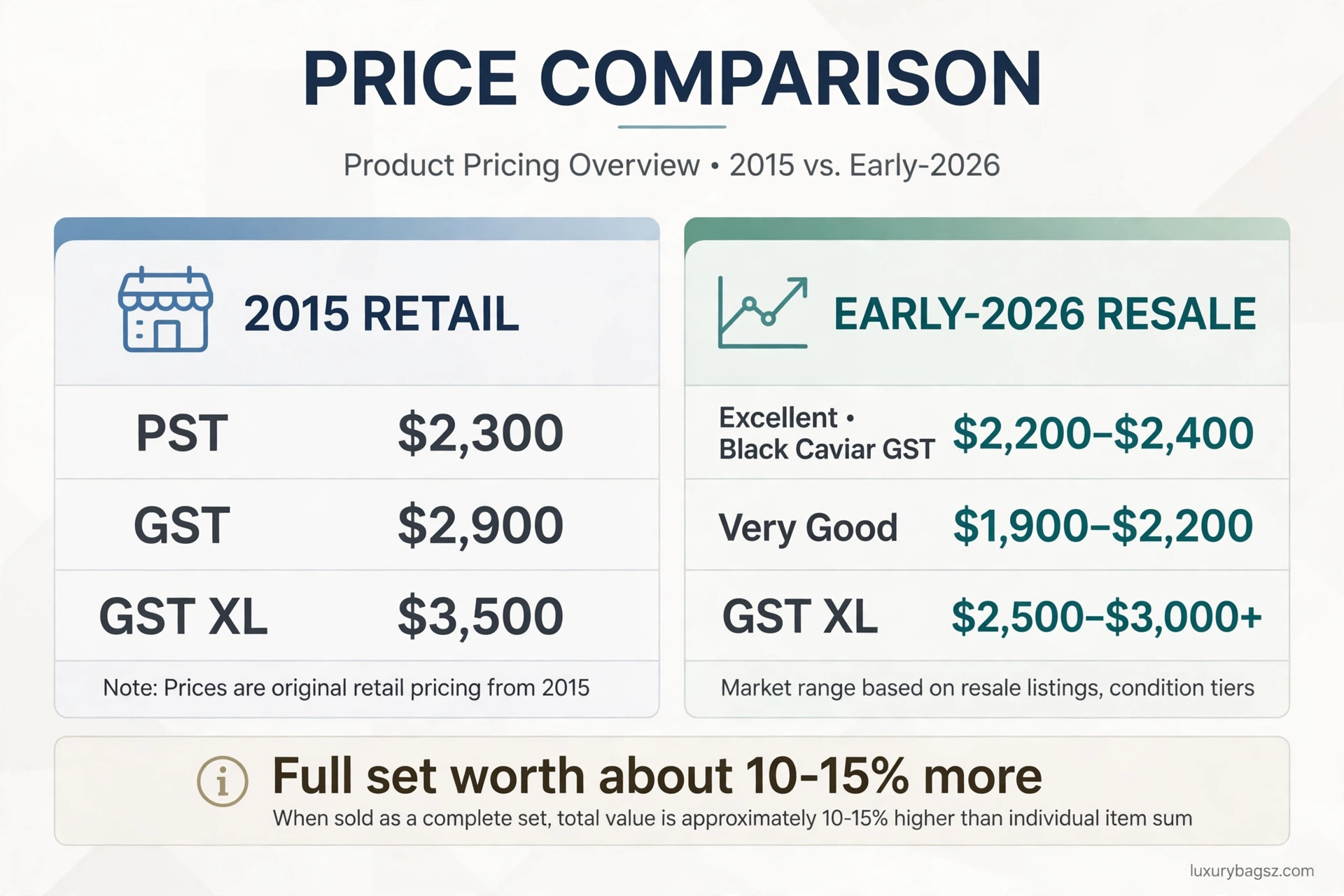
Prices are the GST's clearest buying signal, because the bag is pre-owned only and the market is mature. The 2015 retail prices from a full competitor read were about $2,300 for the PST, $2,900 for the GST, and $3,500 for the GST XL. Those are history, not budgets, but they anchor what the bag cost new.
Early-2026 resale from the same guide runs about $2,200–$2,400 for an excellent black caviar GST, about $1,900–$2,200 for very good condition, and about $2,500–$3,000 or more for a GST XL. A full set — box, dust bag, card and booklet — is worth roughly 10–15% more than a bag alone. For scale, the same guide puts a 2025 Classic Flap Medium at $11,300, so a GST at resale is roughly a fifth of a new Classic Flap's price. Treat any GST priced far below the resale ranges above as a warning, not a bargain.
Colours and Materials
Caviar leather is the common GST leather, and it is the right default choice. Caviar is grained calfskin: firm, structured, and forgiving of daily knocks, rain spots and corner scuffs. It holds the GST's shape well, which matters in a tote that is carried loaded. Lambskin GSTs exist but are rarer, softer, and far easier to scratch, so a lambskin GST in excellent condition commands attention and a careful inspection.
Black caviar with gold hardware is the most popular combination, followed by black caviar with silver hardware, then beige with gold hardware. Popular colours resell fastest and hold value best; unusual seasonal colours can be beautiful but slower to sell and harder to price. If you want one GST to use hard and resell later, buy black caviar with gold hardware. If you want a colour, buy it because you love it, not because you expect it to outperform black.
Wear Points: Where a GST Shows Its Age
Every used GST wears in the same places, so check these four points before you pay. First, the bottom corners: the GST's structured base meets pavements, car boots and office floors, and corner scuffs are the most common flaw. Heavy corner wear should lower the price, because corners are expensive to restore invisibly.
Second, the strap leather at the bends: the chain-and-leather handles flex at the same points every time the bag is carried, and cracking there is a sign of heavy use. Third, the CC turn-lock: scratches and plating loss on the lock face are common and honest, but a lock that sticks or wobbles is a repair bill. Fourth, the fabric lining: pen marks, makeup and loose-change stains are hard to remove from fabric without marking leather, so inspect the lining in bright light, including the centre divider's zip.

Authentication Checks Specific to the GST
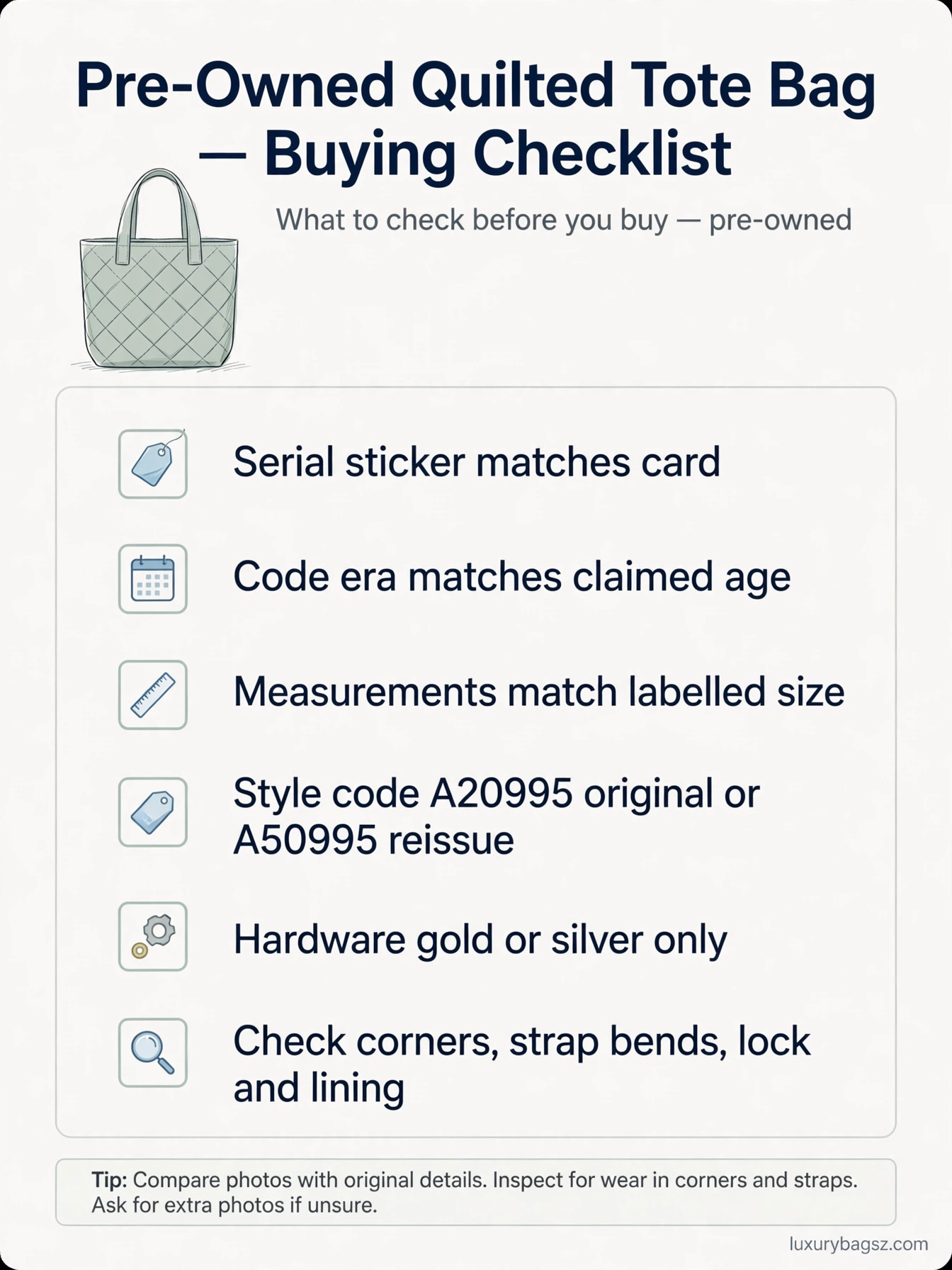
GST authentication starts with the serial sticker and card. The serial sticker must match the card exactly, and the code era must match the bag's claimed age: a GST claimed to be from the 2010 reissue should not carry a code from the wrong decade. A missing sticker does not automatically mean fake — stickers peel and fall off — but it should lower the price and trigger harder checks.
Next, check the size label against the measurements in the sizes section. A bag labelled GST but measuring like a PST, or labelled XL but measuring like a GST, is either mislabelled or misrepresented, and either way it is not what the listing claims. Check the style code too: A20995 for the original, A50995 for the reissue. Finally, check the hardware rule from the structure and hardware section: gold or silver only. A GST with dark gunmetal hardware, a wrong-style lock, or a chain that feels light and hollow deserves serious questions.
Buying Pre-Owned: The Full Checklist
Run this checklist in order before you pay. Demand width, height, depth and handle drop in centimetres, and compare them with the sizes section. Demand photos of all four bottom corners, the strap bends, the CC lock front and back, the interior lining and divider zip, and the serial sticker and card together.
Ask directly whether the bag has been restored or redyed, since redye can hide the very flaws you are checking for. Ask whether the set is complete, and price a bag without its box, dust bag or card about 10–15% below a full set. Buy only from a seller who accepts returns, and only through a platform with buyer protection. Remember the blunt rule from a competitor guide: any seller who says they have a brand new GST from a boutique is lying, because the bag has been out of production for about a decade.
Care and Repairs for a Work Tote
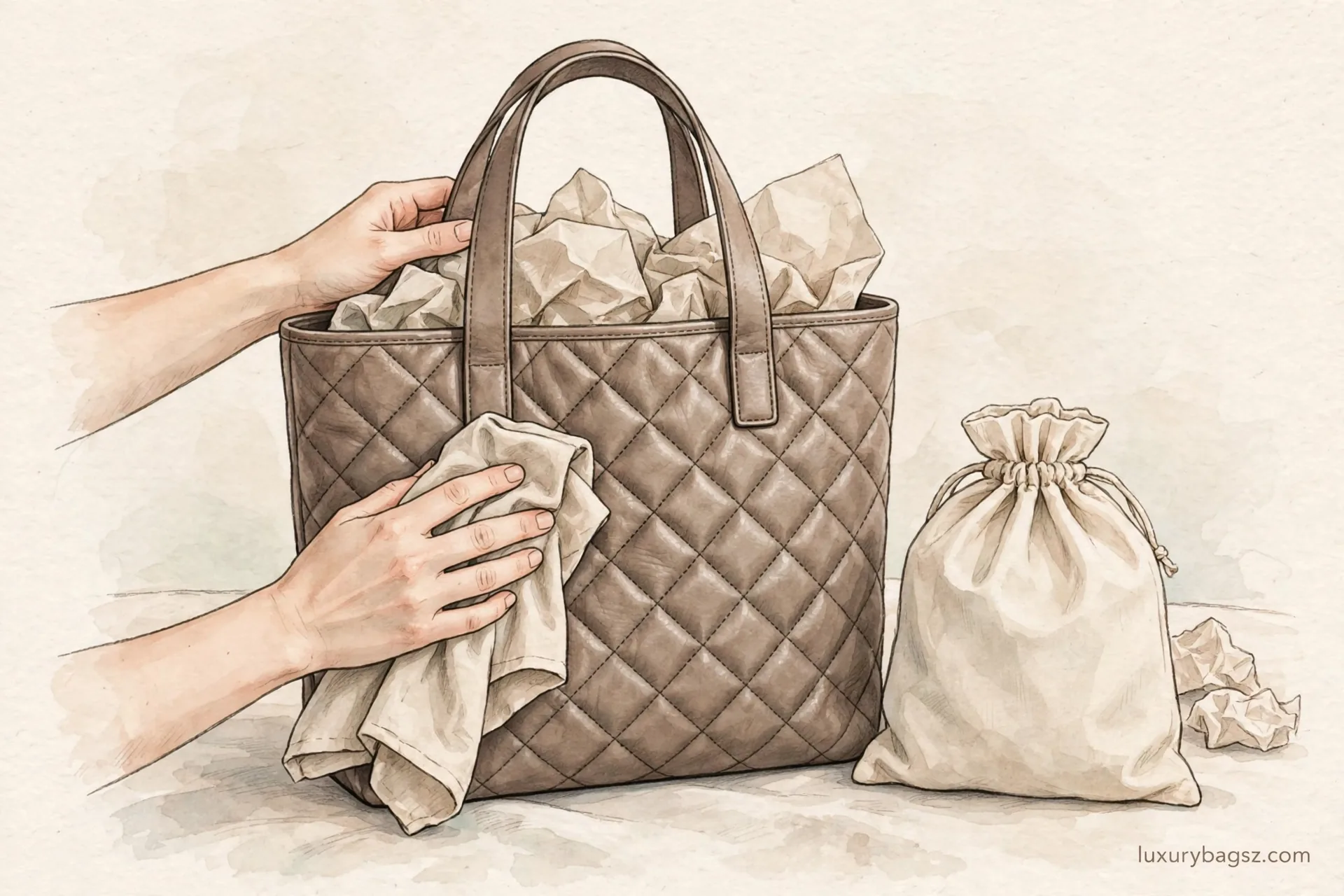
A GST used for work needs a simple, regular routine. Wipe caviar leather with a soft, dry cloth after use, keep the bag out of prolonged sun, and store it stuffed and upright in its dust bag so it keeps its structure. Never hang a loaded GST by its handles for long periods, since the weight stretches the handles and pulls at the attachment points.
For stains, blot rather than rub, and stop before you make the mark worse — a work tote's lining and corners are better served by a professional clean than by an aggressive home attempt. Our guide on how to clean Chanel bags covers gentle cleaning routines in detail. For repairs, corners and strap bends are the usual jobs: a good leather specialist can stabilise both, but invisible corner restoration is expensive, so price heavy wear into your offer. A base insert or organiser helps a GST hold its shape and protects the lining from pen marks and spills.
Who Should Buy a GST, and Who Should Skip It
Buy a GST if you carry a tablet or documents daily, want a structured bag that looks professional, and prefer a recognisably Chanel tote at resale prices rather than boutique prices. It suits office, travel and university use, and it suits buyers who like a bag that holds its shape when set down.
Skip it if you need a light bag: a loaded GST is heavy, and the chain-and-leather handles do not make it light. Skip it if you need a fully secure top closure, since the GST is open at the top with only a centre divider for security. Skip it if you want boutique warranty, current parts support, or a bag in a current seasonal colour, since the GST offers none of those. And skip any listing that cannot provide measurements, corner photos, or a serial sticker and card photo — a genuine seller with the bag in hand can provide all three in minutes.
Frequently Asked Questions
When was the Chanel GST discontinued?
In 2015, after a 2004 launch and a 2010 reissue. One guide says the last production was 2014 with a phase-out in 2015; either way, no GST has been made for about a decade, and every GST on the market is pre-owned.
What are the GST sizes?
Three: PST at about 25 x 24 x 10 cm, GST at about 33 x 25.5 x 13.5 cm, and GST XL at about 38 x 30 x 16 cm. Sellers mislabel sizes, so check measurements against the sizes section rather than trusting the listing title.
How much does a Chanel GST cost pre-owned?
Early-2026 resale runs about $2,200–$2,400 for an excellent black caviar GST, about $1,900–$2,200 for very good condition, and about $2,500–$3,000 or more for a GST XL. A full set is worth roughly 10–15% more than a bag alone.
What is the difference between the original GST and the reissue?
The original, from 2004, carries style code A20995, while the 2010 reissue carries A50995. The code is the fastest way to tell which version you are looking at, and it should match the bag's claimed age.
Does the GST fit a laptop?
It fits a 10-inch tablet or a small laptop, plus a full wallet, sunglasses, phone, keys, cosmetics, a slim water bottle or umbrella, and A4 documents. No verified empty or full weights were found in the opened guides, so try the bag loaded before you buy.
Is caviar or lambskin better for a GST?
Caviar is the better default: grained, firm, structured and forgiving of daily knocks, and it holds the GST's shape well. Lambskin GSTs are rarer and softer but scratch far more easily, so they need more careful handling and inspection.
How do you tell a fake GST?
Check that the serial sticker matches the card and the code era matches the claimed age, that the measurements match the labelled size, that the style code is A20995 or A50995, and that the hardware is gold or silver only. A missing sticker alone does not prove a bag fake, but it should lower the price.
What is the GST's most common wear?
Bottom corners first, then strap leather cracking at the bends, CC turn-lock scratches and plating loss, and fabric lining pen marks. Check all four points in bright light before you pay, and price heavy wear into your offer.
Can you still buy a new GST from a boutique?
No. The GST has been out of production since about 2015, so any seller claiming a brand new GST from a boutique is lying. Every genuine GST on the market is pre-owned, whatever its condition.
Is the GST worth it in 2026?
Yes, if you want a roomy, structured, recognisably Chanel work tote at roughly a fifth of a new Classic Flap's price. No, if you need a light bag, a secure top closure, or boutique warranty and current parts support.
Conclusion
The Grand Shopping Tote earns its reputation the unglamorous way: it carries a working day, holds its shape, and survives years of use in caviar leather. It is not the lightest tote, the most secure tote, or a bag you can buy new. It is the structured Chanel workhorse that the pre-owned market still trusts, at a price far below a new Classic Flap.
Buy by measurement, not by title. Buy by corner, strap, lock and lining photos, not by adjectives. And buy the full set when you can, since it is worth roughly 10–15% more when you eventually sell. A GST bought that way is a bag you will use daily without doubting, and that confidence is exactly what the pre-owned market rewards.