

History of the Cartier Love Bracelet
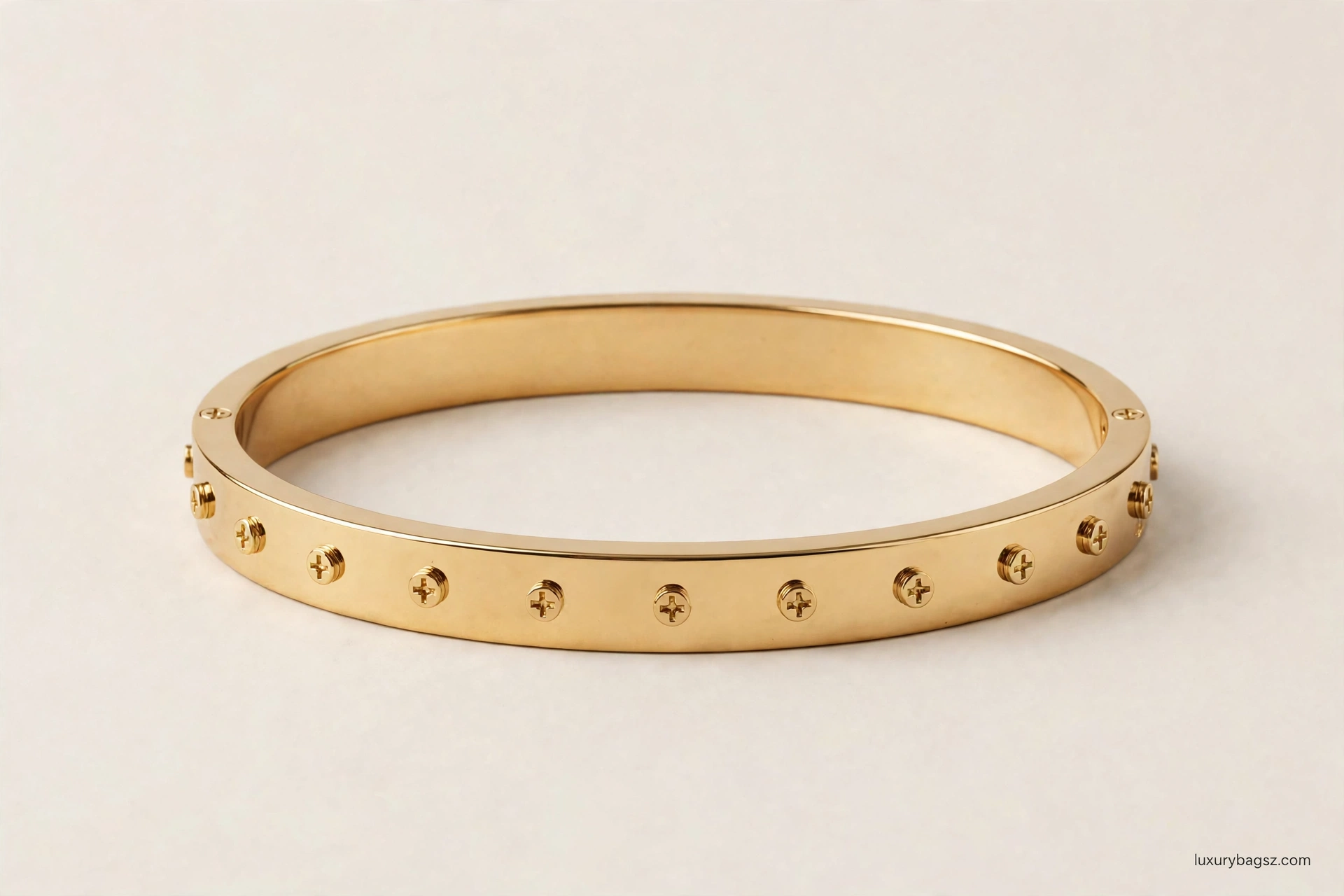
The Love Bracelet in Brief
The Cartier Love bracelet is a plain gold bangle, fastened with screws, that has become one of the most recognisable pieces of jewellery in the world. It was designed in New York in 1969 by Aldo Cipullo, at a moment when jewellery was becoming more personal, more symbolic, and more tied to the idea of commitment between two people.
The bracelet's genius was its simplicity: an oval bangle in yellow gold, decorated only with screw heads, that could only be fastened and removed with a small screwdriver, traditionally by one's partner.
That screwdriver ritual is the key to the Love bracelet's history. It turned a piece of jewellery into a statement about permanence, about love that could not be taken off casually, and about a relationship sealed by a deliberate act. In the 1970s, Cartier leaned into that symbolism, presenting the bracelet to celebrity couples and making it a fixture of New York social life.
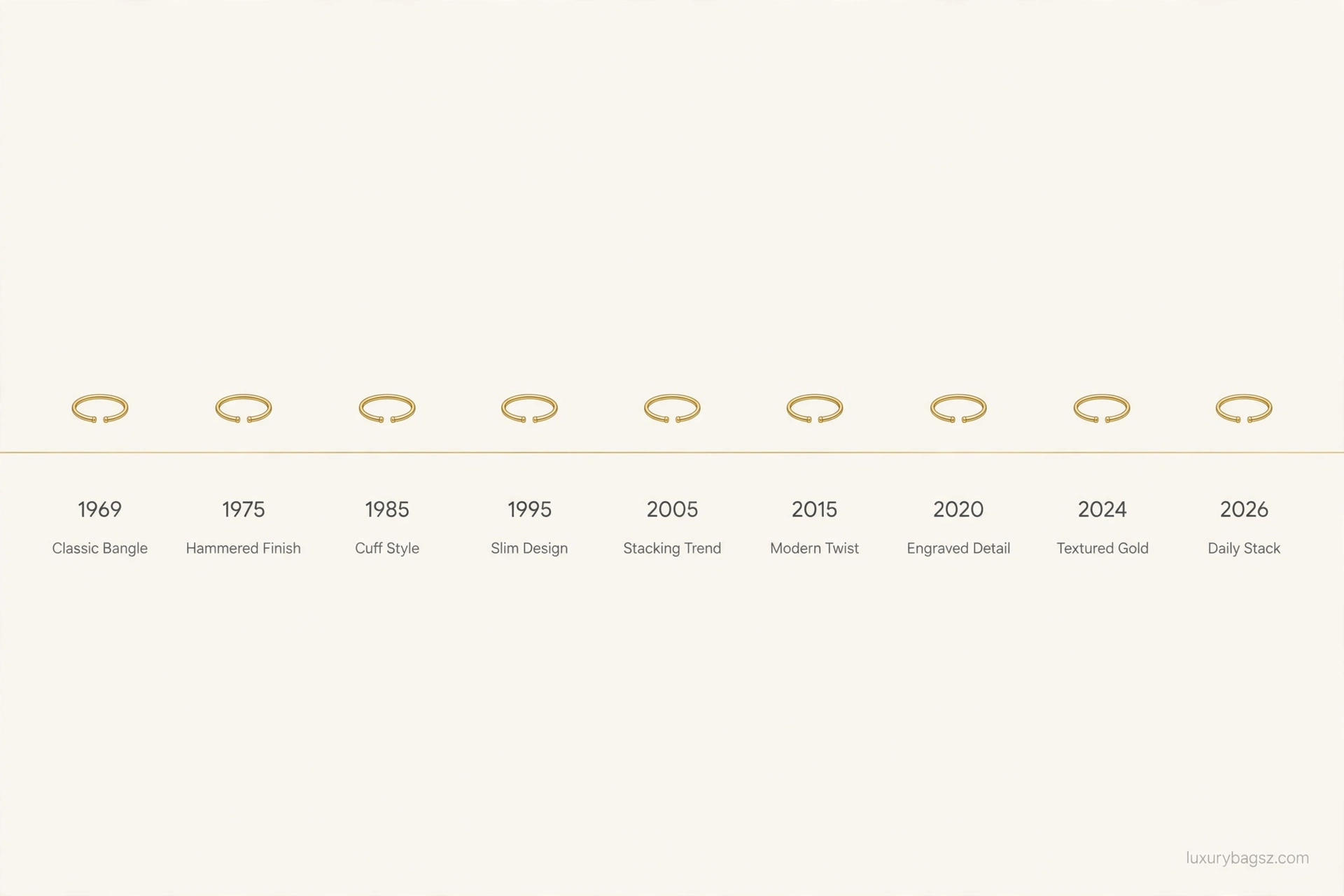
Over the decades that followed, the Love bracelet evolved from a single design into a family of variations, from a countercultural symbol into a luxury staple, and from a New York story into a global one.
This guide tells that history only. It does not repeat the Love bracelet size guide, which covers fitting and sizing in detail, and it does not repeat the fake guide, which covers authentication checks. What follows is the story: the designer, the design, the 1970s moment, the cultural afterlife, and the Love bracelet's place in jewellery history today.
Key Takeaways
- The Love bracelet was designed in New York in 1969 by Aldo Cipullo, a Cartier designer known for modern, everyday jewellery.
- Its design is an oval gold bangle fastened with screws, traditionally requiring a screwdriver, and therefore a partner, to put on and take off.
- Cartier presented the bracelet to celebrity couples in the 1970s, making it a symbol of committed love and a fixture of New York social life.
- The bracelet's symbolism, permanence, fidelity, and modern romance, mattered as much as its design, and explains its endurance.
- Over the decades, the Love family expanded into new metals, diamond-set versions, and related designs, while keeping the screw motif central.
- Today the Love bracelet is both a luxury staple and a cultural shorthand for committed love, recognised far beyond the jewellery world.
New York in 1969: The World the Love Bracelet Entered
To understand the Love bracelet, start with New York in 1969. The city was at a cultural crossroads: the optimism of the early 1960s had given way to social change, youth culture, and a questioning of traditional institutions, including marriage. Jewellery was changing too.
The formal, occasion-only jewellery of earlier decades was giving way to pieces meant for everyday wear, to designs that were simpler, more personal, and more expressive of the wearer's identity and relationships.
Cartier's New York house, long associated with high jewellery and formal occasions, was ready for a modern statement. The brand had a history of bold, wearable designs, from the Tank watch to the Panthere, and its New York workshop was a place where designers could experiment with ideas that Paris might have considered too informal. Into that environment came Aldo Cipullo, a designer whose work would define Cartier's modern era.
The Love bracelet arrived, therefore, not as a traditional high-jewellery piece, but as a modern design for a modern moment. It was gold, but it was plain. It was luxurious, but it was wearable every day. It was romantic, but its romance was expressed through a screwdriver rather than through gemstones or ornate decoration.
That combination, luxury made everyday and romance made modern, is what made the Love bracelet feel new in 1969, and it is what has kept it feeling relevant ever since.
Aldo Cipullo: The Designer Behind the Bracelet
Aldo Cipullo, born in Naples in 1935, came to Cartier New York after working in jewellery in Italy and the United States. He was known for designs that combined classical inspiration with modern wearability, and for an interest in hardware, industrial forms, and everyday objects as jewellery motifs.
That interest would shape both of his most famous Cartier designs: the Love bracelet in 1969 and the Juste un Clou, the nail bracelet, a few years later.
Cipullo's approach to the Love bracelet was characteristically direct. He took the idea of a bangle, stripped it to its essentials, and added a single, meaningful detail: screws. The screws were not decoration in the conventional sense; they were the fastening, the structure, and the symbolism all at once.
By making the bracelet fastenable only with a screwdriver, Cipullo turned the act of wearing it into a ritual, one that required another person and therefore expressed commitment in a tangible, everyday way.
Cipullo's biography adds poignancy to the story. He died young, in 1984, but his two great Cartier designs have outlived him by decades and have become central to the brand's identity. The Love bracelet is often described as his masterpiece, not because it is the most technically complex piece he made, but because it is the most conceptually complete: a simple form, a single idea, executed with total clarity.
That clarity is why the design has survived changing fashions without needing reinvention.
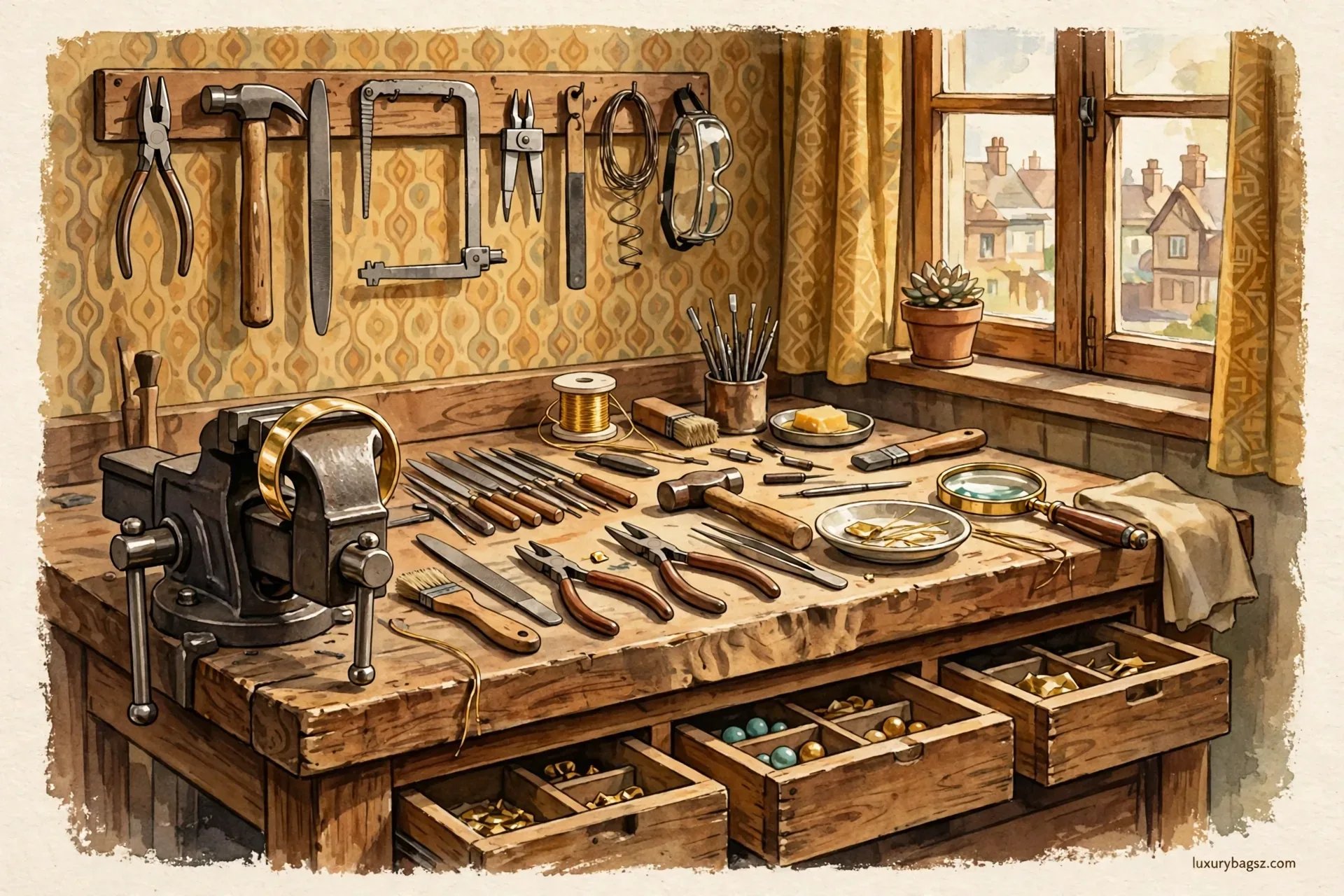

The Design: An Oval Bangle, Screws, and a Screwdriver
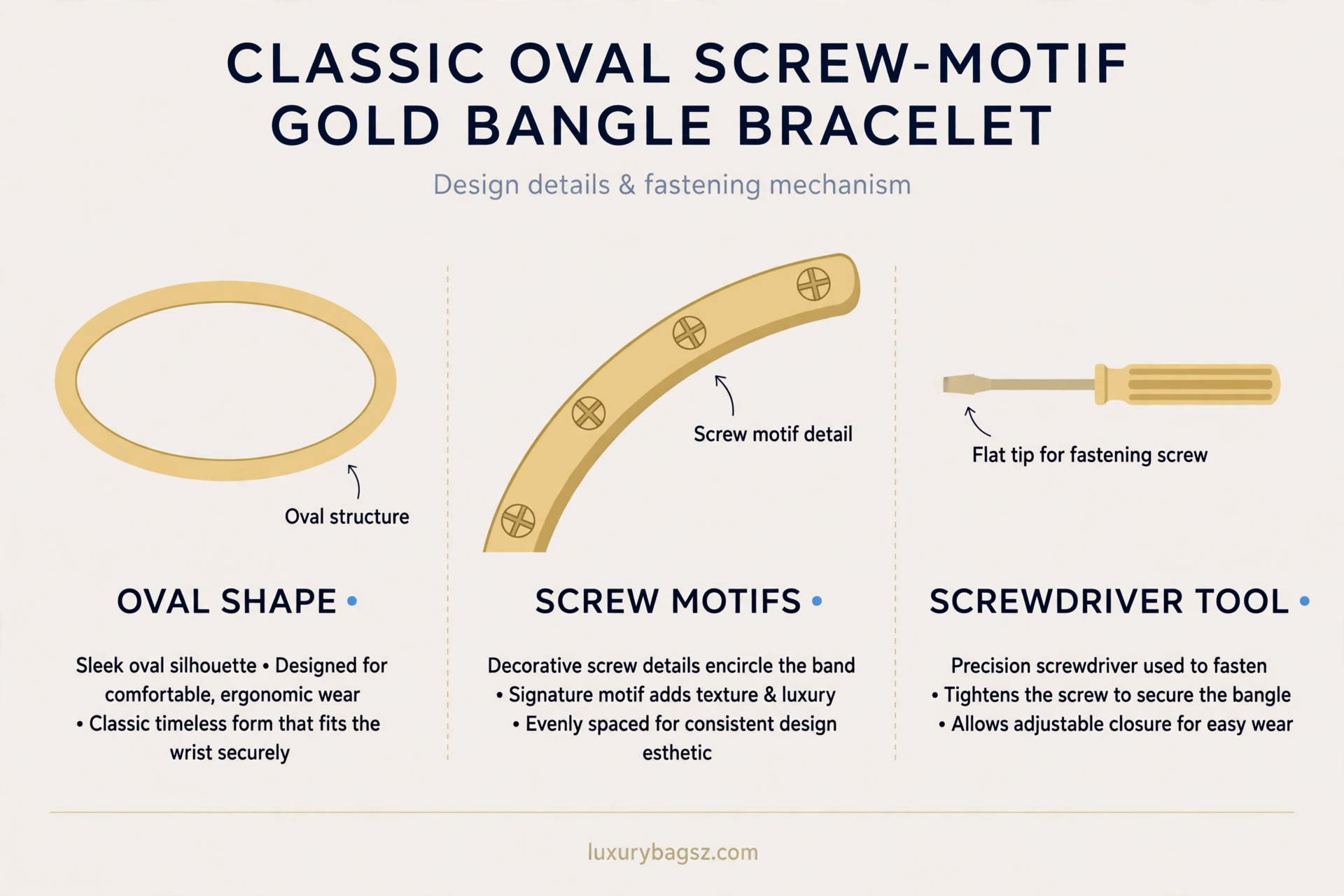
The Love bracelet's design is famously minimal. It is an oval bangle, shaped to fit the wrist comfortably, made in gold, and decorated only with screw heads spaced around its circumference. The screws are functional: the bracelet separates into two halves that are screwed together around the wrist, and the small screwdriver supplied with the bracelet is required to fasten and unfasten it. That functional detail is the design's emotional core.
The oval shape matters. A round bangle would rotate and sit awkwardly; an oval bangle follows the wrist's natural shape, sits comfortably for everyday wear, and stays in place. The screw heads, rendered as clean, functional motifs, give the bracelet its visual identity without ornament: from a distance, the bracelet reads as a plain gold bangle, and only up close do the screws reveal themselves.
That restraint, luxury that does not shout, became a hallmark of Cartier's modern jewellery language.
The screwdriver ritual matters most of all. In Cartier's original presentation, the bracelet was meant to be fastened by one's partner, who kept the screwdriver, so that the bracelet could not be removed without the partner's help. The symbolism was explicit: love as a deliberate, mutual commitment, sealed by a small, shared act.
Whether couples today follow that ritual literally or simply keep the screwdriver in a drawer, the story remains the bracelet's defining narrative, and it is retold in almost every account of the design.
The 1970s: Celebrity Couples and New York Social Life
The Love bracelet's breakthrough came in the 1970s, when Cartier presented it to prominent couples and it became a fixture of New York social life.
The brand is widely reported to have given Love bracelets to famous couples of the era, including Elizabeth Taylor and Richard Burton, Sophia Loren and Carlo Ponti, and other celebrated pairs, though the exact list of recipients varies between retellings, and this guide treats the general pattern, celebrity couples receiving the bracelet as a symbol of their commitment, as more reliable than any single claimed recipient list.
That celebrity association did two things. First, it made the Love bracelet visible: photographs of famous couples wearing matching gold bangles circulated widely, and the bracelet became recognisable even to people who had never entered a Cartier boutique. Second, it made the bracelet meaningful: it was not just a beautiful object, but a public statement about a relationship, worn by people whose relationships were themselves public.
In an era when celebrity culture was becoming a dominant force, that combination was powerful.
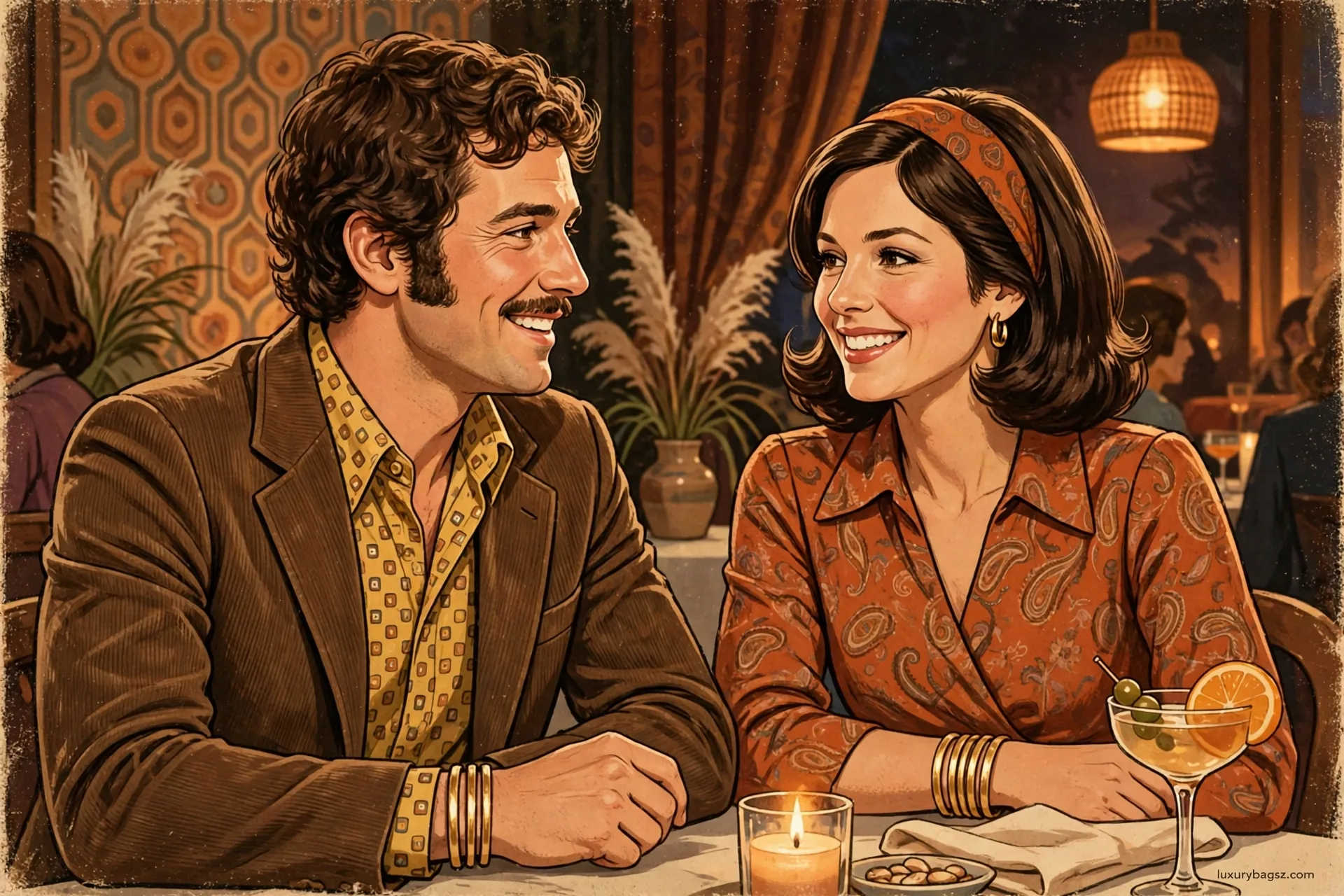
New York in the 1970s also gave the Love bracelet a social context. The bracelet was worn at dinners, parties, and public events, where its plain gold form suited both formal and informal dress, and where its screwdriver story gave its wearers something to talk about. It became, in effect, a social signal: a marker of being in a committed relationship, of belonging to a certain sophisticated world, and of appreciating modern design.
That social life, as much as any advertising, built the Love bracelet's reputation.
The Symbolism: Permanence, Fidelity, and Modern Romance
The Love bracelet's symbolism deserves attention because it explains the design's endurance better than its materials or craftsmanship alone. The bracelet's central idea is permanence: once screwed on, it stays on, and removing it requires a deliberate act with a tool. In a decade when traditional marriage was being questioned, that permanence was both provocative and reassuring, a modern way of expressing an old idea.
Fidelity is the companion idea. The screwdriver ritual, in which one's partner keeps the screwdriver, literalises fidelity: the bracelet cannot be removed without the partner, so wearing it is a daily, visible commitment. That idea resonated in the 1970s, when relationships were being reimagined, and it continues to resonate today, when couples seek symbols of commitment that feel personal rather than institutional.
The Love bracelet offers commitment without a ceremony, romance without formality, and permanence without heaviness.
Modern romance is the broader frame. The Love bracelet belongs to a generation of jewellery that expresses relationships in contemporary terms: not through inherited diamonds or formal engagement rings alone, but through wearable, everyday pieces that couples choose together.
That shift, from jewellery as occasion to jewellery as identity, is one of the most important changes in twentieth-century jewellery history, and the Love bracelet is one of its clearest expressions.
The 1980s and 1990s: From Counterculture to Classic
By the 1980s, the Love bracelet had moved from novelty to classic. It was no longer a new design making a statement about the 1970s; it was an established Cartier icon, worn by a broader range of people, in a broader range of contexts, and recognised as a staple of fine jewellery.
That transition, from fashionable to classic, is the hardest one for any design to make, and the Love bracelet made it because its form was simple enough to survive changing fashions and its symbolism was broad enough to mean different things to different wearers.
The 1980s and 1990s also saw the Love bracelet become a gift for milestones: anniversaries, birthdays, graduations, and other moments when permanence and commitment were being celebrated. That gifting role expanded the bracelet's meaning beyond romantic couples, to include family, friendship, and personal achievement, while keeping its core symbolism intact.
A Love bracelet given by a parent to a child, or bought for oneself to mark a milestone, carries a different story from a couple's bracelet, but the same form and the same idea of lasting significance.
During these decades, Cartier also consolidated the Love bracelet's place in its collection, presenting it alongside other icons such as the Juste un Clou and the Panthere, and ensuring its availability across its boutiques worldwide. That consolidation mattered: a design that is only available briefly becomes a curiosity, while a design that remains available for decades becomes a classic.
The Love bracelet's continuous availability, from 1969 to today, is itself part of its history.
The Love Family Expands: Variations on a Theme
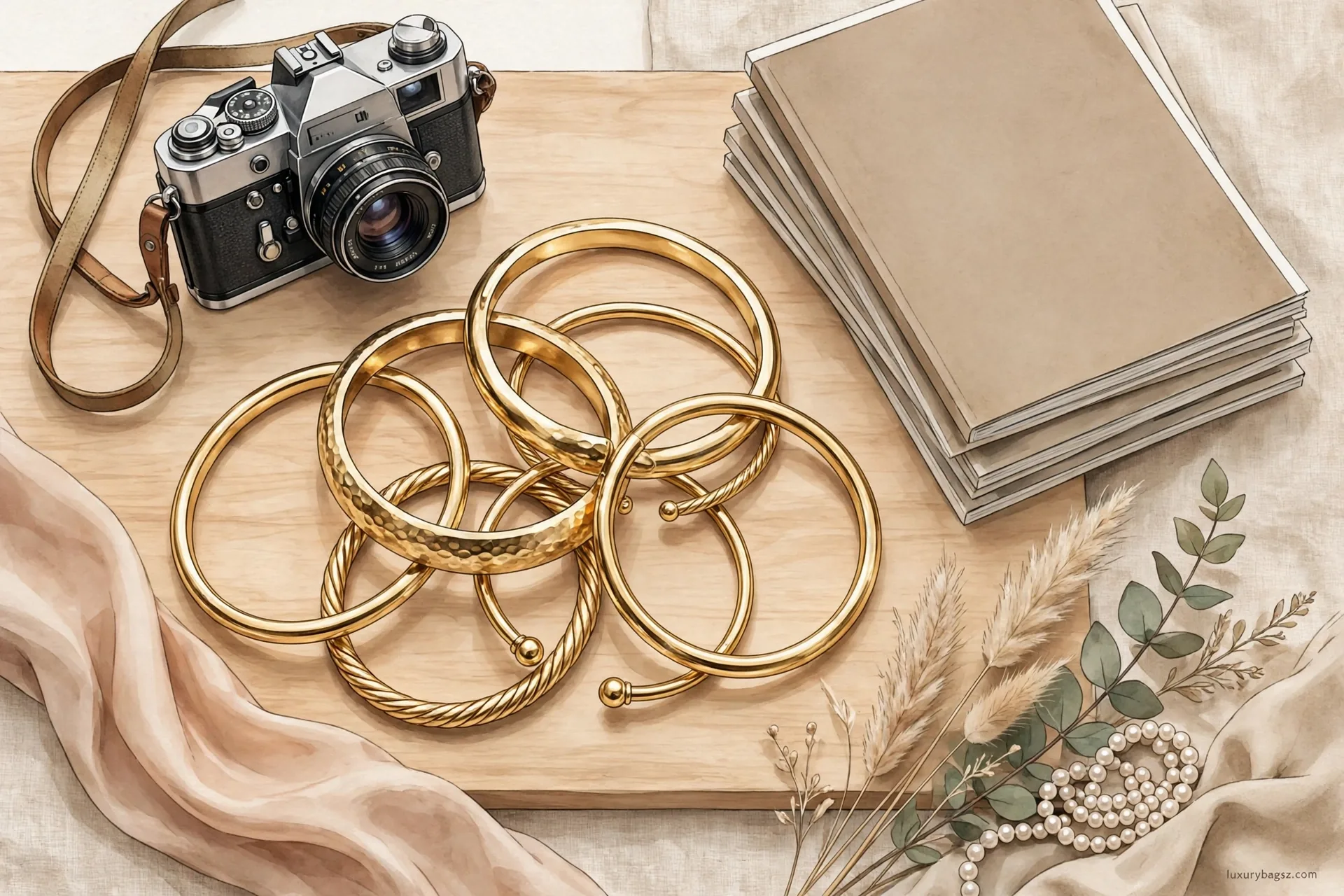
Over the decades, the Love bracelet expanded from a single design into a family. New metals joined the original yellow gold, including white gold, rose gold, and other combinations, allowing wearers to choose the metal that suited their style and their other jewellery. Diamond-set versions added brilliance to the plain bangle, with diamonds set into the screw motifs or around the bracelet, while keeping the screw design central.
Related designs, including rings, earrings, necklaces, and other Love pieces, extended the motif beyond the wrist.
That expansion was careful, not indiscriminate. Cartier kept the screw motif and the oval bangle form at the centre of every Love variation, so that even the most diamond-covered Love bracelet remains recognisably a Love bracelet. That discipline is why the family feels coherent rather than diluted: each new variation is a variation on a clear theme, not a departure from it.
Collectors and wearers can therefore mix Love pieces, stacking bracelets or pairing a bracelet with a ring, while maintaining a unified look.
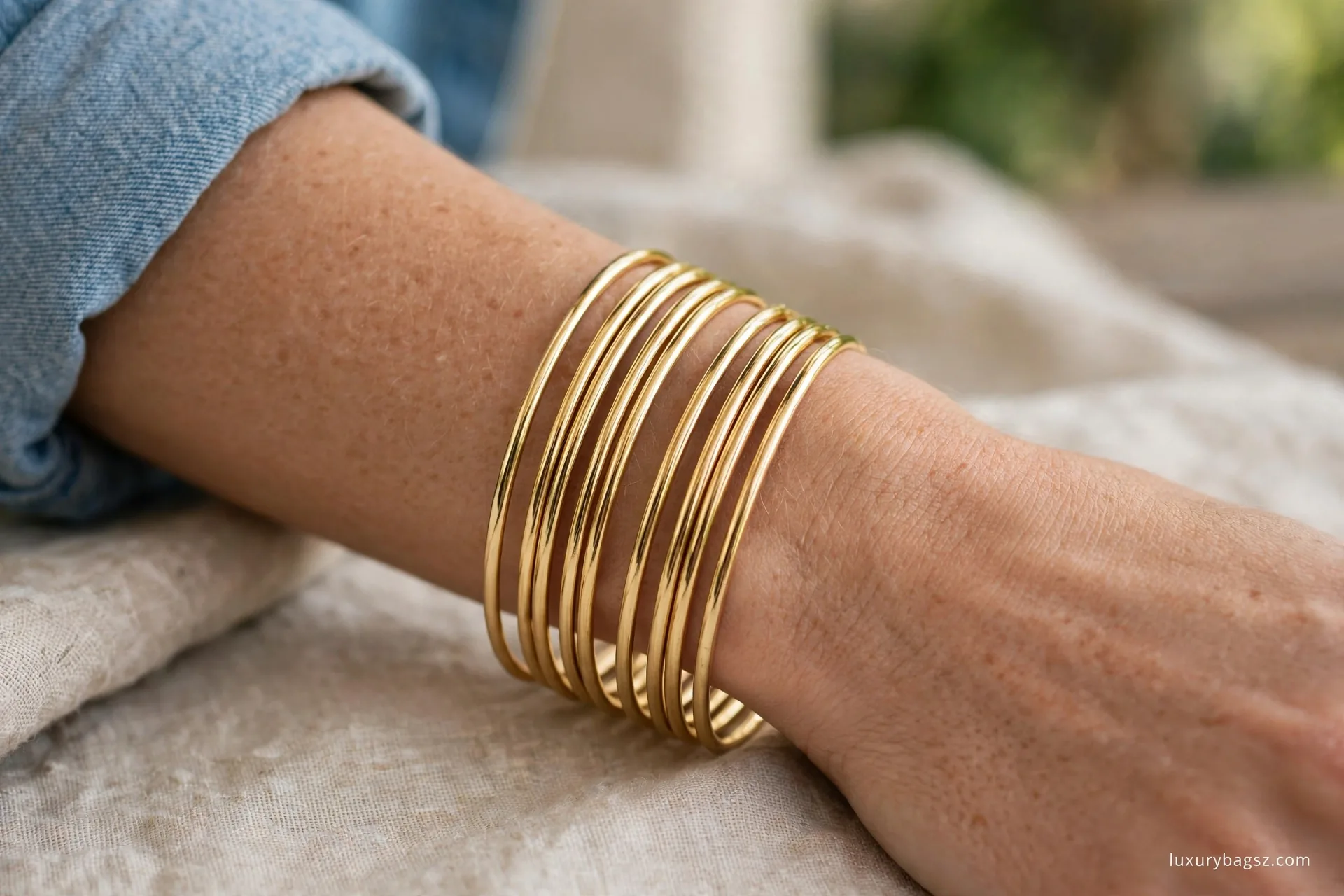
The expansion also reflects changing tastes. As jewellery became more personal and more stacked, with multiple bracelets worn together, the Love bracelet's plain form made it an ideal stacking piece, pairing well with other bangles, watches, and bracelets. That versatility, a plain gold bangle that complements almost anything, has helped the Love bracelet remain relevant in eras when more ornate designs have felt dated.
The Love Bracelet in Popular Culture
The Love bracelet's cultural afterlife extends far beyond jewellery circles. It has appeared in films, television, music, and fashion photography, often as shorthand for wealth, commitment, or sophisticated taste. When a character in a film wears a plain gold bangle with screw heads, audiences familiar with the design read it immediately, without needing exposition.
That instant readability is rare for a piece of jewellery, and it testifies to the design's cultural penetration.
Fashion has embraced the Love bracelet in waves. In some eras, it has been worn alone, as a single statement piece; in others, it has been stacked with other bracelets, watches, and bangles, as part of a layered wrist. Both styles suit the design, because its plain form works as a solo piece and as a team player.
Fashion editors and stylists have repeatedly returned to the Love bracelet as a reliable element in shoots, because it photographs cleanly, reads as luxury without ostentation, and pairs with a wide range of clothing.
Social media has added a new chapter. The Love bracelet is a frequent presence in jewellery collections shared online, in unboxing and gifting stories, and in couple's photographs, where its screwdriver ritual translates naturally into shareable moments.
That digital afterlife has introduced the bracelet to younger wearers who were not alive in the 1970s, and who encounter it first as a contemporary luxury staple rather than as a historical design. The bracelet's history, in that sense, is still being written, by each new generation that adopts it.
The Love Bracelet Today: Icon, Staple, and Heirloom
Today, the Love bracelet occupies a distinctive position: it is simultaneously a fashion item, a luxury staple, and a potential heirloom. As a fashion item, it is worn daily by people of all ages, stacked or solo, in a variety of metals and diamond options. As a luxury staple, it is a core Cartier collection, available in boutiques worldwide, and recognised as one of the brand's defining designs alongside the Tank watch and the Juste un Clou.
As a heirloom, it is passed between generations, with vintage Love bracelets carrying stories of the couples and milestones they marked.
That triple role explains the Love bracelet's pre-owned strength. Vintage Love bracelets are actively traded, not only because they are beautiful, but because they carry history: a 1970s Love bracelet is a piece of jewellery history, a witness to the decade that made it famous.
Buyers of vintage Love bracelets often value that history as much as the gold itself, and they seek out pieces with documented provenance, original screwdrivers, and honest wear that tells a story.
The Love bracelet's future seems secure, because its design and symbolism are both timeless. Simple forms age well, and ideas about commitment, permanence, and love do not go out of fashion, even as their expression changes. New variations will continue to appear, new wearers will continue to discover the design, and the screwdriver ritual will continue to be retold, adapted, and personalised by each couple that adopts it.
Love in Jewellery History: Why This Bracelet Matters
In jewellery history, the Love bracelet matters for three reasons. First, it redefined what luxury jewellery could be: plain, wearable, everyday, and symbolic, rather than ornate, occasional, and purely decorative. That redefinition influenced a generation of jewellery designers, who learned that a simple form with a strong idea could be more powerful than a complex form without one.
Second, it made jewellery about relationships in a new way. Earlier romantic jewellery, such as engagement rings and lockets, expressed commitment through gemstones or portraits. The Love bracelet expressed commitment through an act, the screwing on of the bracelet by a partner, and through a form, the unbroken bangle that could not be casually removed.
That shift, from symbol to ritual, was innovative, and it has influenced relationship jewellery ever since.
Third, it demonstrated the power of a single, clear design idea sustained over decades. Many jewellery designs enjoy a brief vogue and then fade; few sustain relevance for more than fifty years without fundamental redesign. The Love bracelet has done so by keeping its form constant while allowing its meanings to evolve: from 1970s romance to 1980s classic to contemporary staple to heirloom.
That evolution, managed without diluting the design, is a case study in how icons are made and maintained.
Collecting Love: Vintage, Provenance, and Stories
For collectors, the Love bracelet offers a rich field. Vintage examples from different decades show subtle variations in marking, finishing, and presentation, reflecting Cartier's evolving production and the bracelet's long life.
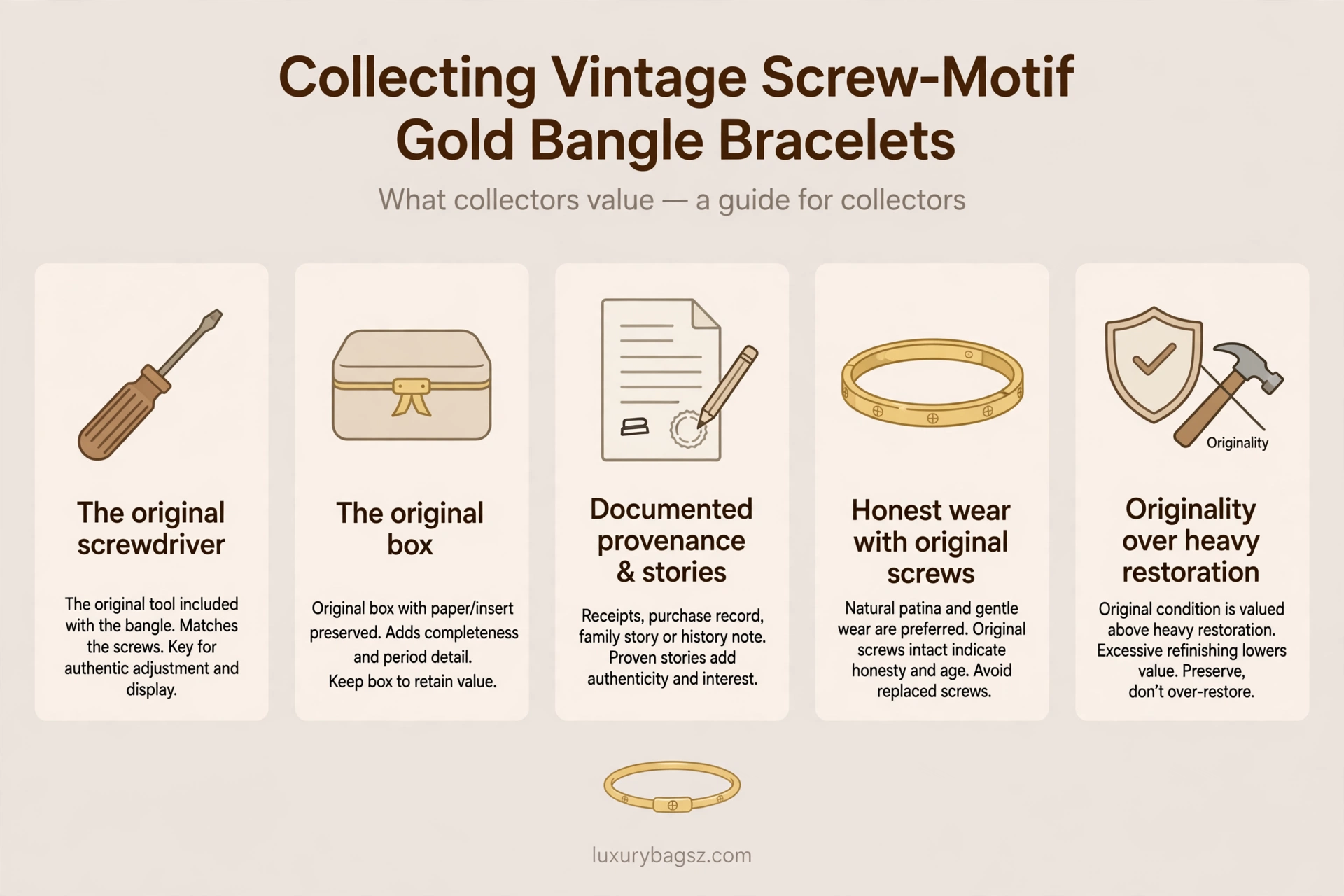
Collectors value original screwdrivers, original boxes, and documented provenance, not only for authentication, which is covered in the companion fake guide, but for the stories they tell: a bracelet with its original screwdriver and box is a more complete historical object than a bracelet alone.
Provenance adds particular interest for Love bracelets because of their personal nature. A bracelet given to mark an anniversary, a wedding, or another milestone carries a story that, when documented, enhances its interest beyond its material value.
Collectors should therefore seek out documented histories where available, while respecting privacy: personal stories belong to their owners, and a bracelet's history should be shared only with permission.
Condition and originality matter for collecting as they do for wearing. A vintage Love bracelet with honest wear, original screws, and an original screwdriver is generally more desirable than a heavily restored example, however shiny. Restoration has its place, but collectors prize originality, and any restoration should be disclosed and documented.
Those principles, familiar from watch and art collecting, apply equally to Love bracelets, which are, after all, wearable works of design history.
The Enduring Ritual: Why Couples Still Choose Love
The Love bracelet endures, finally, because its ritual endures. In an age of instant communication and disposable fashion, the idea of a bracelet that requires a partner, a screwdriver, and a deliberate act to put on feels refreshingly intentional. Couples who choose Love bracelets today are not merely buying gold; they are choosing a story, a ritual, and a daily reminder of a commitment they made together.
That ritual adapts to each couple. Some follow Cartier's original presentation literally, with one partner keeping the screwdriver. Others keep the screwdriver together, or in a drawer, or wear the bracelet without thinking about the ritual at all. All of those adaptations are legitimate, because the bracelet's symbolism is broad enough to accommodate them.
The design does not dictate a single story; it provides a form and a starting point, and each wearer completes the story.
The Love bracelet's history is therefore not finished. It will continue as long as couples seek symbols of commitment that feel modern, personal, and lasting. Aldo Cipullo's simple bangle, designed in New York in 1969, has already outlived its decade, its designer, and many of the fashions that surrounded its birth.
Its next chapters will be written by the couples who screw it on, wear it daily, and pass it on, keeping a small, golden idea alive for another fifty years.
For practical next steps beyond this history, the Cartier Love bracelet size guide covers fitting, the Cartier Love bracelet fake guide covers authentication, and the Cartier Juste un Clou guide covers Cipullo's companion design.
Love in the Twenty-First Century: Auctions and Anniversaries
The Love bracelet's twenty-first-century history is a story of anniversaries, auctions, and new generations of wearers. Milestone anniversaries of the 1969 design have been marked by Cartier with celebrations, exhibitions, and special presentations that retell the Cipullo story for audiences who were not alive when the bracelet debuted.
Those moments matter historically, because they show a design being actively maintained as an icon, not merely left in a catalogue: Cartier invests in retelling the Love story, which keeps the design culturally alive rather than historically frozen.
Auction houses have added another chapter. Vintage Love bracelets, particularly early examples with documented provenance, original screwdrivers, and original presentation, appear regularly at auction, where they are catalogued alongside other twentieth-century design icons.
Their auction presence confirms the bracelet's status beyond fashion jewellery: it is treated as design history, collected and studied as such, and its prices at auction reflect both its gold value and its historical significance. Collectors watch those results not only for pricing, but for what they reveal about which eras, metals, and variations are most valued by the collecting world.
New wearers complete the story. Each year, couples, individuals marking milestones, and younger buyers discovering Cartier for the first time adopt the Love bracelet, often through social media, gifting stories, or family inheritance. Those new wearers do not merely repeat the 1970s story; they adapt it, stacking Love bracelets with other jewellery, mixing metals, and personalising the screwdriver ritual for their own relationships.
That adaptation is healthy for an icon: a design that can only mean what it meant in 1969 becomes a museum piece, while a design that can mean new things to new wearers remains alive. The Love bracelet's twenty-first-century history, still being written, suggests it will remain alive for a long time.
Cipullo's Twin Legacy: Love and Juste un Clou
Aldo Cipullo's two great Cartier designs, the Love bracelet of 1969 and the Juste un Clou nail bracelet of the early 1970s, belong together in jewellery history, because they express the same idea in two forms. Both take an everyday hardware object, a screw and a nail, and transform it into luxury jewellery, keeping the object's form recognisable while rendering it in gold.
Both are wearable every day, plain in form, and symbolic in meaning: the Love bracelet symbolises commitment through its screwdriver ritual, while the Juste un Clou symbolises resourcefulness, creativity, and the beauty of the ordinary, bent into a bracelet. Together, they defined Cartier's modern jewellery language: luxury that does not need gemstones or ornament to be luxurious, because its idea is strong enough.
The two designs also share a cultural trajectory. Both were embraced in New York, both became associated with stylish, creative people who appreciated modern design, and both expanded over the decades into families of variations in different metals and with diamonds, while keeping their hardware motifs central.
Collectors often pair them, wearing a Love bracelet with a Juste un Clou, because their plain gold forms complement each other and their shared Cipullo origin gives the pairing a narrative coherence. That pairing, in turn, has become a recognisable style in its own right, photographed in fashion editorials and worn as a deliberate statement about modern Cartier.
Cipullo's legacy, viewed through both designs, is a lesson in design thinking. He showed that a jewellery idea could come from anywhere, including a toolbox, that simplicity could be more powerful than complexity, and that a piece's story, its ritual, its symbolism, its everyday wearability, could matter as much as its materials.
The Love bracelet remains the more famous of the two, because its romance is universal, but the Juste un Clou completes the picture, showing that Cipullo's hardware vision was not a single lucky idea but a coherent philosophy. Together, they remain two of the most influential jewellery designs of the twentieth century, and their influence continues in every contemporary designer who looks to everyday objects for luxury inspiration.
Frequently Asked Questions
When was the Cartier Love bracelet designed?
The Love bracelet was designed in New York in 1969 by Aldo Cipullo, a Cartier designer. It was introduced at a moment when jewellery was becoming more personal and more suited to everyday wear.
Who designed the Love bracelet?
Aldo Cipullo, born in Naples in 1935, designed the Love bracelet for Cartier New York. He later designed the Juste un Clou nail bracelet, another Cartier icon based on an everyday object.
Why does the Love bracelet need a screwdriver?
The bracelet separates into two halves that are screwed together around the wrist, and the small screwdriver supplied with it is required to fasten and unfasten it. Traditionally, one's partner kept the screwdriver, making the bracelet a symbol of commitment.
Was the Love bracelet originally given to celebrity couples?
Cartier is widely reported to have presented Love bracelets to prominent couples in the 1970s, helping to make the design famous. The exact recipient list varies between retellings, but the general pattern of celebrity association is well established.
Is the Love bracelet still made today?
Yes. The Love bracelet remains a core Cartier collection, available in boutiques worldwide, in a range of metals and diamond options, alongside related Love rings, earrings, and necklaces.
What makes the Love bracelet different from an ordinary bangle?
Its screw fastening and screwdriver ritual, its oval shape designed for comfortable everyday wear, and its symbolism of permanence and commitment, all combined in a plain gold form without conventional ornament.
Did Aldo Cipullo design anything else famous?
Yes, most famously the Juste un Clou nail bracelet, designed a few years after the Love bracelet, which applies the same idea, an everyday hardware object transformed into luxury jewellery, to a bent nail form.
Why is the Love bracelet considered a jewellery icon?
Because it redefined luxury jewellery as plain, wearable, and symbolic, because it expressed commitment through a ritual rather than through gemstones alone, and because it has sustained relevance for more than fifty years without fundamental redesign.
Can vintage Love bracelets be collected?
Yes. Vintage Love bracelets are actively collected, with original screwdrivers, boxes, and documented provenance adding historical interest. Condition and originality are valued, and restoration should be disclosed.
Where can I find Love bracelet sizing and authentication guidance?
Sizing is covered in the companion Love bracelet size guide, and authentication is covered in the companion fake guide. This history guide deliberately does not repeat those subjects, so you can use all three together without duplication.
Conclusion
The Cartier Love bracelet began as a simple idea in New York in 1969: a plain gold bangle, fastened with screws, that could only be put on with a partner's help. That idea, designed by Aldo Cipullo and embraced by the celebrity couples and social world of 1970s New York, became a symbol of modern romance, a classic of jewellery design, and a cultural icon recognised far beyond Cartier's boutiques.
More than fifty years later, it remains what it has always been: a small, golden circle, screwed shut by love, and worn every day as a reminder of a promise made together.






