Tumi 40th Anniversary and Brand History: From Peruvian Leather to Ballistic Nylon Icon
Forty Years of Tumi, in One Paragraph
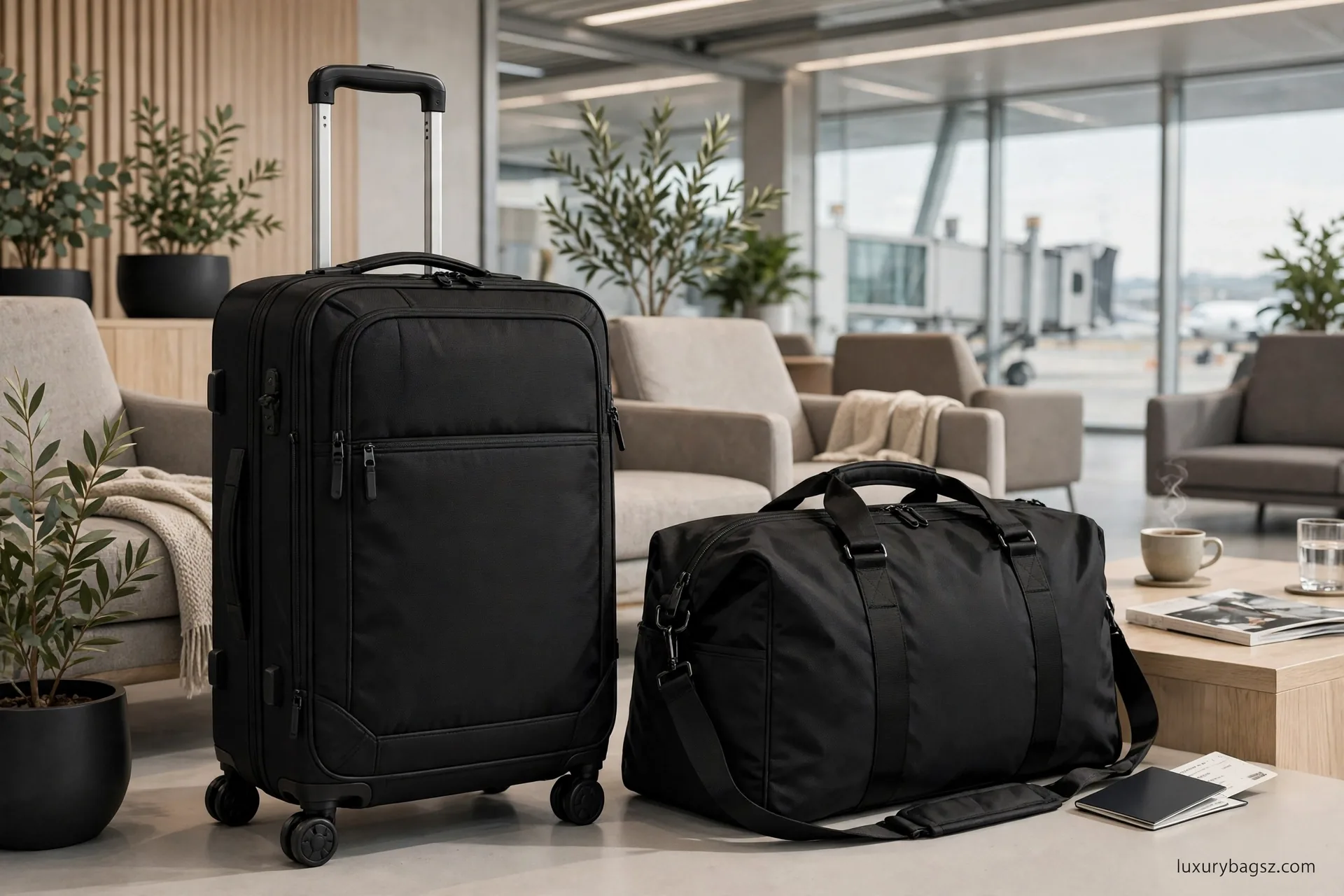
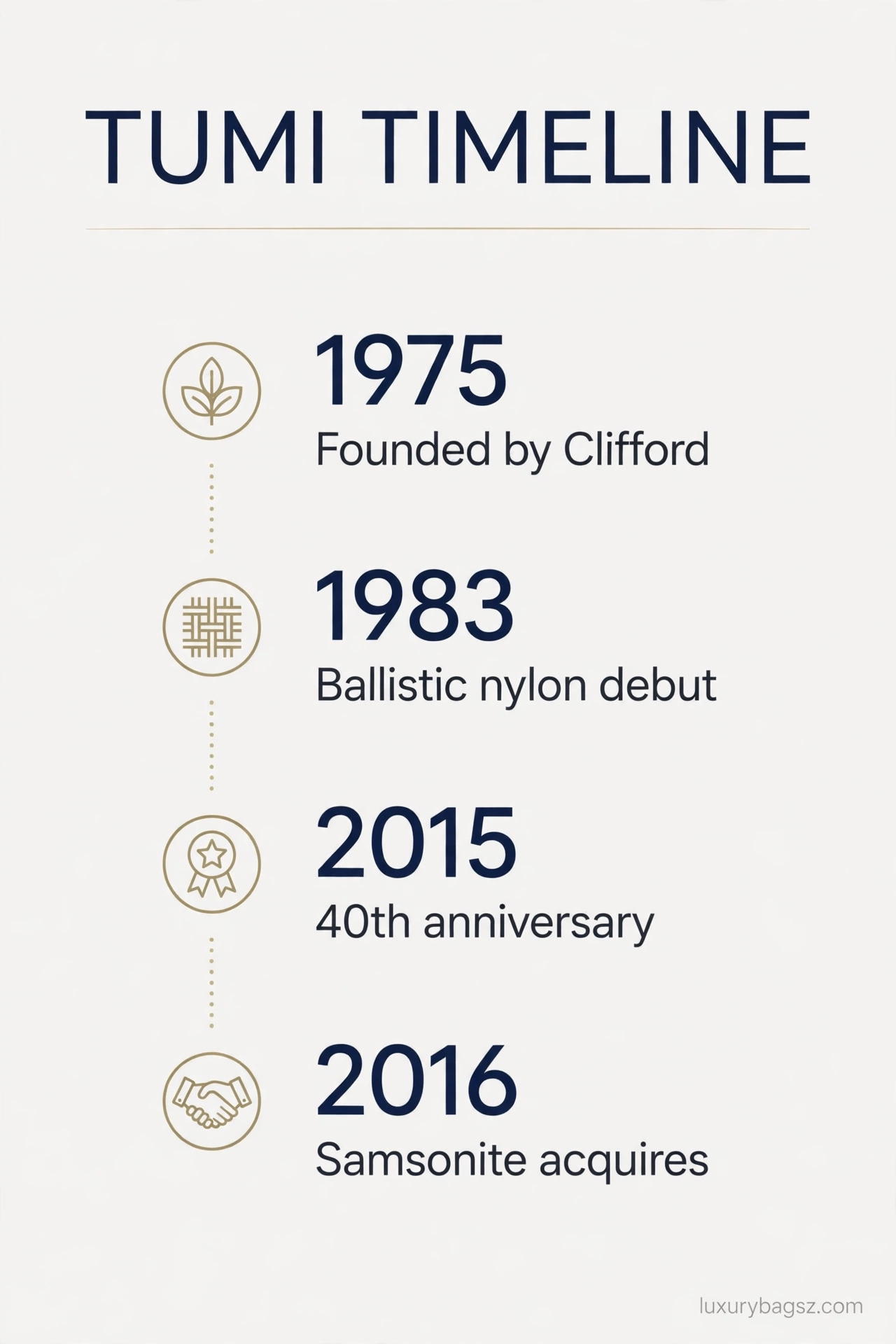
Tumi was founded in 1975 by Charlie Clifford, a former Peace Corps volunteer in Peru, and it marked its 40th anniversary in 2015 as a global premium luggage brand built on ballistic nylon, organisation, and relentless testing.
The name comes from the Peruvian tumi, a ceremonial knife Clifford encountered in Peru. That small detail explains the brand: travel goods inspired by craft, built for people who actually travel, and tested until they survive the journey.
Key Takeaways
- Tumi was founded in 1975 by Charlie Clifford after his Peace Corps service in Peru.
- The brand takes its name from the Peruvian tumi ceremonial knife.
- Ballistic nylon, introduced to consumers in 1983, became Tumi's signature material.
- The 40th anniversary fell in 2015, with a limited Core Collection in tan leather and ballistic nylon.
- Samsonite acquired Tumi in 2016 for about $1.8 billion, after a 2012 stock market listing.
Dreams From Peru: How Charlie Clifford Started
Charlie Clifford's story begins not in a boardroom but in Peru, where he served as a Peace Corps volunteer and developed a deep appreciation for artisanal craftsmanship. On returning to the United States, he began importing handcrafted leather bags from South America.
The early business, based in New Jersey, sold rugged leather duffels and travel bags to buyers who valued craft over flash. The leather was beautiful, but it was heavy, weather-sensitive, and hard to scale for frequent travellers.
Clifford's answer was not to abandon craft but to translate it. He kept the focus on construction, pockets, and durability, and looked for a material that could carry those values into daily business travel. That search led, within a decade, to the decision that defined the brand.
1983: Ballistic Nylon Changes the Business
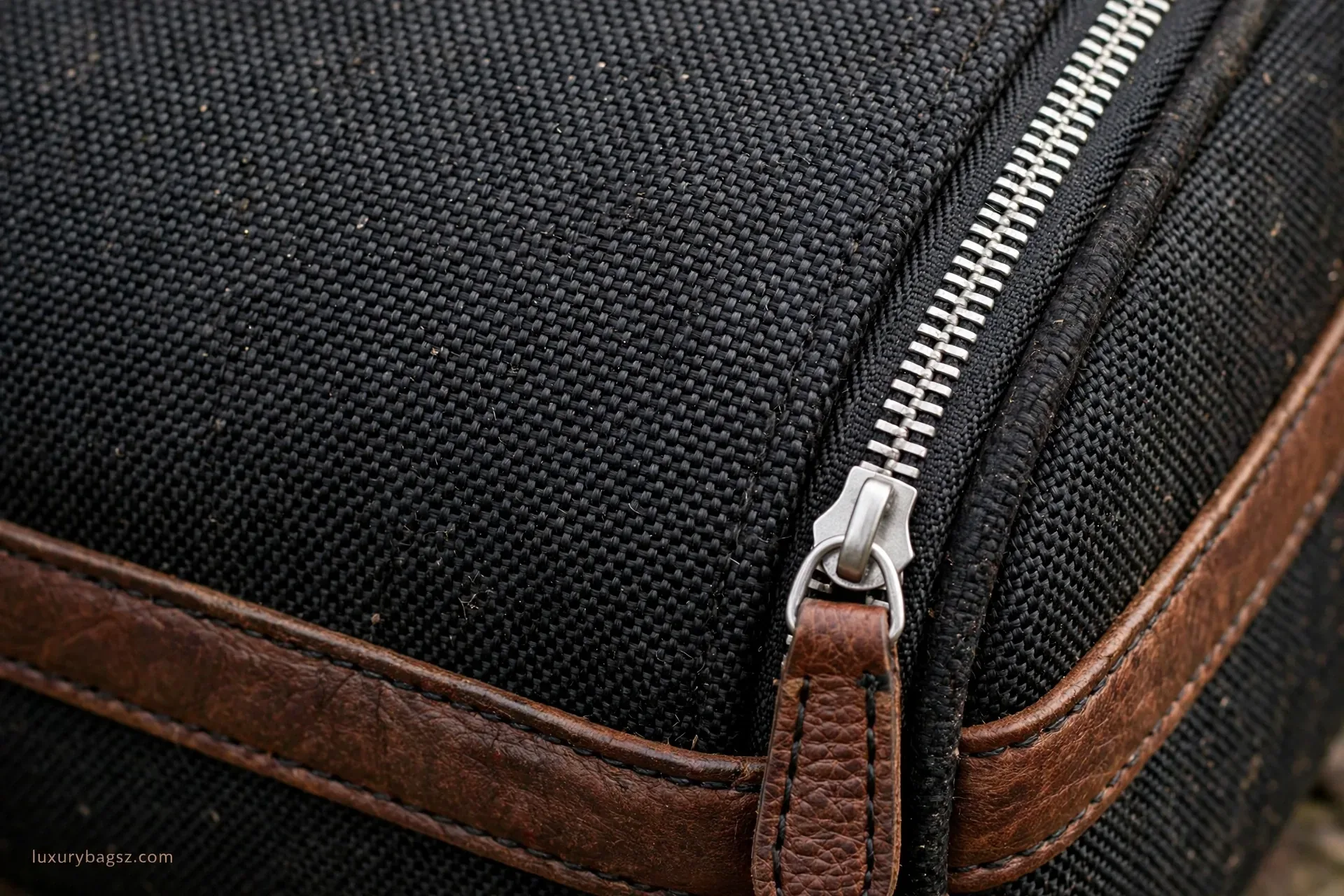
In 1983, Tumi introduced ballistic nylon to the consumer luggage market, a thick, tightly woven nylon originally developed for military flak jackets. The brand later perfected it as FXT ballistic nylon, a tough fabric engineered for abrasion resistance.
The material solved several problems at once. It was lighter than leather, far more resistant to scuffs and tears, and it held the brand's signature black-on-black look without showing every mark of travel. Business travellers noticed immediately.
Design followed material. Tumi built wide U-shaped openings, deep organisational pockets, and garment compartments that made packing easier for frequent flyers. The soft briefcase category, launched in 1986, broke the industry mould by treating a work bag as a system, not a sack.
The 40th Anniversary in 2015
Tumi celebrated its 40th anniversary in 2015, forty years after its 1975 founding, with events around the world, including celebrations in Beirut and Manila that showcased the brand's milestones and innovations.
The anniversary centrepiece was the 1975 Core Collection, a limited 12-piece edition combining tan leather with ballistic nylon, made in Naples, Florida. Its original logo emblem, an illustration of a Peruvian knife, recalled the brand's early days as an importer of South American hides.
The collection was deliberately backward-looking and forward-looking at once. It honoured the leather origins while showing that ballistic nylon, not leather alone, was now the house material. For collectors, anniversary pieces are worth noting, but condition and completeness matter more than the anniversary label alone.

Testing, Patents, and the Five-Step Promise
Tumi's reputation rests on testing as much as design. The brand describes a five-step approach spanning design, innovation, quality testing, function, and customer service, and its testing stories are famously physical.
Before launch, products endure tumbler tests for hours, wheels strapped to treadmills to prove they will not give up, and hot and cold environmental testing. That rigour is why business travellers trusted Tumi cases through years of airport handling.
The brand also built practical systems around its bags, including the Tumi Tracer recovery programme, which helps reunite owners with lost or stolen luggage. It is a small feature with an outsized effect on loyalty: a lost case hurts less when it can find its way home.
If you travel with a laptop daily, test any case the way Tumi tests its own: load it realistically, roll it over rough ground, and lift it into an overhead bin before committing.

From Listing to Samsonite: Growth and Ownership
Tumi's growth in the 1990s and 2000s took it from a specialist American brand to a global name, with its first store opening in Santa Monica, California, in 1997, and distribution spreading across dozens of countries.
In 2012, Tumi listed on the New York Stock Exchange, pricing its initial public offering at $18 a share. Four years later, in 2016, Samsonite acquired the company for about $1.8 billion, and Tumi has operated under Samsonite ownership since.
For buyers, ownership matters in practical ways: warranty handling, repair networks, and parts availability all sit within a larger group now. Check current warranty terms for your region before buying, since terms and repair routes can differ by market.
One date to keep straight: the 40th anniversary was 2015, under independent ownership, while the Samsonite acquisition followed in 2016. Some summaries blur the two, but the order matters for dating anniversary pieces.
Buying Tumi Well: Lines, Sizes, and Checks
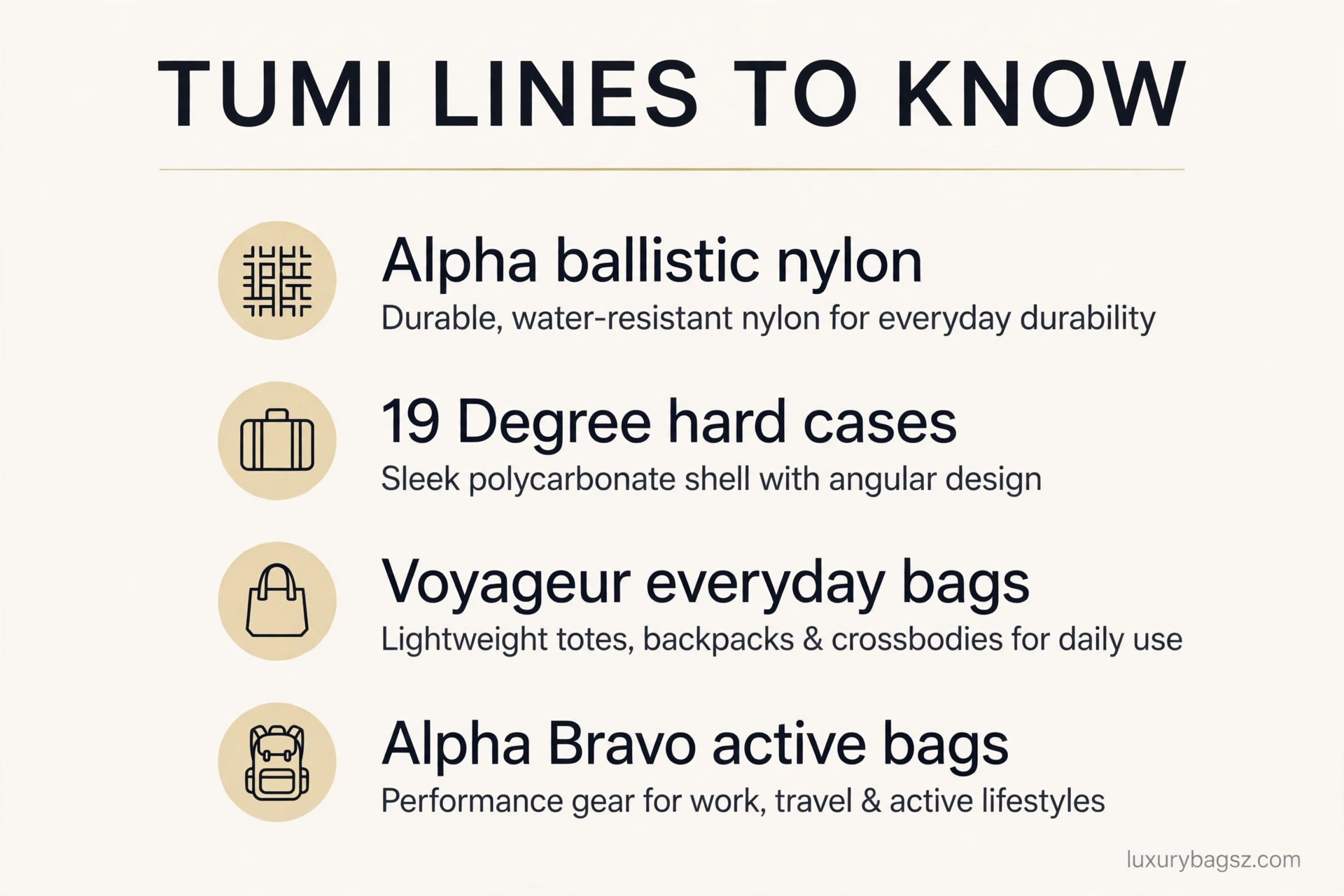
Tumi's flagship Alpha line is the soft-sided ballistic nylon collection most travellers picture first: black-on-black, heavily organised, and built for business trips. The 19 Degree line, introduced in aluminium form in 2016, covers hard cases with a distinctive contoured design.
Voyageur serves everyday and women's travel with lighter, more versatile bags, while Alpha Bravo targets active, go-anywhere use with tougher, sportier builds. Knowing which line fits your trip prevents the most common mistake: buying a beautiful case for the wrong job.
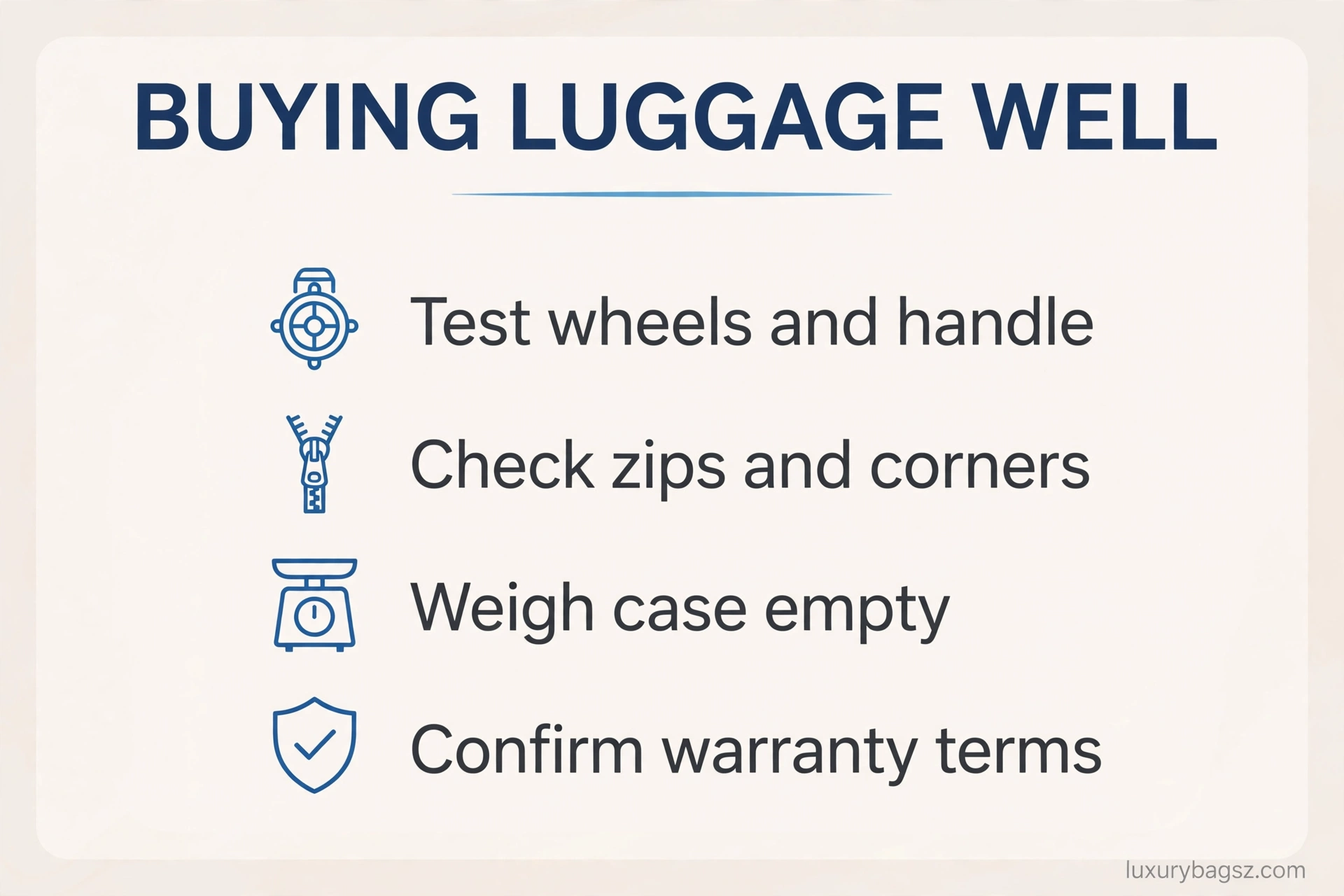
Before buying, test the wheels on a hard floor, extend and retract the handle several times, and open every pocket. Check zips at the corners, where stress concentrates, and weigh the case empty, since a heavy empty case eats your airline allowance.
Compare a Tumi workhorse with a classic everyday bag shape before deciding: our Louis Vuitton Alma guide shows how a structured handbag serves a different daily job, and why one bag rarely does everything.
Tumi Versus Fashion Luggage: What to Choose and Avoid
Choose Tumi when durability, organisation, and repairability matter most: weekly business travel, heavy packing, and rough handling. Its black-on-black look also suits travellers who prefer discretion over logos.
Avoid Tumi when you want the lightest possible case above all else, or when fashion, not function, is the priority. Some fashion houses make lighter or more decorative cases, though usually with less organisation and weaker repair networks.
Also avoid buying on brand alone. Within Tumi, an Alpha Bravo backpack and a 19 Degree hard case serve entirely different trips, and the wrong line will disappoint even though the brand is right.
Our guide to designer handbag styles helps map bag shapes to daily jobs, and if you are weighing pre-owned luxury more broadly, our vintage designer bags guide covers value and risk honestly.
Caring for Ballistic Nylon and Keeping a Case for Decades
Ballistic nylon is forgiving, but not invincible. Brush off dust, spot-clean with mild soap and water, and let the case dry fully before storing. Avoid harsh solvents, which can damage coatings and zips.
Store cases upright or nested, with wheels clean and handles retracted, in a dry place away from direct heat. A case stored damp in a garage will age faster than one used weekly and stored dry.
Keep receipts, warranty cards, and Tracer details together, and register the case where the brand offers it. When a wheel or handle eventually wears, use official repair routes first: a repaired Tumi often outlasts a replaced cheaper case, which is the real economy of buying well once.
Choosing the right everyday bag follows the same logic as choosing luggage: match the piece to your daily load first, and let brand follow. Our guide to choosing a Louis Vuitton handbag applies that test step by step.
Frequently Asked Questions
1. When was Tumi founded? In 1975, by Charlie Clifford, after his Peace Corps service in Peru and a period importing South American leather bags.
2. Why is it called Tumi? After the Peruvian tumi ceremonial knife, a symbol Clifford encountered in Peru.
3. When was Tumi's 40th anniversary? In 2015, marked by celebrations worldwide and a limited 1975 Core Collection in tan leather and ballistic nylon.
4. What is ballistic nylon? A thick, tightly woven nylon originally developed for military flak jackets, introduced by Tumi to consumer luggage in 1983.
5. Who owns Tumi now? Samsonite International, which acquired Tumi in 2016 for about $1.8 billion, after Tumi's 2012 stock market listing.
6. What is the Alpha line? Tumi's flagship soft-sided ballistic nylon collection, known for organisation, durability, and a black-on-black look.
7. What is 19 Degree? A hard case line with a distinctive contoured design, introduced in aluminium form in 2016.
8. What should I check before buying Tumi luggage? Wheels, handle action, corner zips, empty weight, warranty terms, and whether the line suits your trip type.
9. How do I clean ballistic nylon? Brush off dust, spot-clean with mild soap and water, dry fully, and avoid harsh solvents on coatings and zips.
10. Is Tumi worth the premium price? For frequent travellers who value durability, organisation, and repair support, yes; for rare or light-only trips, a cheaper case may serve equally well.
Summary: The Knife, the Nylon, and Forty Years of Travel
Tumi's story runs from a Peruvian knife to a global luggage icon in forty years, and the thread is consistent: build for the journey, test until it survives, and organise every pocket with intent.
Buy the line that fits your trip, test it loaded, and keep it repaired. Do that, and a Tumi case can easily outlast the anniversary that made you notice it.