

How to Spot a Fake IWC Watch
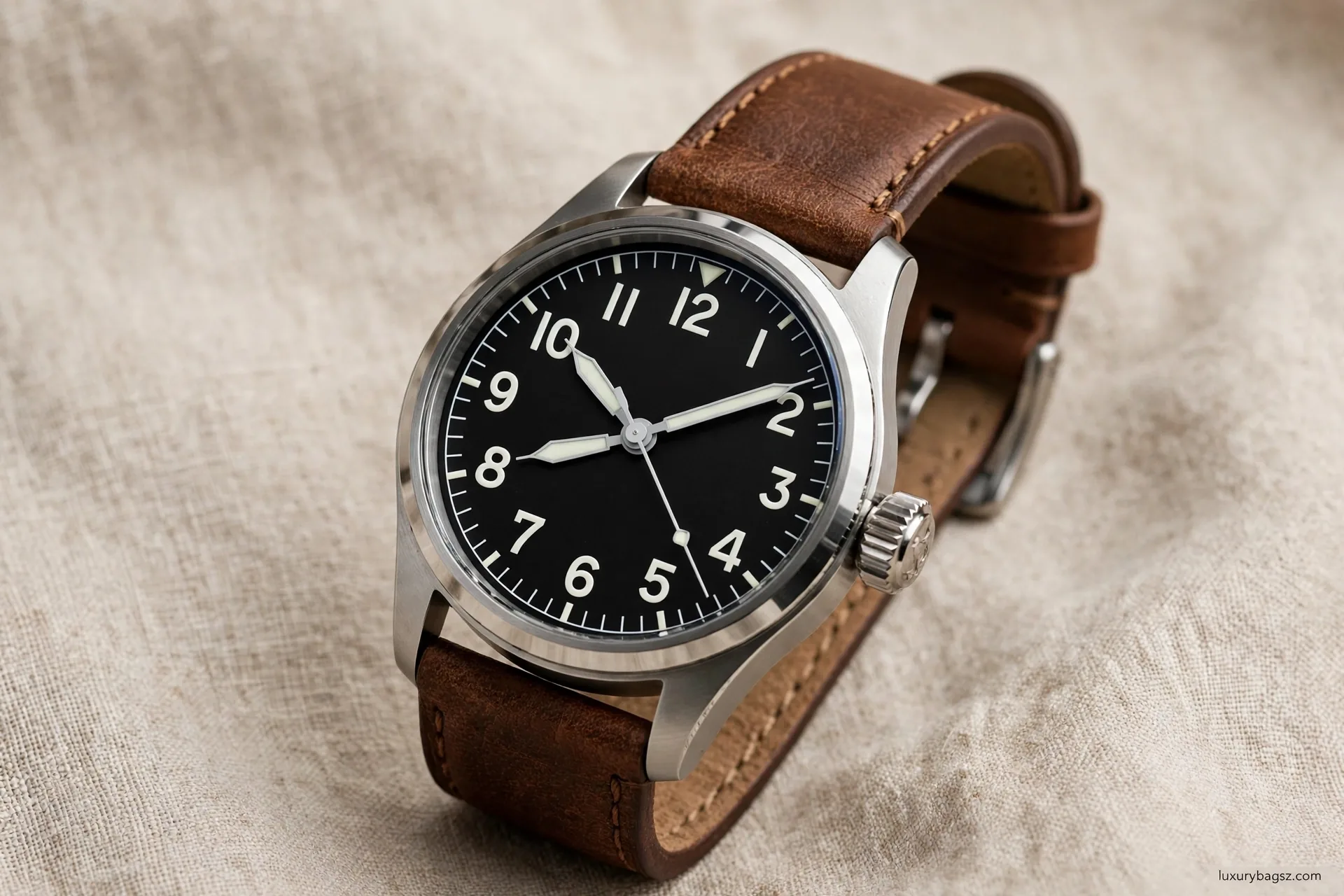
Judging an IWC Against Its Own Reference
Start by naming the exact family and reference number, then judge the dial, case measurements and movement against that specification alone — fakes rarely survive that comparison. Genuine dial lettering stays sharp under magnification, with numerals and the signature positioned exactly as that model requires.
Measure the diameter and especially the thickness, since copies frequently miss thickness, and confirm the case finishing is even with clean transitions between surfaces. The calibre inside must be the one fitted to that reference and period, whether in-house or a modified base movement, with correct finishing and markings.
Finally, caseback engraving and serial details should line up with the papers and with the production period. A mismatch on any of those points is reason to walk away, not to negotiate.
The IWC Test at a Glance
IWC Schaffhausen makes watches that look deceptively simple: clean Pilot dials, elegant Portugieser layouts, restrained Portofino designs, and purposeful Aquatimer divers. That restraint is precisely what makes IWC fakes dangerous. A counterfeiter does not need to copy ornate decoration; they need to copy clean lines, and clean lines expose sloppy execution quickly, but only to a buyer who knows what clean looks like on the specific reference.
IWC's range adds complexity. Pilot's watches, Portugieser chronographs, Portofino dress watches, Ingenieur models, and Aquatimer divers differ widely in case, dial, hands, and movement, and IWC has used both manufacture calibres and modified ETA and Sellita base calibres across different references and eras.
A movement that is correct for one reference may be wrong for another, and a dial layout that is correct for a Spitfire may be wrong for a Big Pilot. Reference discipline is therefore the foundation of every check that follows.
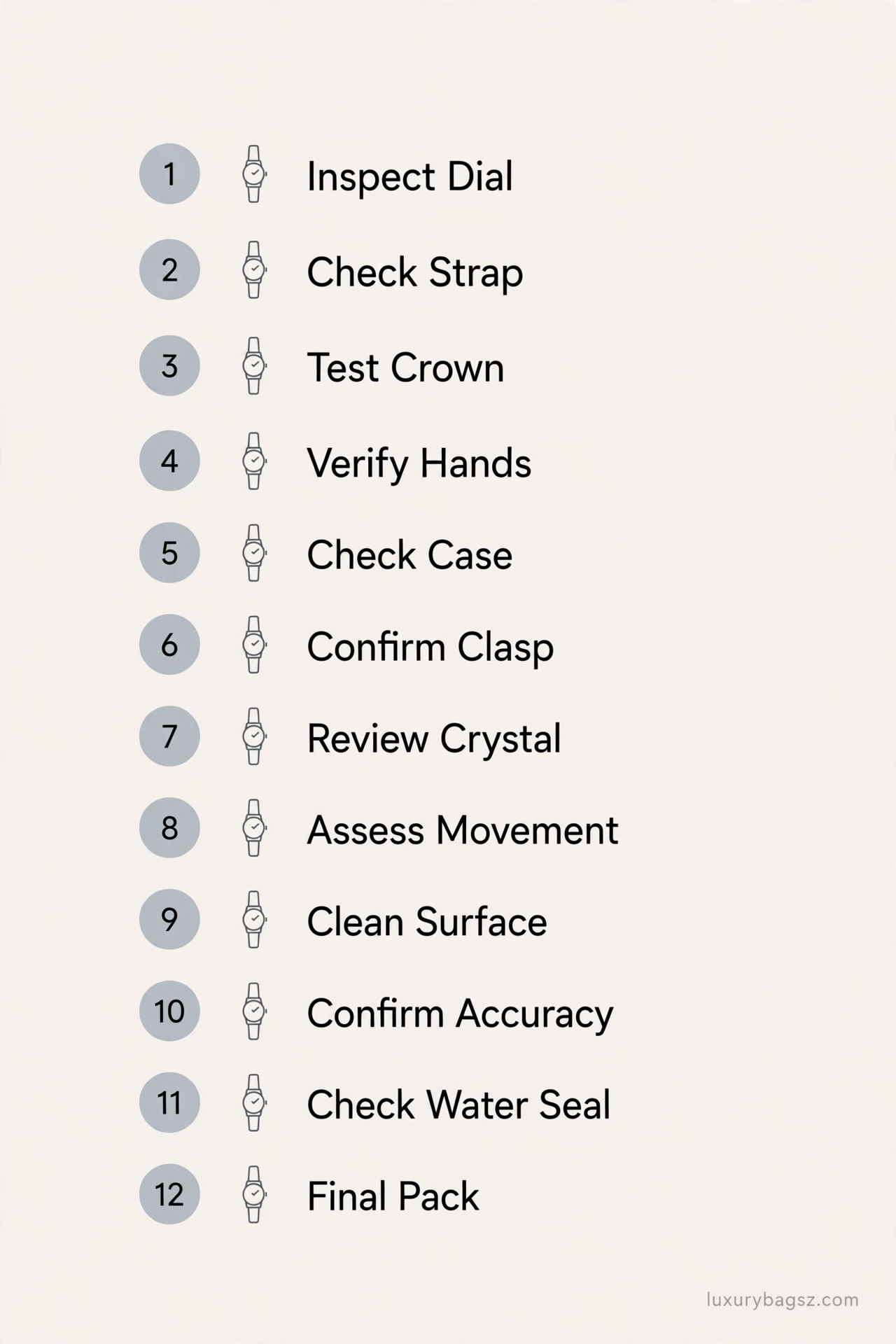
This guide gives you twelve checks that work across the IWC range, with family-specific notes where Pilot, Portugieser, and Aquatimer models diverge. As ever, no single check authenticates a watch. The verdict comes from the whole watch, judged against its reference, and confirmed by an independent inspection before a high-value purchase.
Key Takeaways

- IWC covers very different families, Pilot, Portugieser, Portofino, Ingenieur, Aquatimer, so every check must be judged against the exact reference, not against IWC in general.
- Genuine IWC dials show crisp printing, correctly formed numerals and markers, and a signature whose font and placement match the reference and era.
- Case finishing should be even and precise, with correct dimensions, including thickness, which fakes frequently miss.
- The movement must be the calibre specified for the reference and era, whether manufacture or modified base calibre, and its finishing and markings must be correct.
- Engravings, serial numbers, and papers must agree with each other and suit the production era; mismatches are hard stops.
- Pilot triangle markers, Portugieser subdial layouts, and Aquatimer bezels each carry family-specific tells that counterfeiters often get slightly wrong.
Identify the Family and the Reference First
Begin by naming the family and the reference. A Pilot's Chronograph Spitfire, a Big Pilot's Watch, a Portugieser Chronograph, a Portofino Automatic, and an Aquatimer Automatic are different watches that happen to share a brand. Each has a correct case diameter and thickness, dial colour and layout, hand style, crown size, movement calibre, and bracelet or strap type.
Without the reference number, usually in the IW format such as IW387901, you cannot know which specification to judge against.
Ask the seller for the reference, the serial number, and clear photographs of the dial, caseback, crown, clasp or buckle, and movement where an exhibition back allows it. Compare those against IWC's own materials and several reputable dealer listings for the same reference.
If the seller names a reference that does not exist, or describes a combination of features no genuine example carries, stop and demand clarification or an independent inspection.
Limited editions and special Pilot's models deserve extra care. IWC produces many limited Pilot's editions with distinctive dials, casebacks, and engravings, and counterfeiters target them because buyers are less certain what is correct. For any limited edition, verify against auction records and specialist dealer archives, and treat edition claims without paperwork as unverified.
The Dial: Printing, Numerals, and Signature
IWC dials reward close reading. On a genuine dial, printing is razor-crisp under magnification, with clean edges, even ink density, and no feathering or bleeding. The IWC Schaffhausen signature should match the reference and era in font, weight, and placement. Fakes commonly render the signature slightly too bold or too thin, with letter spacing that drifts, or placed a fraction too high or low.
Compare against a verified genuine dial of the same reference rather than relying on memory.
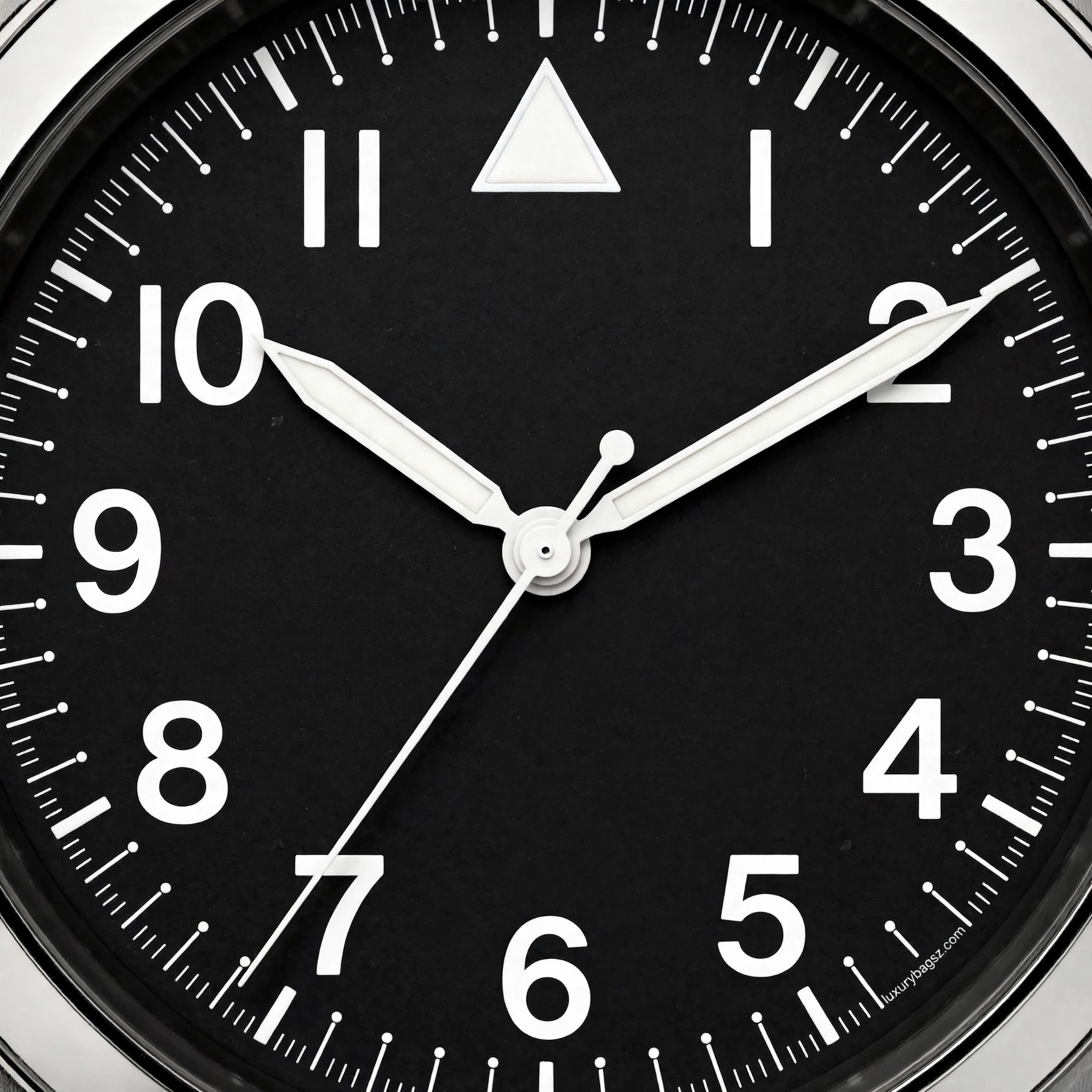
Numerals and markers are family-specific tests. Pilot's dials use large Arabic numerals with a distinctive triangle at 12 o'clock, and the triangle, numerals, and minute track must all be correctly formed and evenly printed. Portugieser dials use applied Arabic numerals and elegant subdial layouts, where the applied work must sit evenly with clean facets.
Portofino dials use slim applied markers and restrained printing, where any unevenness stands out immediately. In every family, a numeral that is malformed, a marker that leans, or a minute track that wobbles is a warning.
Check subdials, date windows, and additional indications with the same rigour. Portugieser chronograph subdials must be concentric with even tracks; date windows must be neatly cut with a centrally aligned date disc; power-reserve and other indicators must be correctly placed and correctly labelled for the reference.
A date that sits off-centre, a subdial hand that is the wrong style, or text that is misspelled or misplaced all indicate a fake dial or a badly replaced one.
Hands and Lume: Shape, Length, and Consistency
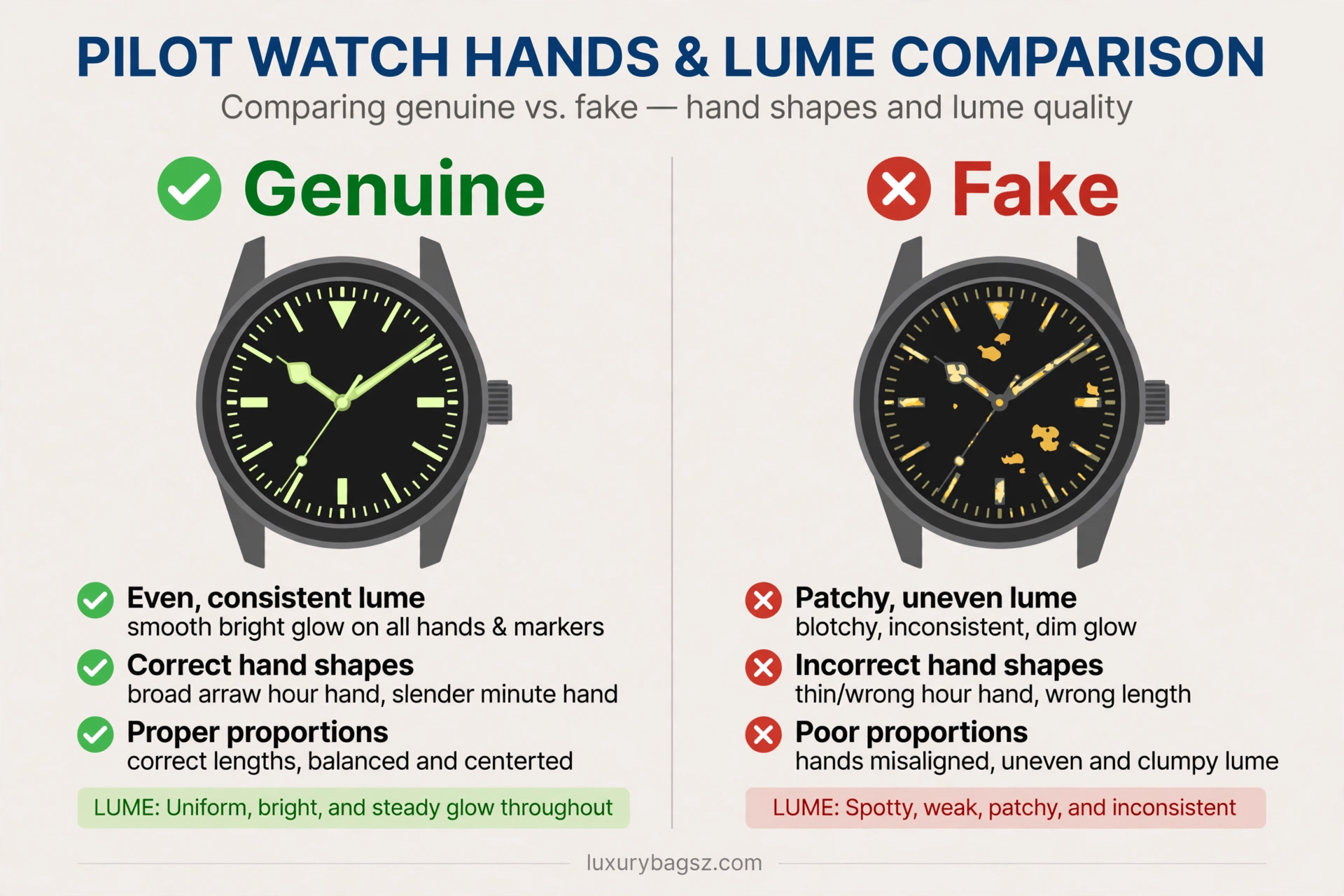
IWC hands vary by family but are consistent within a reference. Pilot's watches use bold, highly legible hands, often in a propeller-inspired or sword style depending on the model; Portugieser chronographs use slim, elegant feuille or baton hands; Aquatimer models use bold diver hands with generous lume. Within any reference, the hand shape, length, and finish are fixed.
Hands that are too short to reach their markers, too long and overlapping the track, or shaped differently from the reference are warnings.
Finish and lume consistency matter as much as shape. Genuine hands are cleanly finished with no burrs, paint blobs, or uneven coating, and lume, where fitted, is evenly applied and consistent in colour with the dial markers. Patchy, bubbly, or mismatched lume suggests a re-lumed or fake dial.
On Pilot's models, where legibility is the point, uneven lume is particularly telling, because IWC's luminous application on these models is normally exemplary.
On vintage IWC watches, lume patina should be consistent between hands and dial. Hands that look freshly lumed while the dial shows heavy patina, or vice versa, suggest replacement. Replacement hands are maintenance when disclosed, but on a watch sold as fully original they must be disclosed and priced accordingly, and they always justify a closer look at everything else.
Case: Dimensions, Finishing, and Lugs
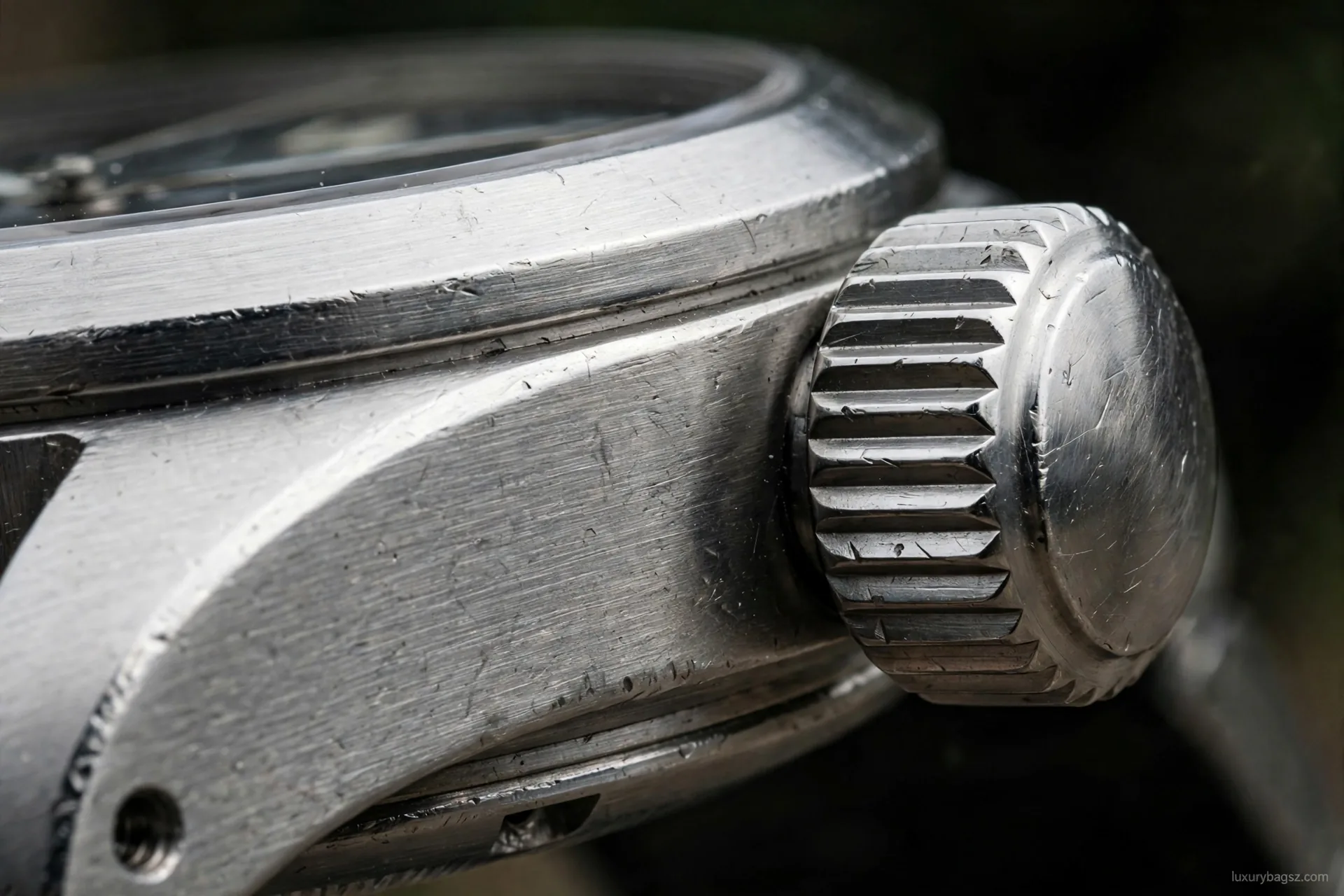
A genuine IWC case is finished to a high standard, with even brushing or polishing as the reference requires, crisp transitions between finishes, and clean lug edges. Fakes often show uneven brushing, polishing that bleeds into brushed areas, wavy reflections on supposedly flat surfaces, or lugs that are too thick, too thin, or asymmetrical.
Examine the case flanks, the bezel, and the lug undersides, where counterfeiters often economise on finishing.
Dimensions are a powerful objective test. Measure the case diameter, thickness, and lug-to-lug distance and compare them against the reference specification. IWC fakes frequently miss on thickness, because copying a thin manufacture calibre and slim case is mechanically demanding, and a watch that is a millimetre or two thicker than the genuine reference is suspect even if its dial looks right.
Big Pilot's models are genuinely large, so do not mistake legitimate size for fakery; the test is deviation from the stated reference, not absolute size.
Check the area between the lugs, where reference and serial information is often found. Genuine engraving there is sharp, evenly deep, and correctly formatted for the era. Shallow, uneven, or oddly formatted engraving in this hidden area is a warning, because counterfeiters concentrate on visible surfaces.
Crown, Pushers, and Water-Resistance Details
IWC crowns vary by family and are a precise test. Big Pilot's watches carry a large, distinctive onion or diamond-shaped crown that is easy to grip with gloves; Portugieser crowns are smaller and more restrained; Aquatimer crowns are screw-down and robust.
Whatever the family, the crown must match the reference in size, shape, and markings, and it must operate smoothly: winding with a clean feel, setting precisely, and sitting flush or screwing down correctly as the design requires. A crown that wobbles, feels gritty, or is visibly the wrong size or shape is a warning.
Chronograph pushers on Portugieser and Pilot's chronographs should operate with a firm, precise click and return cleanly. Mushy, sticky, or uneven pushers suggest poor manufacturing or a wrong movement. On Aquatimer models, test the rotating bezel: it should rotate with firm, even clicks, align precisely, and carry crisp, correctly formed markings.
A bezel that rotates loosely, clicks unevenly, or shows fuzzy markings is a warning, and on a diver it also undermines the watch's claimed water resistance.
Do not attempt home water-resistance tests on an unknown watch. A genuine watch with aged gaskets can fail, and a fake with new gaskets can pass a shallow test. Water resistance is verified by a watchmaker with proper pressure-testing equipment, as part of a service or inspection, not by a buyer in a sink.
Bracelet, Strap, and Clasp
IWC bracelets and straps should match the reference in material, construction, and finishing. Bracelets articulate smoothly with even gaps and consistent link finishing, and clasps close with a firm, precise snap, sit flush, and carry clean, correctly rendered markings. A bracelet that feels stiff, rattly, or roughly finished, or a clasp that closes loosely or shows shallow or misspelled engraving, undermines the whole watch.
Straps deserve equal attention. Genuine IWC straps use quality leather, rubber, or textile as specified, with clean stitching, even edges, and correct markings. Pilot's straps, often in calfskin or textile, should feel substantial and well made, not thin or plasticky. Buckles and deployant clasps should be solidly made and correctly marked for the case material.
As with other brands, straps are consumable and often replaced, so a replaced strap alone is maintenance; a replaced strap combined with a poor buckle or bad lug fit is a reason for greater scrutiny.
Check strap and bracelet fit at the lugs. The fit should be snug and even, with matching gaps on both sides. A strap or bracelet that is too narrow for the lugs, that sits crooked, or that uses ill-fitting spring bars suggests a mismatched or fake assembly, which is a common way fake watches are put together from mixed parts.
The Movement: Calibre, Finishing, and Markings
IWC movements require reference-specific knowledge, because the brand has used manufacture calibres such as the 52000 and 69000 series alongside modified ETA and Sellita base calibres on different references. The first question is always whether the movement in the watch is the calibre specified for its reference and era. A manufacture calibre claimed in a reference that IWC only made with a base calibre, or vice versa, is a serious discrepancy.
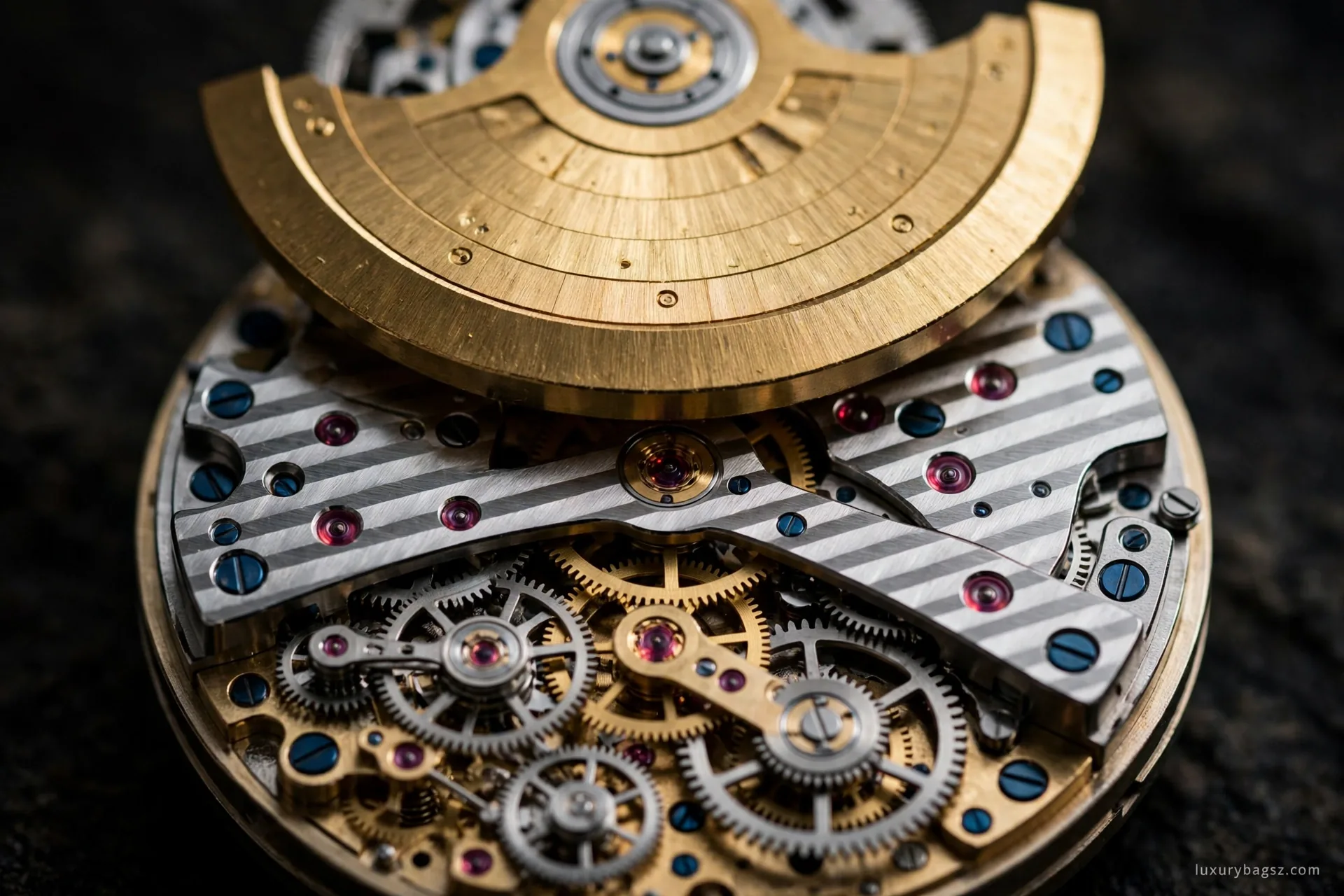
When the case is opened by a qualified watchmaker, or viewed through an exhibition back, a genuine IWC movement shows clean finishing: even Geneva stripes or perlage as specified, bridges with clean edges, screws that are correctly finished, and calibre and IWC markings that are correctly engraved and match the reference.
Rough bridges, unpolished screws, glue, generic unmarked parts, or a movement that is visibly a cheap generic calibre with an IWC-branded rotor are hard evidence of fakery.
Movement behaviour is a functional check. The watch should run steadily, the date should change crisply at midnight where fitted, chronograph functions should start, stop, and reset precisely, and any power-reserve, GMT, or perpetual-calendar indication should advance correctly.
Erratic behaviour, a date that drags over hours, or a complication that sticks is not merely a servicing issue on an unknown watch; it is a reason to question the movement itself before purchase.
Caseback Engravings and Serial Numbers
IWC casebacks vary by reference: some are solid with engravings, some are exhibition backs, and some, particularly limited Pilot's editions, carry special engravings such as aircraft or squadron motifs. Whatever the configuration, it must match the reference.
A solid back where an exhibition back is specified, a missing special engraving on a claimed limited edition, or an engraving that does not match verified examples of that edition are all serious discrepancies.
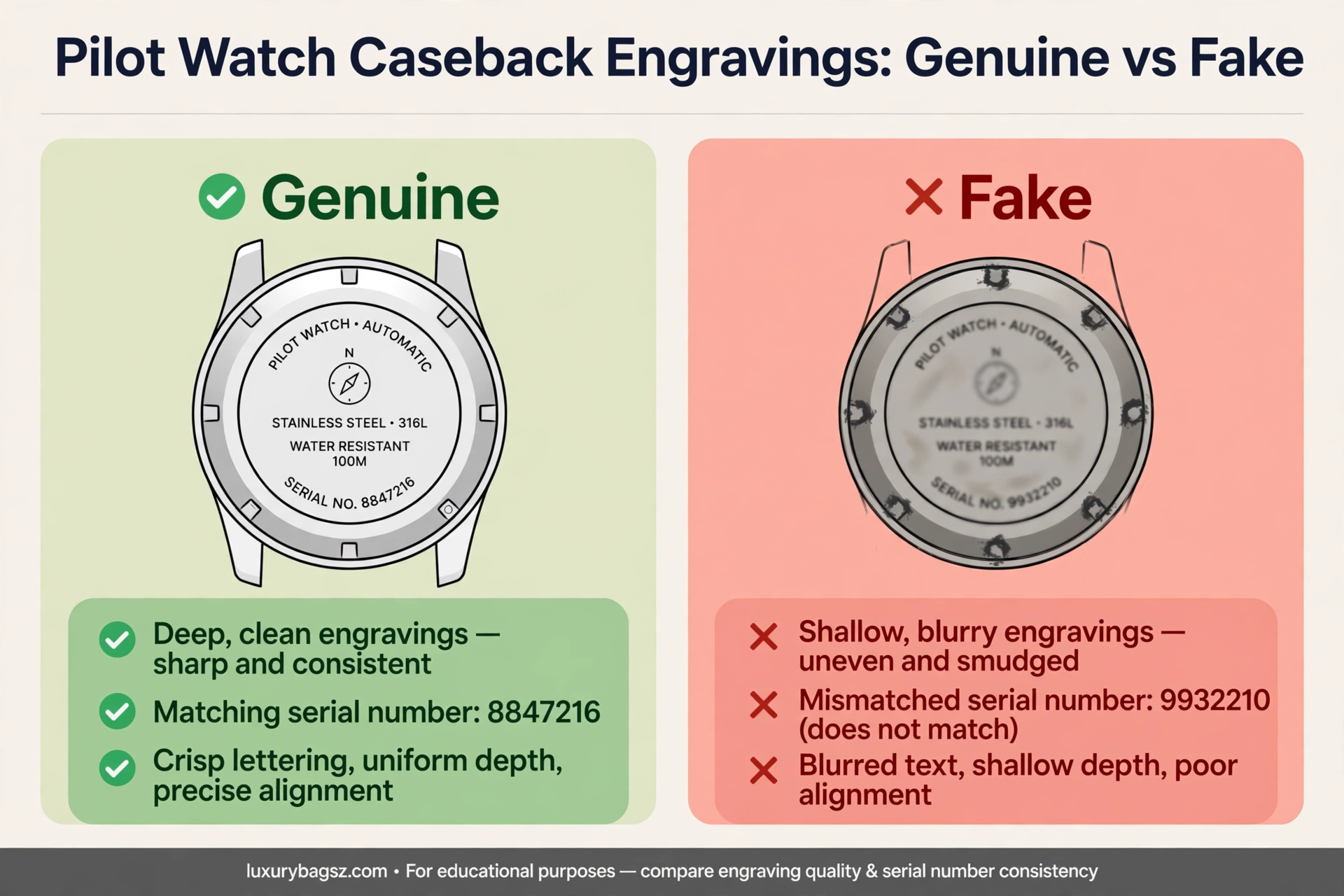
Engraving quality is the test within the test. Genuine IWC engravings are sharp, evenly deep, and correctly rendered, including fine detail on special-edition motifs. Fakes often show shallow, uneven, or slightly blurred engraving, with fine detail lost or muddied. Photograph the caseback in raking light to reveal uneven depth, and compare motifs directly against verified examples rather than from memory.
Serial numbers must agree across the case, the papers, and any other documentation, and must suit the claimed production era. A serial that looks freshly engraved on a worn case, that uses a different font from surrounding engraving, or that belongs to a different era than the watch's design is a warning.
IWC serial numbering has changed over the decades, so era-appropriate checking, ideally by a dealer or specialist, matters more than any single rule of thumb.
Weight, Feel, and Overall Finish
A genuine IWC has a balanced, considered feel: the case weight suits its material and size, the crown and pushers operate precisely, and the bracelet or strap drapes naturally. Fakes often feel too light, because of cheaper base metals and hollow construction, or oddly balanced, because the case, movement, and strap weights do not match. Weight alone never authenticates a watch, but a watch that feels wrong should trigger the full checklist.
Overall finish is the companion test. Examine every surface under good light: case flanks, bezel, crown, lugs, clasp, and buckle. Genuine finishing is consistent, with no rough casting marks, burrs, pitting, or rushed polishing. Fakes often finish the dial and case front well while neglecting the case sides, lug undersides, and clasp interior. Those neglected areas are where careful buyers look first, and they frequently decide the verdict.
Also assess the watch as a functioning object. Wind it, set it, operate its complications, and rotate its bezel where fitted. A genuine IWC operates with precision at every control; a fake often feels gritty, loose, or inconsistent at one or more controls. That tactile evidence, combined with the visual checks, is difficult for counterfeiters to fake across every control at once.
Box, Papers, and Provenance
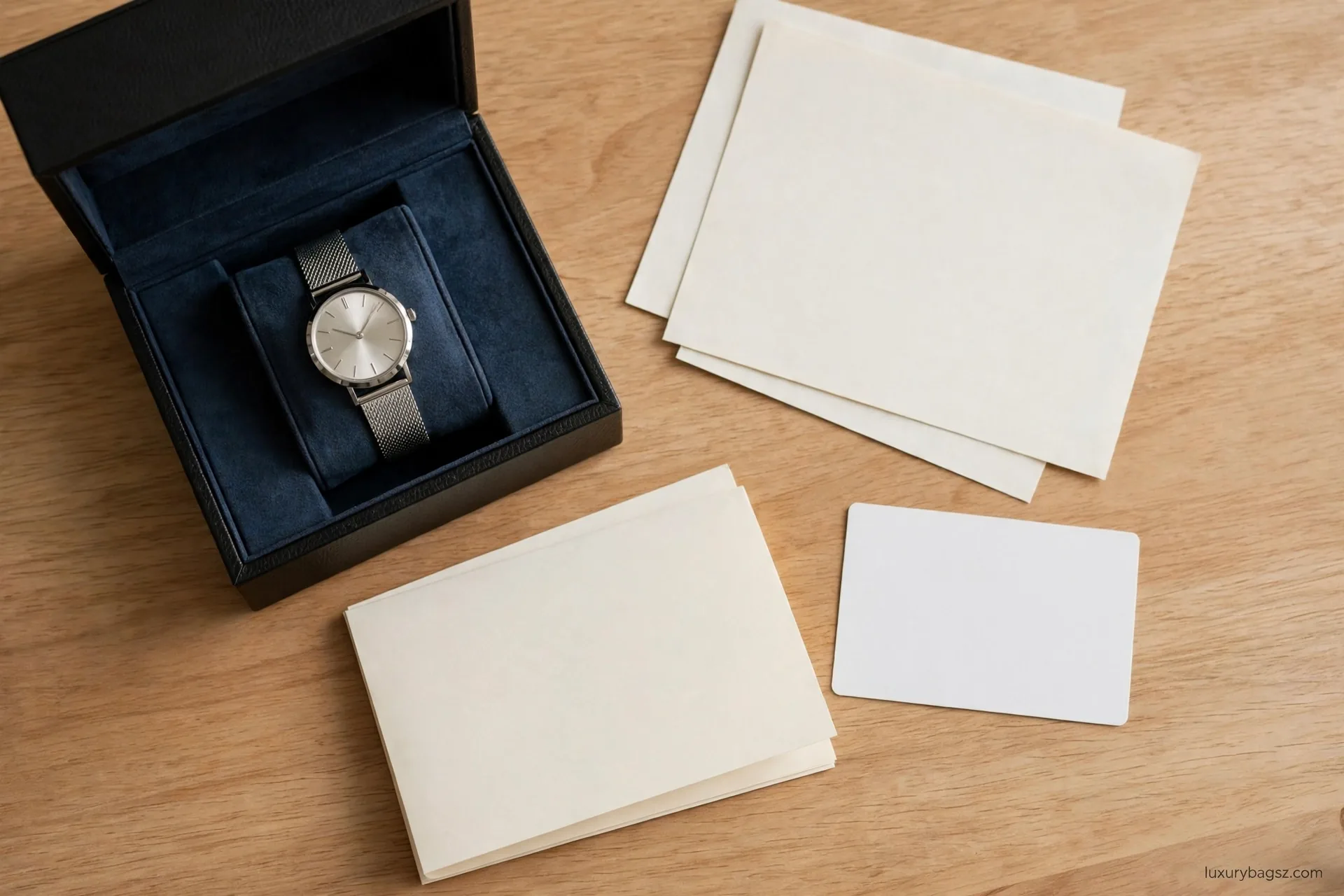
IWC boxes and papers should suit the watch's era and reference. Modern IWC presentation boxes are well made and correctly branded, and the papers, including the guarantee card, should show the reference, serial number, and purchase details that match the watch exactly. A box style from a different era, papers whose serial differs from the case, or printing that is fuzzy or inconsistent are warnings.
As always, box and papers are supporting evidence, not a verdict: fake boxes and papers are common, and genuine watches frequently lose their boxes.
Provenance for IWC watches means a verifiable dealer history, service records from IWC or a reputable watchmaker, or a reputable marketplace trail. Vague stories about inheritances, duty-free purchases with no paperwork, or sellers who refuse additional photographs are not provenance. They are reasons to insist on independent authentication.
Where servicing has occurred, ask for records and check that replaced parts are disclosed; a serviced IWC with a replaced crystal or strap is normal, while an undisclosed replacement dial or movement is a different matter.
Common Traps: What Fools Buyers
The traps that fool IWC buyers mirror those for other brands, with family-specific twists. The first is judging a Pilot's watch by its triangle marker alone: counterfeiters copy the triangle well, while failing on the movement or the case thickness. The second is judging a Portugieser by its elegant appearance: a beautiful dial can sit on a fake case with a generic movement.
The third is trusting papers without checking the serial match and era style. The fourth is letting a limited-edition story override missing documentation: limited editions need more proof, not less, because they are the most faked variants.
Superclone IWC watches copy external details closely, including case shape, dial printing, and even weight, and they are built to pass casual inspection and to photograph convincingly. The defence is procedural: reference first, then dial, case, crown, movement, engravings, and papers, with an independent inspection before payment.
A seller who welcomes that procedure is behaving like a seller of a genuine watch; a seller who resists it is providing behavioural evidence that should weigh heavily in your decision.
Buying Safely: Inspection, Escrow, and Recourse
Before paying in full for a pre-owned IWC, secure a written return period that allows an independent inspection, including opening the case where appropriate, and agree in writing what happens if the watch is judged fake or not as described. Take the watch to a reputable watchmaker or IWC specialist, ask them to check the movement, the caseback engravings, and the dial, and get their opinion in writing.
If the seller refuses an inspection window, walk away.
Use payment methods with recourse and avoid irreversible transfers to unknown sellers. Escrow through a reputable marketplace can help, but check what it covers: some services verify only that the watch matches its listing photographs, not that it is genuine in the full sense of this guide. Keep complete records of the listing, the seller's description, correspondence, photographs of the watch and serial number, papers, and the inspection report.
A genuine IWC is a precise, long-lived instrument; the days spent verifying it are a small price for confidence in it.
The same inspection-first approach applies to jewellery purchases too, as the Cartier Love bracelet fake guide shows: check the whole piece, demand an inspection window, and walk away when a seller resists one.
Servicing, Accuracy, and Long-Term Care Across IWC Families
A genuine IWC is an instrument, and instruments need maintenance, which makes service history part of authentication rather than a footnote. IWC recommends servicing at intervals measured in years, varying by calibre and use, and a pre-owned IWC with a documented service history from IWC or a reputable specialist is easier to trust, because each service involved inspection by people who know the movement.
When buying, ask when the watch was last serviced, by whom, and what was done, including whether gaskets, crowns, and pushers were addressed, and budget for a service if the history is vague or long ago. A watch that has not been serviced for many years may keep acceptable time, but its lubricants are aged, its water resistance is unknown, and its complications, where fitted, are untested under service conditions.
Accuracy expectations should be realistic and calibre-specific. A modern IWC automatic should keep time within a range appropriate to its calibre and certification, but vintage watches, watches overdue for service, and watches with complications all vary, and a single day's observation proves little.
If you are concerned about accuracy, have a watchmaker test the watch on a timing machine, which measures rate, beat error, and amplitude, rather than judging from wrist observation alone. That test also reveals movement health: low amplitude or erratic rate suggests service is due, while a healthy amplitude with a steady rate suggests a movement in good condition, even if its daily rate needs regulation.
Family-specific care completes the picture. Pilot's watches, with their large crowns and legible dials, benefit from regular crown and gasket checks, because their crowns are operated frequently and their water resistance depends on them. Portugieser chronographs need their pushers and chronograph functions exercised periodically and checked at service, because unused chronograph mechanisms can stiffen and because pusher gaskets age.
Aquatimer divers need bezel and water-resistance checks above all, with pressure testing before any swimming, and rinsing after saltwater exposure. Portofino dress watches, worn less roughly, still need strap checks and periodic service, because leather straps age even when unworn and lubricants age even when a watch sits in a box.
Across all families, the habits are the same: store the watch safely, keep it away from strong magnets and shocks, keep papers and service records together, and service on schedule. A well-maintained IWC is not only a better watch to wear; it is a watch whose genuineness is easy to demonstrate, because its condition, its paperwork, and its behaviour all agree with each other.
Family-Specific Buying Notes: Pilot, Portugieser, and Aquatimer
Buying an IWC well means buying its family well, because each family has quirks that general checks miss. Pilot's watches reward attention to the crown and the dial's legibility under poor light.
The large onion crown on Big Pilot's models should be correctly proportioned and crisply finished, with a stem that winds smoothly and a crown that sits correctly against the case, and the dial's large numerals and triangle marker should remain legible at a glance, which is the whole point of a pilot's design.
A Pilot's watch whose crown feels loose, whose triangle marker is malformed, or whose lume is patchy has failed its family's core promise, however good the rest of the watch looks. Spitfire and Top Gun variants add their own dial colours, case materials, and engravings, which must be verified against their specific references, particularly for limited editions where counterfeiters concentrate.
Portugieser models reward attention to subdial elegance and case thinness. The Portugieser Chronograph's subdials should be perfectly concentric, its applied numerals evenly set, and its feuille hands slender and correctly proportioned, because the family's appeal is classical balance, and any imbalance, a subdial slightly off-centre, a numeral slightly leaning, a hand slightly too long, breaks that balance visibly.
Case thickness matters too: Portugieser models are dressier and slimmer than Pilot's models, and a Portugieser that is noticeably thicker than its reference suggests a wrong movement or a fake case. Portofino models share that dress-watch discipline in a smaller, more restrained form, where any finishing flaw stands out immediately because there is so little decoration to hide behind.
Aquatimer models reward attention to the bezel, the crown, and water resistance as a system. The rotating bezel should click evenly and align precisely, the screw-down crown should operate smoothly and seal correctly, and the watch's water resistance should have been pressure-tested recently, because a diver whose bezel, crown, or seals fail has failed as a diver, whatever its dial looks like.
Ingenieur models, with their anti-magnetic heritage and integrated bracelets, reward attention to bracelet integration and to the soft-iron inner case where fitted, which should be verified by a watchmaker rather than assumed. Across families, the lesson is the same: learn your family's promise, whether legibility, elegance, or diving capability, and test the watch against that promise, not just against generic quality.
A watch that keeps its family's promise, across dial, case, crown, movement, and papers, is a watch worth buying.
Dealer, Marketplace, and Private Sellers: Where to Buy Safely
Where you buy an IWC affects how much authentication protection you get, and each channel has a different risk profile. Authorised dealers and reputable specialist dealers offer the strongest protection, because they stake their reputation on authentication, usually inspect watches before sale, and offer warranties and return policies.
Their prices are typically higher than private sellers, but that premium buys inspection, recourse, and peace of mind, which is valuable for high-value IWC models. When buying from a dealer, still check the reference, papers, and return terms yourself, because dealer reputation supports but does not replace your own checklist.
Specialist pre-owned marketplaces offer a middle ground: wider selection and often lower prices than dealers, with varying levels of authentication. Some marketplaces authenticate watches in-house before shipping, others rely on seller representations with buyer protection, and the difference matters enormously. Read the marketplace's authentication terms carefully: does it inspect the movement, or only compare the watch to listing photographs?
Does it cover your reference and condition? What is the return window, and who pays return shipping if the watch fails inspection? A marketplace that inspects thoroughly is worth its fees; one that does not is little better than a private sale with a nicer website.
Private sellers, including individuals on general marketplaces and social platforms, offer the lowest prices and the highest risk. Private sales can yield excellent watches from genuine collectors, but they can also yield sophisticated fakes from sellers who disappear after payment.
With private sellers, insist on the full procedure: reference verification, detailed photographs, a written return window for independent inspection, and a payment method with recourse. Never pay by irreversible transfer to an unknown private seller, never accept a story in place of documentation, and never let urgency override inspection.
The channel you choose should match the watch's value: the higher the value, the stronger the channel's protection needs to be, and for a high-value IWC, dealer or thoroughly authenticated marketplace purchase is usually the wisest route.
Frequently Asked Questions
Can I authenticate an IWC from photographs alone?
Sometimes for crude fakes, but not reliably for good ones. Movement finishing, engraving depth, case thickness, and crown action all need the watch in hand or a watchmaker's inspection. Photographs screen; they do not verdict.
What is the most common fake IWC tell?
In practice, a combination of slightly wrong case thickness and a movement that does not match the reference. Either flaw alone can have innocent explanations, but together they are a strong warning.
Do all genuine IWC watches use manufacture movements?
No. IWC has used both manufacture calibres and modified base calibres, depending on reference and era. Judge the movement against the specific reference, not against a general assumption about IWC.
Are Pilot's watches faked more than Portugieser models?
Pilot's models are heavily faked because of their popularity and strong secondary demand, but Portugieser, Portofino, and Aquatimer models are faked too. No family should be assumed safe.
Does a guarantee card prove an IWC is genuine?
No. Guarantee cards are faked and can be paired with fake watches. A card helps only when its reference, serial, and era all match the watch itself.
Should I buy an IWC limited edition without papers?
Only with specialist authentication and a price that reflects the missing documentation. Limited editions need more proof than standard models, not less, because they attract the most sophisticated fakes.
Can IWC verify my watch's serial number?
IWC service centres can inspect and service watches and will generally decline to work on a watch identified as counterfeit. Ask the service centre what inspection options apply to your reference.
How much does professional IWC authentication cost?
It varies by provider and by whether the case is opened, but it is normally a small fraction of the watch's value. Factor it into your budget before purchase.
Do all genuine IWC watches have exhibition casebacks?
No. The correct caseback varies by reference: some are solid, some are exhibition, and some carry special engravings. Judge against the specific reference.
Is a serviced IWC with replaced parts still worth buying?
Yes, if the replacements are disclosed, correctly done, and reflected in the price. Undisclosed replacement dials, movements, or bezels are a different matter and should end the deal unless an expert advises otherwise.
Conclusion
A genuine IWC earns its verdict through precision at every level: a dial printed with absolute crispness, a case finished without a careless edge, a crown and pushers that operate with authority, a movement that matches its reference exactly, and engravings and papers that agree with each other. Fakes copy the clean look; they struggle to sustain clean execution across the whole watch.
Check the reference first, run the twelve checks, and buy only with an inspection window. The IWC you bring home will then be what it claims to be: an instrument of quiet, engineering-led elegance.






