

How to Spot a Fake Balenciaga Motorcycle Bag: Leather, Lampo Zips, Rivets and Tag Numbers
The Motorcycle Verdict in Brief: Slouch, Zip, Tag
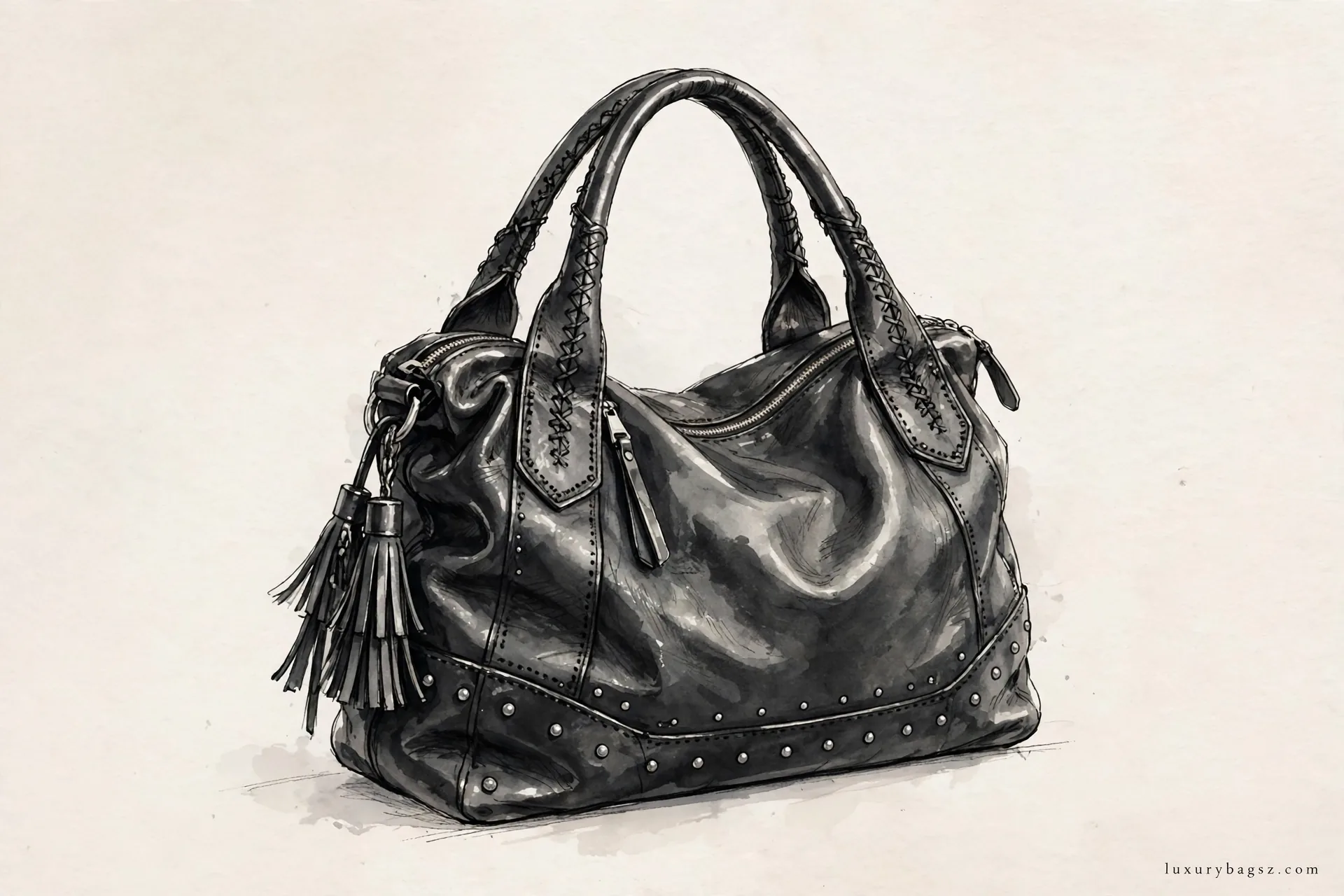
Let the bag slump first. A real motorcycle bag uses thin, distressed leather that collapses when empty, with Lampo zips and tag numbers that match front and back. A fake usually stands too stiff and shiny. Its zips carry the wrong mark or none, its handles shine with coating, and its tag numbers tell two different style stories.

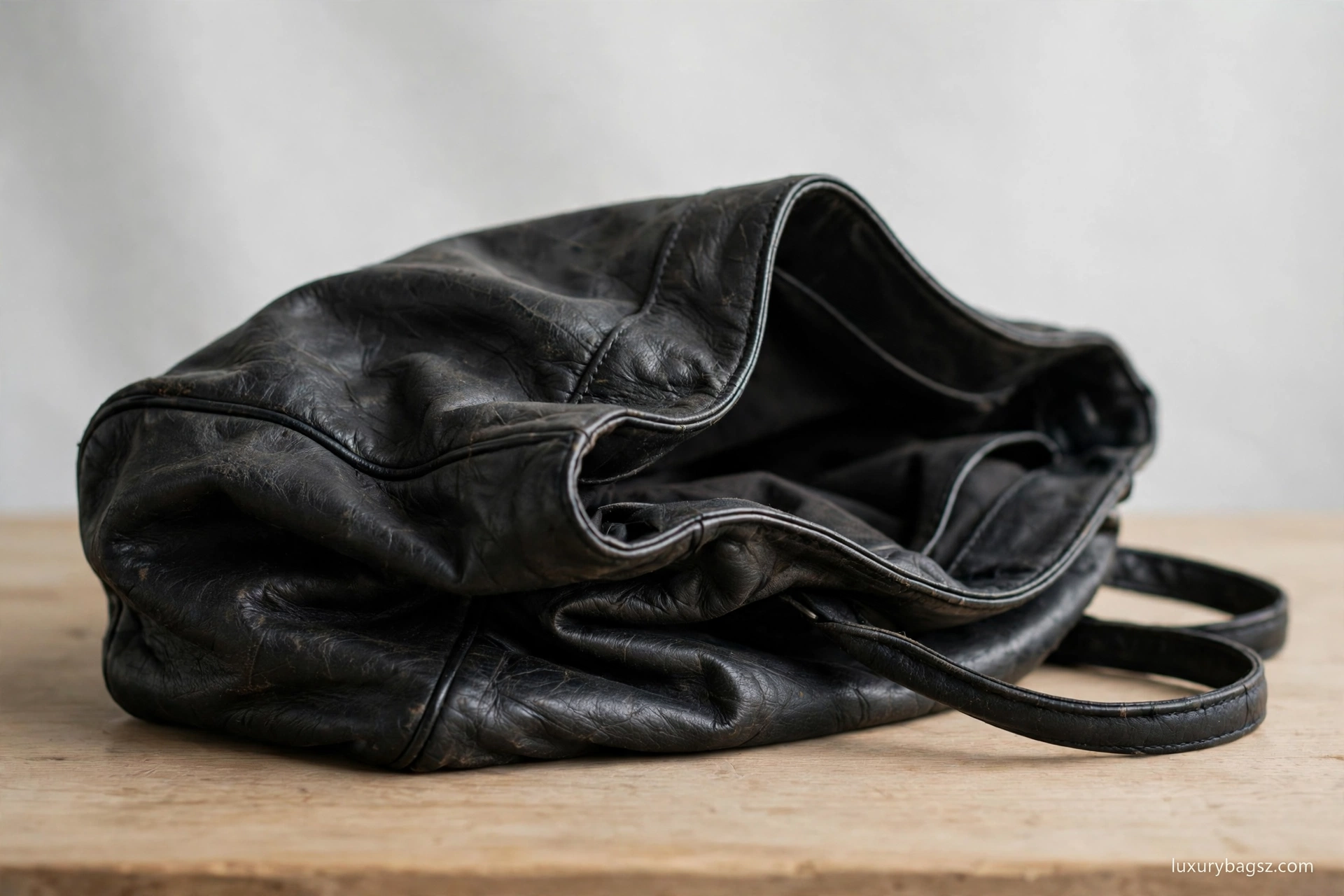
Give me a Balenciaga Motorcycle and I let it slump before I judge anything else. The real bags use thin, distressed leather that collapses softly when empty; a stiff, shiny bag standing to attention has already told me a great deal. Next I turn the zip pulls over to look for the Lampo mark, then compare the interior tag numbers front and back until both sides tell the same story. I have handled hundreds of pre-owned bags over the years, and the Motorcycle remains the one where leather behaviour and a zip mark settle most arguments between them.
The Motorcycle Family and Its Eras
Motorcycle bags cover the City, First, Work and Weekender shapes, made across many years in lambskin and, on early sought-after pieces, goatskin. Start with our general how to authenticate a Balenciaga bag guide, then use the era checks here for the motorcycle line in particular. Era is everything on these bags. Rivets, zip marks, tag plates and handle details changed over the years, so a detail is only wrong when it is wrong for its year. Our what is a Balenciaga City bag guide covers the best-known shape, whose style number appears again in the tag check below.
Leather: Thin, Distressed and Willing to Slump
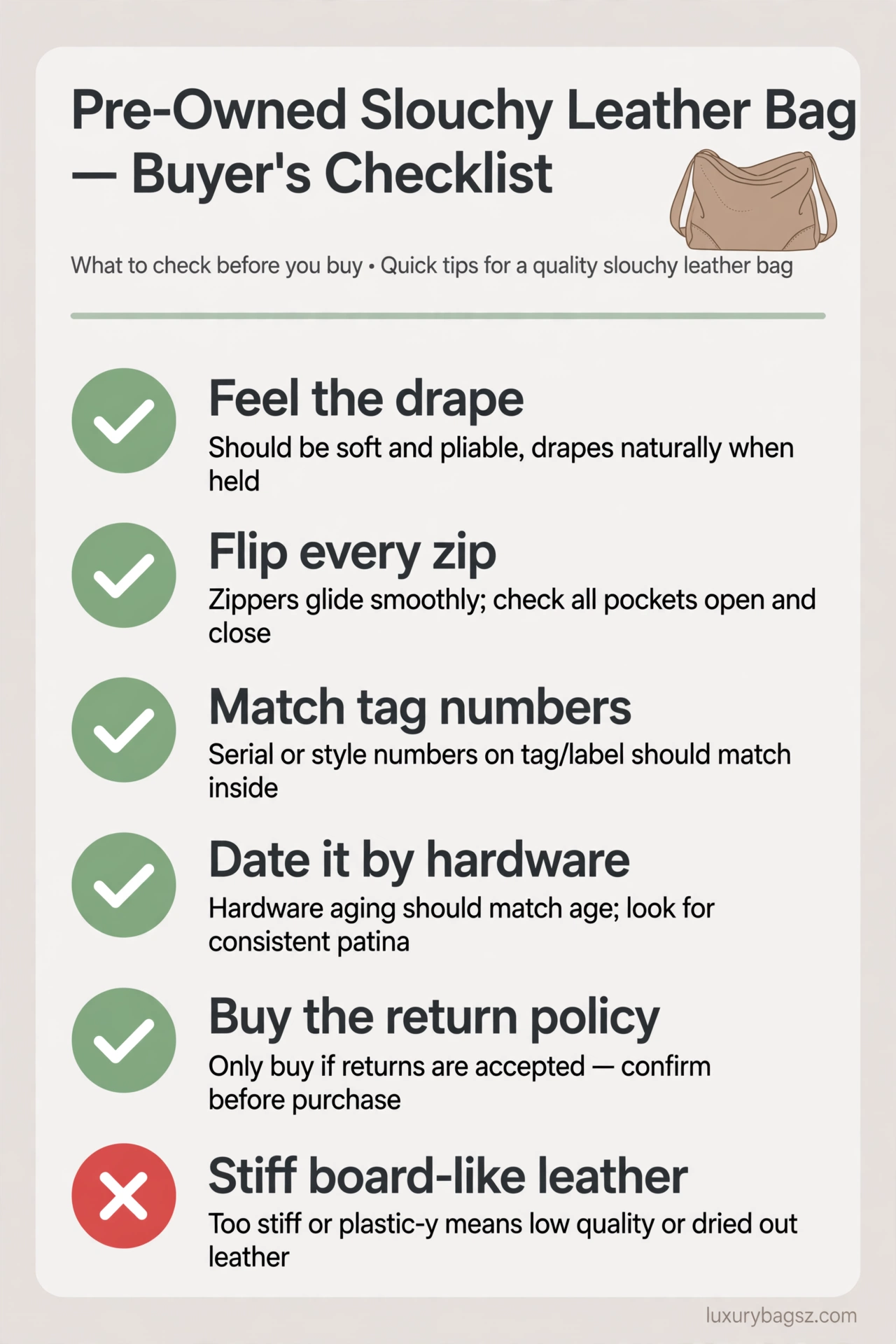
Pick the bag up empty and set it down. Genuine motorcycle leather is famously thin yet durable, with a distressed, slightly crinkled finish that folds and slumps. Run your hand over it. It should feel soft and natural, with variation in the surface. Stiff, board-like leather with a cheap shine is the classic copy failure. Forced distressing is the other tell. On fakes the cracks and wrinkles can look printed on, repeating in a pattern rather than falling where the bag has lived. Colour should look deep and slightly uneven in a natural way. Flat, painted-looking colour that sits on the surface suggests coated, cheaper material.
Zips: The Lampo Mark and How It Changed
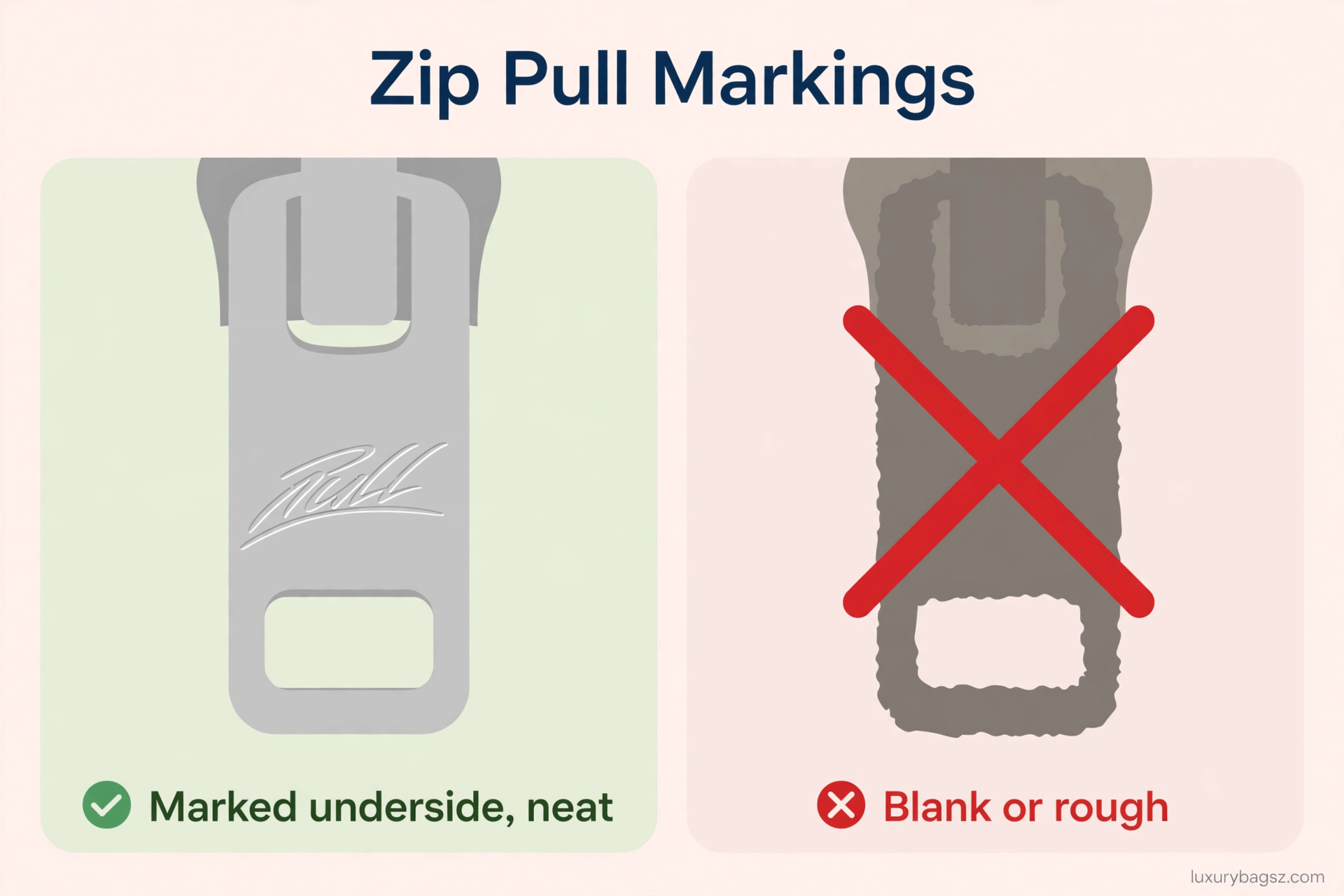
Turn a zip pull over. Motorcycle bags use Lampo zips, and the mark on the back of the pull matters: older bags show the name in underlined italics, embossed. Later pulls carry a different, simpler Lampo mark, so match the mark to the era of the bag rather than expecting one version across all years. A zip with no maker mark, a misspelt name or an engraved mark where an embossed one belongs is a strong warning for that era. Remember the limit of this check: copies can use real Lampo zips. A correct zip proves the zip, not the bag, so keep going through leather, tag and hardware.
Tassels, Mirror and the Small Leather Parts
Every zip should carry its tassel, cut from the same leather as the body. Real tassels feel soft and substantial; coarse, plasticky tassels are a quick tell. The mirror that hangs with many styles should be framed in matching leather and feel properly made. A missing mirror proves nothing, but a cheap one supports doubt. Check the strap. It should be a single piece of leather with clean openings for the hardware at each end, not leather folded over the fittings. Our how to style a Balenciaga City bag guide shows these parts in daily use, which makes worn-but-real examples easier to judge kindly.
Rivets, Knots and Buckles by Era
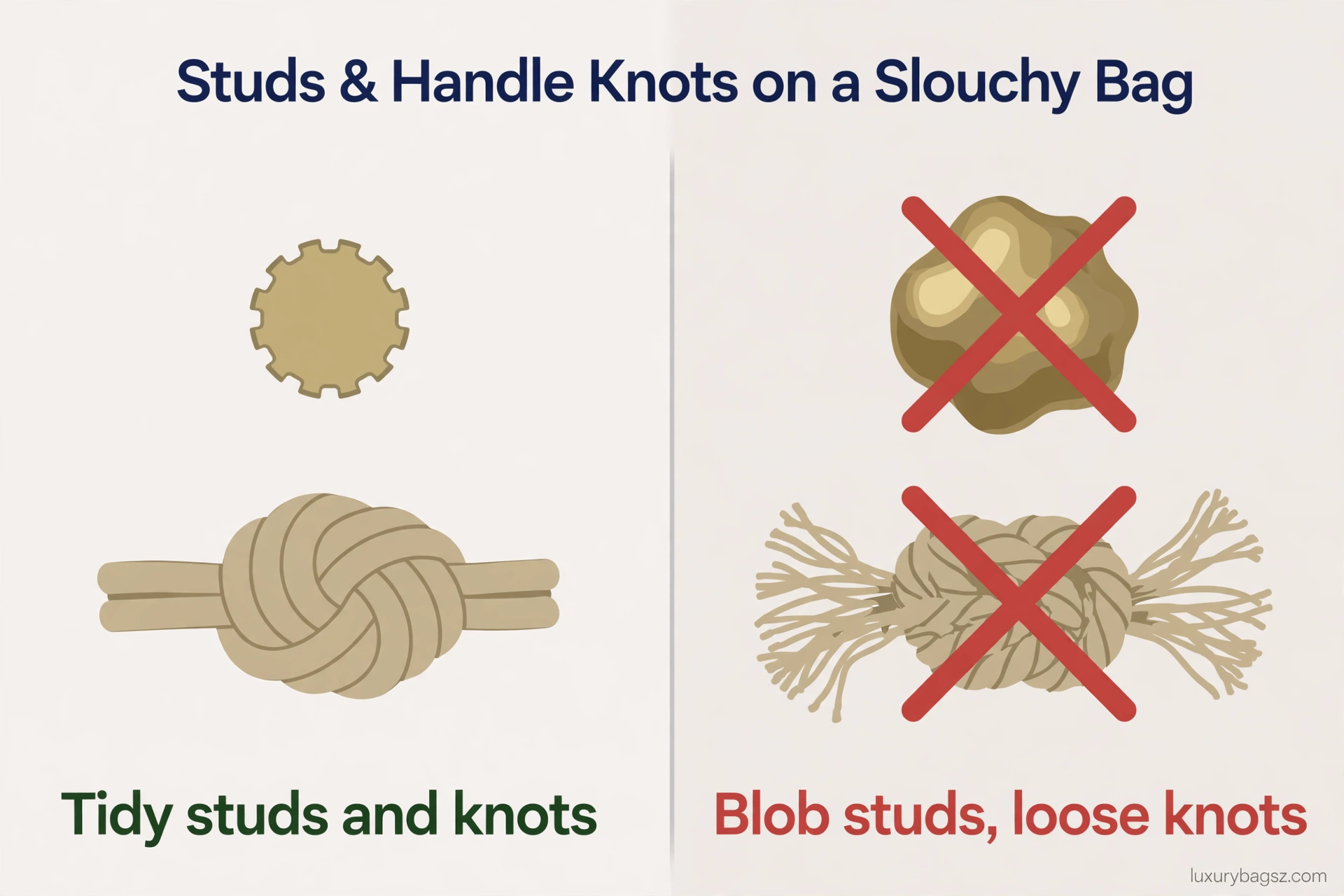
Study the rivets at the base of the handles. The house used only a few rivet types, and later classic hardware carries a small notch shape that collectors check closely. Match rivet to era. Older bags may carry unnotched rivets, so an unnotched rivet alone is not a verdict; it becomes one when the rest of the bag claims to be newer. Handles on older bags should end in a knot detail. An older-style rivet with no knot where one belongs is the kind of mixed detail copies produce. Buckles and rings should look rounded and slightly aged, in brass or dirty-silver tones. Sharp, angular, mirror-bright hardware does not suit these bags at all.
The Interior Tag: Numbers That Must Agree
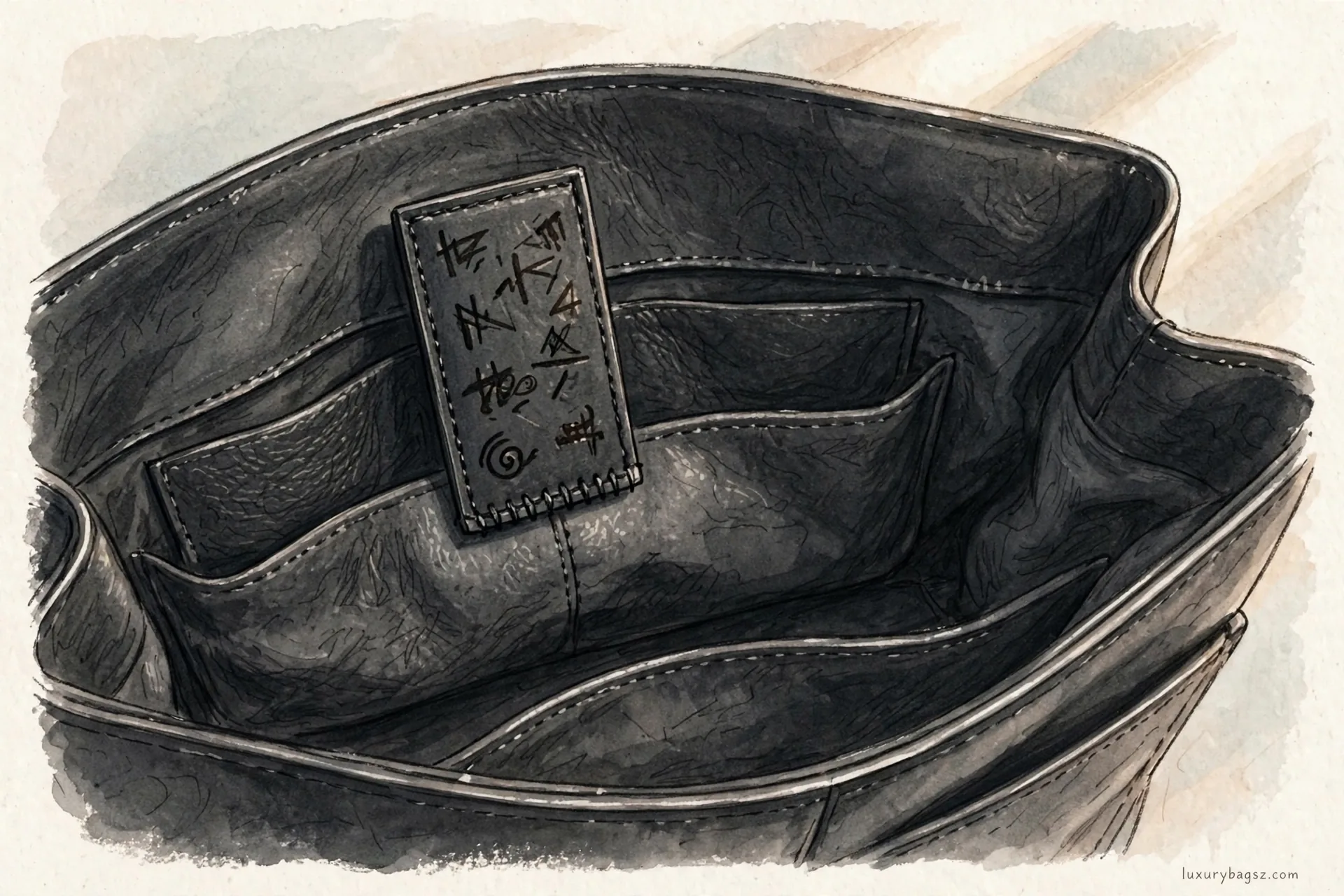
Find the interior tag, on a metal plate or leather tab depending on era and hardware. The stamping should be crisp, centred and evenly spaced. Read the style number, then turn the tag over. The number on the back must repeat the same style, followed by further figures. A front and back that name different styles fail at once. The classic City style number is widely documented as 115748. A bag shaped like a First carrying the City number, or the reverse, is mixing stories it should not mix. Stitching across the top of the tag frame is black on these bags whatever the leather colour. Our Balenciaga Le Cagole bag guide shows how tag habits evolved later.
Cards, Leather Sample and Price Flags
A full genuine set often includes care cards, a controllato card and a small leather sample that should match the bag's leather in feel and colour. A sample that feels different from the bag is interesting evidence. Cards are copied, though, so let them support the leather and tag checks, never replace them. Price needs era sense. Early goatskin pieces and rare colours hold strong money, while common later colours trade lower. A rare colour at a common price is a flag. Sellers who refuse tag photographs are refusing the easiest proof they could give. On these bags the tag front and back are the first pictures to request.
Buying a Motorcycle Bag With Confidence
Ask for the tag front and back, a zip pull back, the rivets and an empty slouch photograph before paying. Those five views answer most listings honestly. Use an authenticator who knows the eras of this line. Motorcycle bags punish generalists, because a true detail in one year is a fake detail in another. Work in order: leather, zips, tassels, rivets, tag numbers, then set and price. A bag should pass for its own claimed year, not for some other year. Our reasons to own a Balenciaga bag guide is the happier read once yours passes: few bags age as gracefully as a real one. Every check in this guide follows the Luxury Bagsz authentication process.
The Season Letter: Dating a Bag From Its Tag
From the autumn and winter collections of 2003 onward, the interior tag carries a single capital letter that encodes the bag’s season and year. Collectors’ references map these letters across the years, which makes the letter a dating tool: it lets you test whether the bag’s other details belong to the period the tag claims.
Bags made before that point carry no season letter at all, and their absence is correct for their age. A letter on a supposedly earlier bag, or a letter that maps to a year when the bag’s hardware did not yet exist, is the tag contradicting the bag.
Use the letter as cross-examination rather than proof. Fakes routinely carry season letters too, sometimes copied faithfully and sometimes not, so the letter only helps when it agrees with the rivets, plate and zip mark around it. When every era witness tells the same year, the story strengthens; the letter alone is one witness among several.
The house has never published an official letter table, so allow honest disagreement between references at the edges of a season. A one-season ambiguity is normal scholarship; a five-year contradiction is not.
Silver Plates, Underscores and the 925 Stamp
Early motorcycle bags carry a metal interior plate, and the earliest are sterling silver. Plates made before around autumn and winter 2008 in genuine silver carry a small 925 purity stamp, and finding it on an early classic-hardware bag is a strong period-correct detail. Later plates are nickel, so expecting silver on a 2012 bag repeats the era error in reverse.
The plate’s lettering changed too. Early plates render the name with an underscore, in the style of Balenciaga_Paris, from roughly 2001 to 2004, before the house moved to a full-stop rendering, Balenciaga.Paris, from about 2005 onward. Typeface also shifted in that period, from a serif style toward a cleaner sans serif.
None of these details is exotic knowledge; they are simply dated, and dated details are what copies scramble. A bag claiming 2003 with a full-stop plate and nickel finish has mixed its decades, however pretty its leather looks.
Not every style carries a metal plate at all: many motorcycle bags use a leather tab instead, embossed to match the hardware colour. A leather tab is not a demotion or a warning; it is the specification for that style and era.
Bales: The Shoulder Strap Connectors Nobody Photographs
The bales are the metal loops that join the shoulder strap to the rings on the bag’s body, and experienced authenticators check them early because copies get them wrong in a way that is easy to see once you know the shape.
On a genuine bag the bale is rounded and crimped, forming a smooth double-layered curve, like a thick wire bent and pinched closed. On copies the bale is often square or angular, a flat-sided rectangle of metal that reads machine-cheap beside the genuine curve. Run the strap through your fingers and feel for the rounded profile as well as looking for it.
Bales also carry the bag’s working life honestly: genuine bales show soft wear where the strap moves, while bright, unworn bales on an otherwise aged bag suggest replaced parts or a story being assembled. Ask for a clear photograph of both bales in any listing; honest sellers supply them, and the request costs nothing.
Because bales are small and unglamorous, listings crop them out and buyers forget them, which is exactly why they survive as a reliable witness when the glamour checks have all been rehearsed.
Giant Hardware Eras and the B Zip Mark
The oversized stud era has its own dating. Giant 21 hardware, the largest stud format, was phased out around 2012 and replaced by the smaller Giant 12. A bag claiming a late year while wearing the earlier giant format is mixing eras again, and stud size should always be judged against the tag’s claimed season.
Studs on genuine bags are solid and firmly set, whatever their size, with the house finish softened rather than mirror-bright. Hollow-feeling, lightweight studs that rock in their settings betray the hardware budget of a copy in a single touch.
The zip mark changed in the same later period: from around 2014, many bags carry a large B on the zip pull in place of the Lampo mark this guide described for earlier years. Expecting Lampo on a recent bag is as mistaken as expecting the B on a 2005 bag.
Hold those three timelines together, studs, zips and plates, and the motorcycle family becomes legible: each bag is a small archive of its year, and authentication is mostly the art of checking that the archive agrees with itself.
Whip-Stitched Handles: The Braiding in Depth
The handles deserve a full minute because they are handmade in a way machines imitate badly. The leather wrapping on genuine handles is whip-stitched by hand: a continuous braided lacing that runs the length of the handle with even tension, even spacing and a confident rhythm you can feel as much as see.
The wrapping leather shares the house character, soft with a slightly sueded, raw quality underneath and at its edges, never coated or polished to a shine. Copies frequently wrap handles in smoother, stiffer material that looks sprayed on, and their braiding drifts: spacing opens and closes, tension varies, and the crossings sit unevenly like a plait done in a hurry.
Wear tells the truth kindly here. Genuine whip-stitching darkens and softens where hands grip, and may eventually loosen or fray at the heaviest-use points on a well-loved bag; that is honest age, repairable by a specialist, and entirely different from new-bag sloppiness.
Compare the two handles against each other as the final handle test. Handmade twins match closely without being mechanically identical, in braiding, colour and softness. A bag whose handles differ noticeably in build, one tight and neat, one loose and shiny, has parts from two different stories.
Frequently Asked Questions
What is the best first check on a motorcycle bag?
The leather slouch and the tag numbers together. Real leather collapses softly when empty, and the style number on the tag front must repeat on the back.
Which zips should a genuine bag have?
Lampo zips, with the mark style that suits the bag's era: underlined italics, embossed, on older pulls, and a simpler mark on later ones.
Does a correct Lampo zip prove the bag is real?
No. Copies can be fitted with genuine zips. The zip is one check; leather, rivets, tag numbers and hardware must all agree for the same era.
What does the City style number look like?
The classic City is widely documented with style number 115748 on its tag. A differently shaped bag carrying that number, front or back, is mixing styles wrongly.
Are unnotched rivets a fake sign?
Not alone. Older bags used unnotched rivets. They become a warning when the bag claims to be from a later era that used notched rivets, or knots are missing.
How should the braided handles feel?
Raw and sueded, like a shoelace texture, never polished or coated. Shiny, protected-looking handle leather is a recognised giveaway on these bags.
What should the tassels feel like?
Soft, substantial and made from the same leather as the body. Coarse, stiff or plasticky tassels suggest the zips and leather came from cheaper stock.
Why does the leather sample card matter?
A full set often includes a small leather sample that should match the bag exactly. A sample that feels different supports doubt, though cards alone prove nothing.
Can a stiff motorcycle bag still be real?
New bags feel firmer than broken-in ones, but the leather should still fold softly rather than stand like board. Stiff, shiny and plasticky together is a fail.
Who can check a motorcycle bag for me?
An authenticator who specialises in this line and its eras. Send tag front and back, zip pull backs, rivets, handles and an empty slouch photograph.
Summary: Judge It by Its Own Year
Every motorcycle check is really one question: do leather, zips, rivets and tag numbers all belong to the same bag from the same year? Copies mix eras carelessly. Let it slump, read both sides of the tag, and match each detail to its era. When the whole bag tells one consistent story, you are looking at the real thing.






