

Gucci Flora Print History: From a 1966 Scarf to a House Code
The Flora Print in Brief
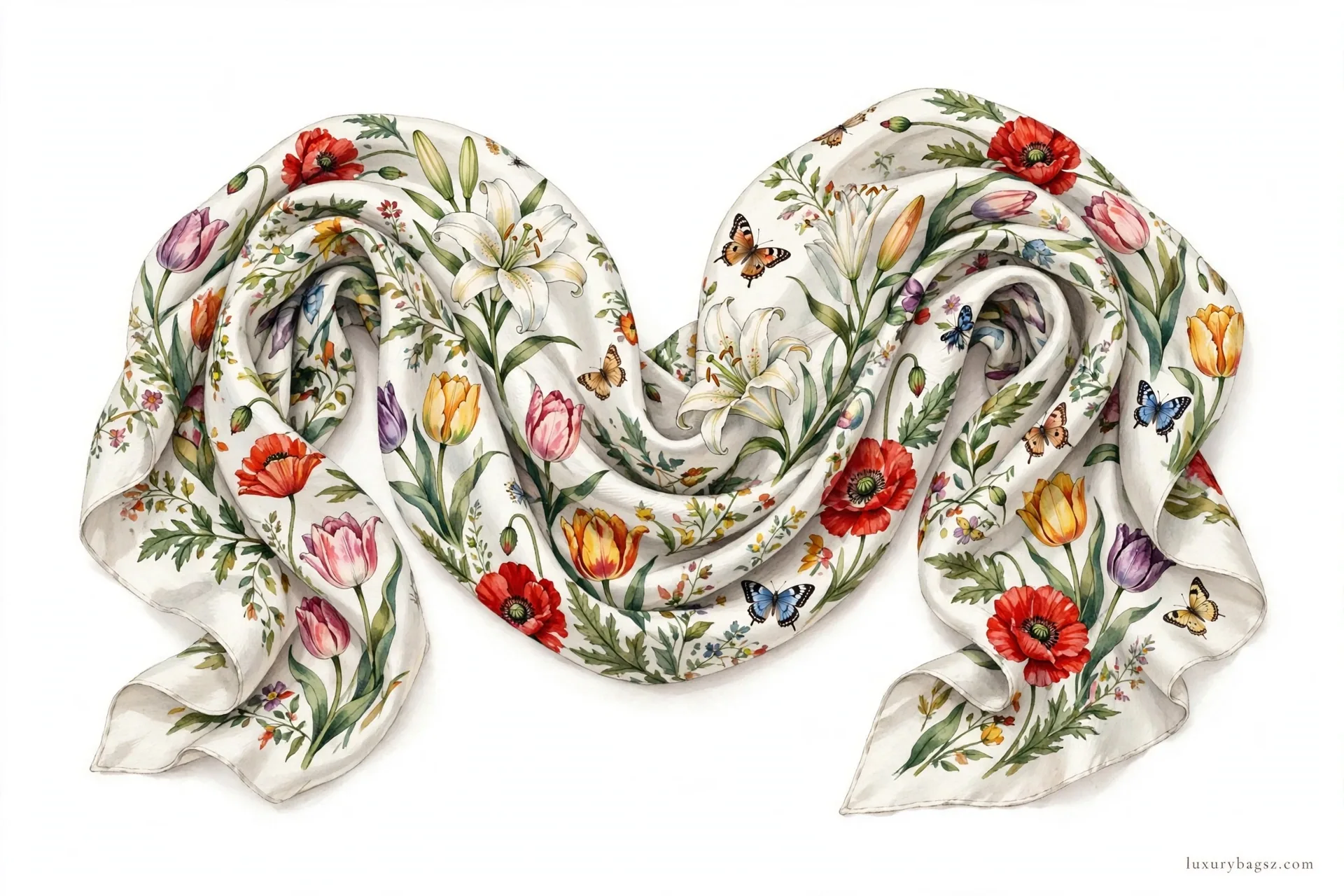
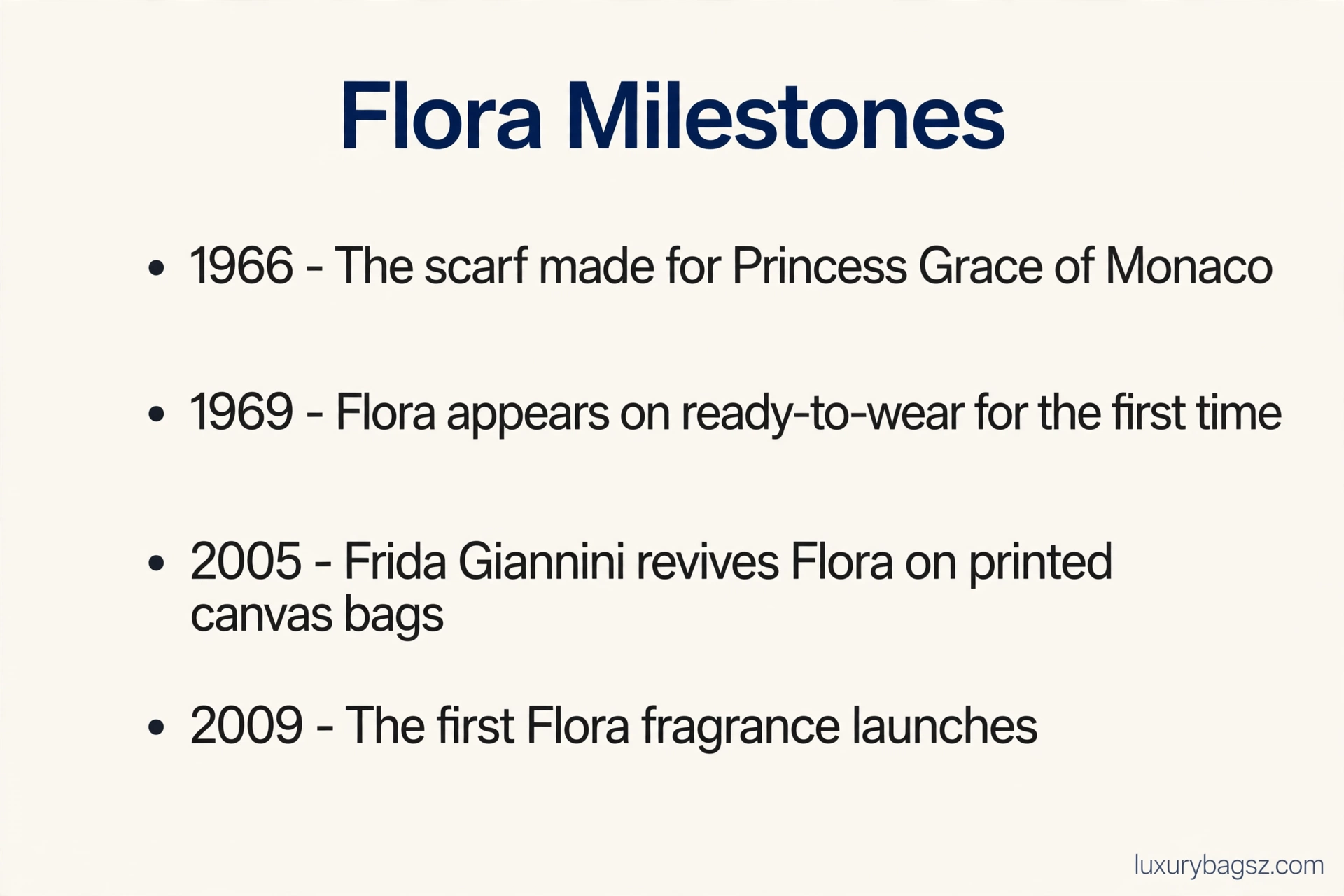
The Gucci Flora print began in 1966 as a silk scarf made for Princess Grace of Monaco, painted by illustrator Vittorio Accornero de Testa. It showed a garden of flowers, fruit and insects in more than 30 colours, arranged like a painting rather than a repeating pattern. It became one of Gucci's most recognisable codes, even though it was never meant to be a permanent logo.
Flora matters today because it keeps returning: on printed canvas bags in 2005, on fragrance from 2009, and on scarves, bags and jewellery in later revivals. If you own or want a Flora bag, the print's story is part of what you are buying, and its condition is part of what you are paying for.
This guide traces Flora from the Milan boutique in 1966 to the pre-owned market today, and explains how to recognise it, wear it and buy it well.
Key Takeaways

- Flora was created in 1966 by Vittorio Accornero for Princess Grace of Monaco.
- The design shows Florentine flowers, fruit and insects in over 30 colours on silk.
- It was inspired by Botticelli's Primavera and the goddess Flora.
- Frida Giannini revived Flora on printed canvas bags in 2005.
- The first Flora fragrance launched in 2009, carrying the print to a new audience.
- On bags, check fading, print alignment and canvas wear before buying pre-owned.
A Scarf for a Princess in Milan, 1966
The story starts in Gucci's Milan boutique in 1966, when Princess Grace of Monaco visited with her husband, Prince Rainier. She had bought a bamboo bag, and Rodolfo Gucci, son of founder Guccio Gucci, wanted to offer her a gift to go with it. She asked for a scarf, but Rodolfo felt the house had nothing beautiful enough for a royal style icon.
He turned to Vittorio Accornero de Testa, an illustrator, painter and set designer who had worked with the house since 1960. Accornero was asked, in effect, for an explosion of flowers. He completed the first design in March 1966, reportedly within a week, and specialist printers in Milan produced it in silk.
The result was Flora: a wearable garden of lilies, poppies, tulips, anemones, irises and more, scattered with butterflies, bees and other insects. The Grace Kelly style guide places the scarf in the wider story of her elegant, understated wardrobe, where one beautiful accessory often carried the whole outfit.
Making that scarf was a feat of craft in itself. Milan's specialist printers used a technique that stopped colours bleeding into each other, with each shade applied separately through layers of fine paper. That care is why the original scarves still look luminous today, with colours that sit cleanly side by side rather than muddying each other.
What the Print Actually Shows
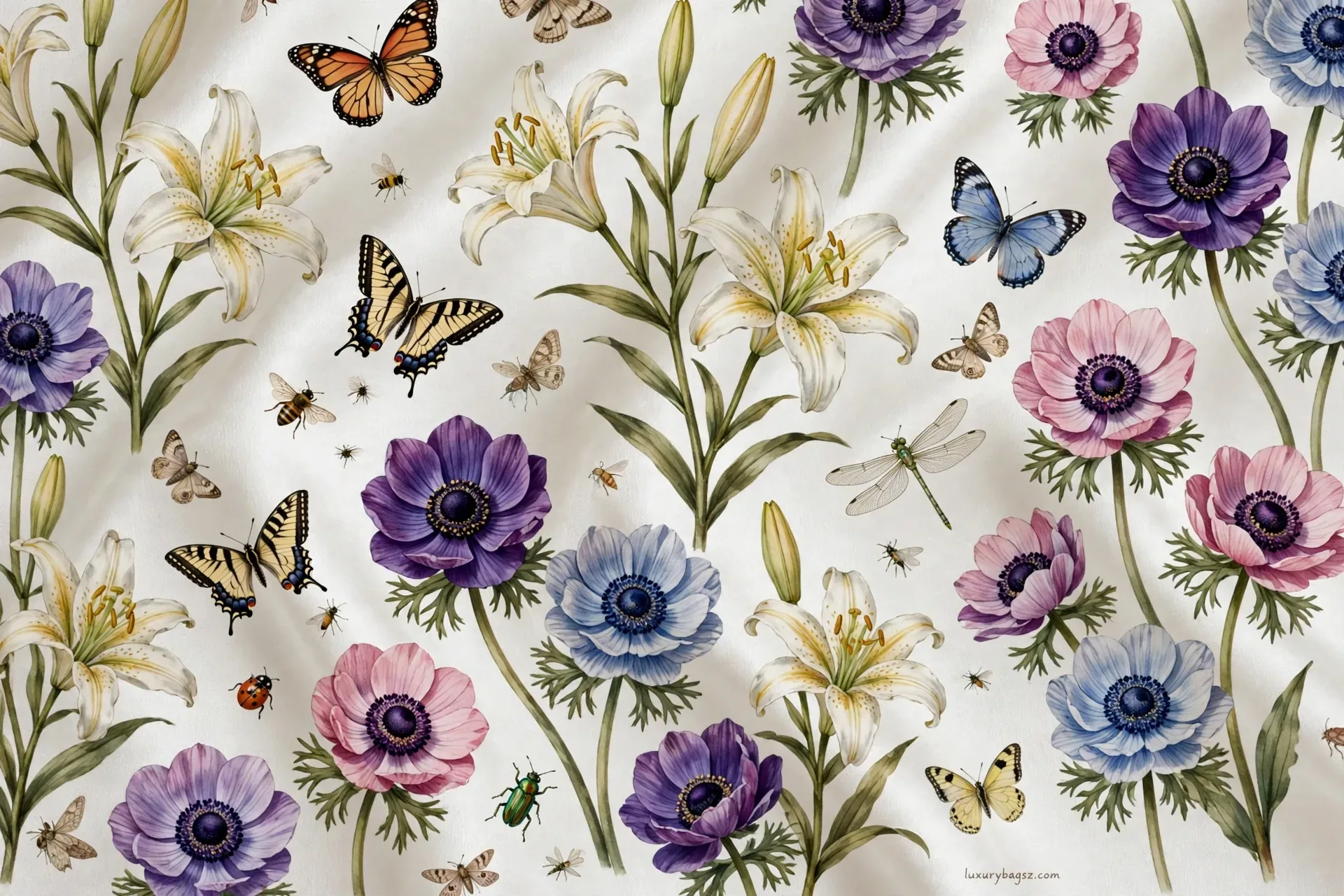
Flora is not a tidy repeating wallpaper pattern. It is a natural, painterly composition, with bouquets arranged across the silk and insects tucked among the blooms. Sources differ on exact counts: Kering, Gucci's parent group, describes 27 Florentine flowers, while other accounts count 37 colours or dozens of flower, plant and insect types. That disagreement is worth noting, since Flora has been retold many times.
The inspiration is Florentine. Accornero looked to Botticelli's Primavera, painted in Florence and now in the Uffizi Gallery, and to the dress of the nymph Flora in that painting. Every flower in the original is a species that grows around Florence, which anchors the print in the house's home city rather than in generic florals.
Look closely and you will also see Accornero's signature touches: a small cursive Gucci note on a scrap of paper among the vines, and his own small mark. Those details remind you that Flora began as one artist's painting, not as a computer-generated repeat. For the wider house story behind that painting, the guide to Gucci sets Flora alongside the horsebit, the web stripe and the bamboo handle.
Accornero went on to create around 80 scarves for the house between 1960 and 1981, and Flora remained his most famous. The house archive in Florence now holds over 300 Flora scarves, a measure of how often the print was revisited, recoloured and reissued across the decades.
From Scarves to Bags, Dresses and Jewellery
Three years after the scarf, Flora appeared on ready-to-wear for the first time, in a silk mini dress. From there it spread across the house: dresses, shoes, handbags and jewellery all carried the garden at different moments. It was never the house's only code, and in the quieter, more minimal 1980s and 1990s it stepped back while equestrian motifs and logos took the lead.
That ebb and flow is part of Flora's charm. It is a romantic, colourful counterpoint to Gucci's horsebit and web stripe, and it returns whenever the house leans feminine and decorative. The Gucci Horsebit 1953 guide covers the other side of that story: the equestrian hardware that dominated when Flora rested.
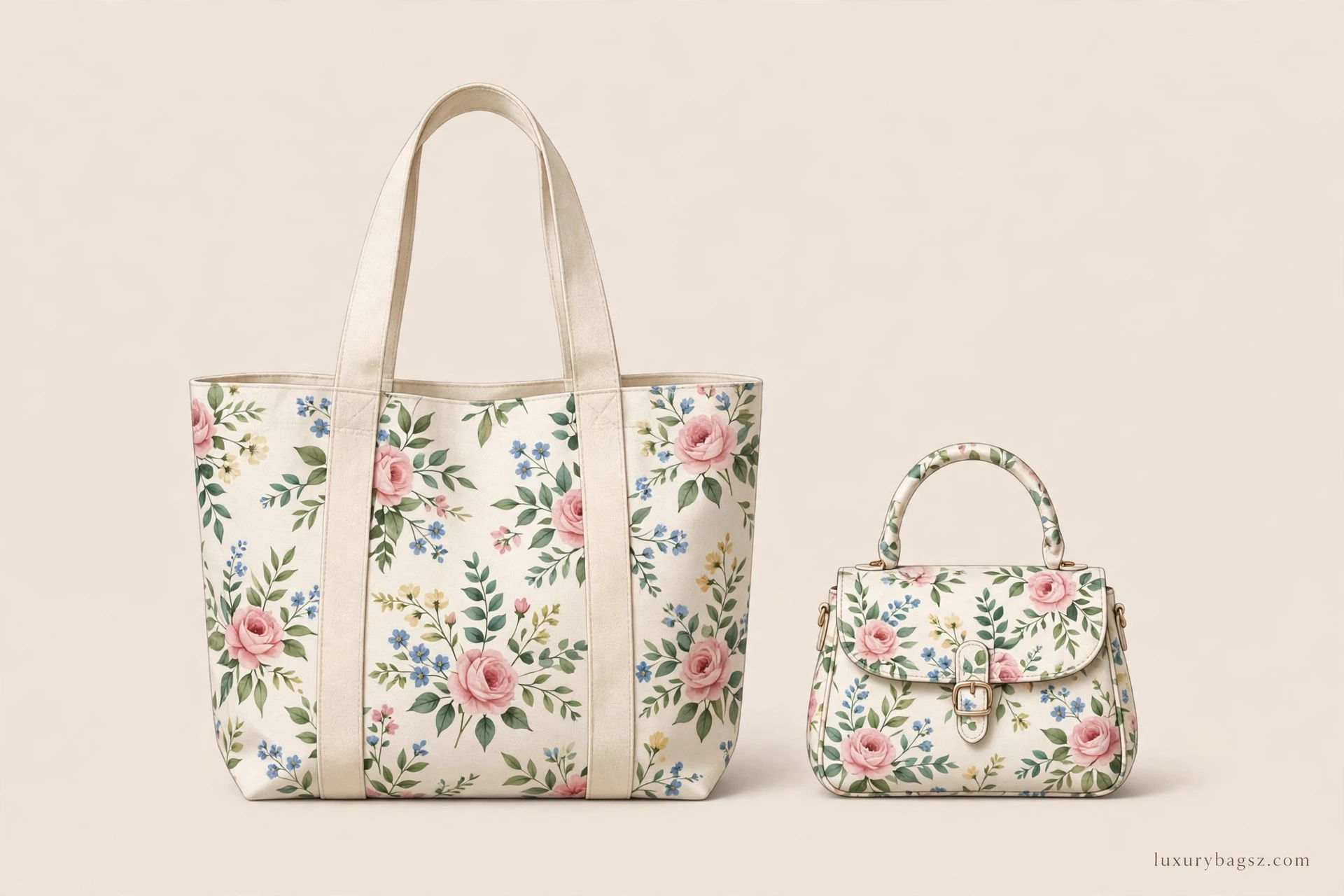
On bags, Flora works best on light canvas grounds, where the colours stay bright and the painterly detail shows. Dark grounds mute it, and heavy hardware competes with it, so the most successful Flora bags keep the rest of the design simple.
A neat example of Flora's bag life came in 2012, when Singapore received exclusive Flora versions of the Jackie, the Boston and the Diana, with a yellow leather trim and the classic print on natural canvas. Limited regional editions like that are now sought after pre-owned, precisely because they were never widely sold.
The 2005 Revival That Made Flora a Bag Print
Flora's great revival came in 2005 under Frida Giannini, then creative director of accessories. She rediscovered the archive print and put it on printed canvas bags, and a new generation fell for it. In 2006 it appeared re-scaled, re-coloured and abstracted on dresses, jewellery and evening bags as well.
The revival mattered because it moved Flora from scarf drawers to shoulders. A printed canvas bag is worn daily, photographed constantly and remembered by a wider audience than a silk scarf kept for occasions. For many buyers today, the 2005 canvas bags are the Flora they know best.
Later creative directors kept the dialogue going. Alessandro Michele reinterpreted Flora with new colours, including bright neon tones on bags, scarves and ready-to-wear in 2019. In 2025 and 2026 the house's Art of Silk project returned to the archive again, with Flora scarves among the most celebrated pieces.
How to Recognise Real Flora
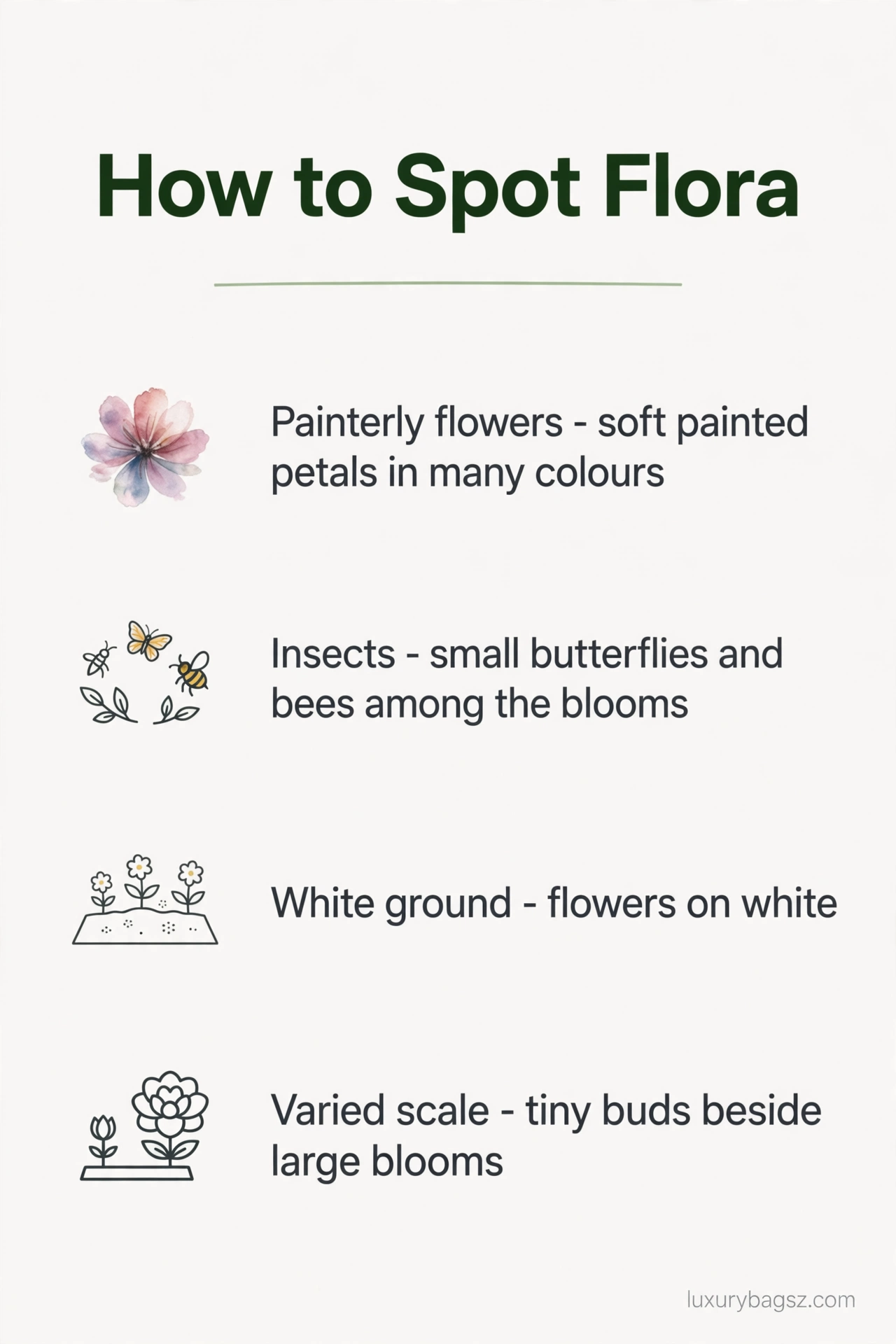
Start with the painting quality. Real Flora looks hand-painted, with soft petals, varied flower sizes and insects that feel part of the garden rather than stamped on top. Flat, mechanical repeats with identical flowers at identical intervals should make you pause, since the original is a natural composition, not a grid.
Next, check the ground and colour. Classic Flora sits on a white or pale ground, with many colours layered rather than a few flat tones. Later versions re-colour the print, so a coloured ground is not automatically wrong, but it should still show the same painterly flowers and insects.
Finally, compare the flowers themselves. Lilies, poppies, tulips, anemones and irises recur, alongside butterflies and bees. A print that calls itself Flora but shows only roses in a tight repeat, with no insects and no variety of scale, is not telling the Flora story, whatever its label says.
Photographs help here more than descriptions. Ask the seller for a full-pattern photograph in daylight, not a cropped detail, so you can see the composition as a whole. A genuine Flora print reads as a garden at a glance, while a weak copy reads as scattered flowers with no relationship to each other.
Flora, Fragrance and the Wider House
Flora's second life as a fragrance began in 2009, when the first Gucci Flora eau de toilette launched. Its packaging carried a part of Accornero's pattern, and later Flora Gorgeous lines reimagined the print for a new generation in pastel and lacquered bottles. Fragrance is not the focus of this guide, but it explains why so many people know the Flora name without owning a Flora bag.
That fame helps and hurts pre-owned buyers. It keeps demand steady, since the name is widely recognised, but it also means many unrelated floral Gucci pieces get described as Flora by hopeful sellers. Judge the print, not the listing title, and ask for clear photographs of the full pattern before paying.
The Gucci resale value guide is a useful companion here. It explains why bold prints usually resell more softly than neutral heritage leather, which is a fair warning for Flora bags too: buy the print because you love it, not because you expect it to appreciate.
Flora's archive status was underlined in 2025, when the house published a book devoted entirely to its silk scarves, drawing on an archive of around 100,000 pieces. Flora designs feature prominently in that history, which helps explain why the print still commands attention sixty years after a single scarf was painted for a princess.
Buying Flora Bags Pre-Owned
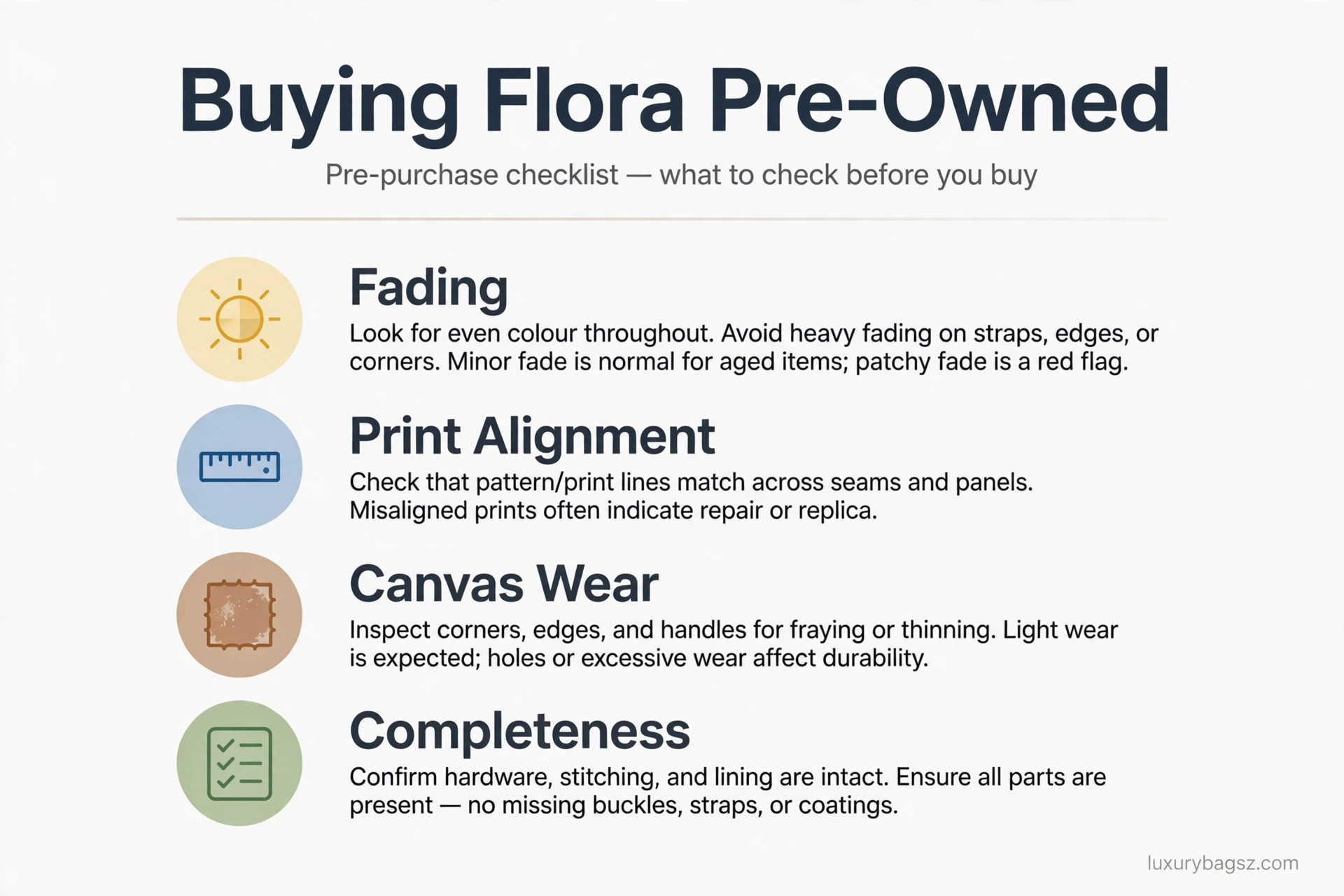
Fading is the first check on any Flora bag. Sunlight dulls printed canvas unevenly, so inspect straps, edges and corners for patchy colour loss, and compare the front, back and sides in the same light. Even, gentle fading with age is normal; patchy fading is a price negotiation at best.
Print alignment is the second check. On a genuine bag, the pattern should flow sensibly across seams and panels, even where it is cut. Wild misalignment, blurred printing or a pattern that stops dead at a seam can indicate repair or a copy, so ask for seam close-ups.
Canvas wear, lining condition and completeness come next. Check corners and handles for fraying, test zips and clasps, and confirm what is included. The fake Gucci checks guide covers the wider authenticity checks, from stitching to hardware, that apply to Flora bags as much as to any Gucci piece.
Price a Flora bag against other Flora bags, not against plain Gucci canvas. The print adds demand among collectors but also adds condition risk, so a faded Flora bag should cost clearly less than a vivid one of the same size. If a seller prices fading as if it did not matter, walk away and wait for a better example.
Frequently Asked Questions
When was the Gucci Flora print created?
In 1966, when illustrator Vittorio Accornero de Testa designed a silk scarf for Princess Grace of Monaco at Rodolfo Gucci's request.
Who designed the Flora print?
Vittorio Accornero de Testa, an Italian illustrator, painter and set designer who worked with Gucci from 1960 to 1981 and created many of its silk scarves.
What inspired the Flora print?
Botticelli's Primavera and the dress of the nymph Flora in that painting. Accornero chose flowers that grow around Florence, Gucci's home city.
How many flowers and colours are in Flora?
Sources differ: Kering describes 27 Florentine flowers, while other accounts cite 37 colours or dozens of flower, plant and insect types. The counts vary because Flora has been retold and re-coloured many times.
When was Flora revived on bags?
In 2005, when Frida Giannini put the archive print on printed canvas bags. It appeared re-scaled and re-coloured on dresses, jewellery and evening bags in 2006.
Is Flora the same as Gucci Bloom?
No. Flora is the 1966 archive print, while Bloom is a later floral print family associated with Alessandro Michele's era. Sellers sometimes confuse them, so judge the pattern itself.
What does Flora look like on a bag?
A painterly garden of varied flowers, fruit and insects, usually on a light canvas ground, with soft colours and varied flower sizes rather than a tight repeating pattern.
Are Flora bags a good investment?
Not as a financial investment. Bold prints usually resell more softly than neutral heritage leather, so buy a Flora bag because you love the print and will wear it.
How do I care for a Flora canvas bag?
Keep it out of prolonged sunlight to prevent fading, wipe gently with a dry soft cloth, and store it stuffed in its dust bag. Avoid harsh cleaners on printed canvas.
How can I tell a fake Flora bag?
Look for painterly, varied flowers with insects on a sensible ground, even printing, and sensible print flow across seams. Check stitching, hardware and the interior tab against trusted guides.
Final Verdict: A Garden That Earned Its Place in the House
Flora endures because it began as art, not as marketing: one painter's garden, made in a week for a princess, that turned out to be timeless. It has survived quiet decades, a blockbuster revival and countless re-colourings, and it still looks fresh on a scarf or a canvas bag today. If you buy Flora, buy the print itself — vivid, painterly and well-kept — and wear it as its first owner did: as a joyful, wearable garden.






