Who Was Jane Birkin? The Story Behind the Birkin Bag
The Woman Behind the Bag, in Brief
Jane Birkin was an Anglo-French actress and singer, born Jane Mallory Birkin in London on 14 December 1946. She died in Paris on 16 July 2023, aged 76, after a career spent mostly in French cinema and music.
She is the woman behind the Birkin bag in the most literal sense. In the early 1980s she told the head of Hermès that she could not find a leather bag big enough, practical enough, and easy enough to use as a young mother.
That complaint, made on a plane, became a sketch, then a prototype, then one of the most famous handbags in the world. This article keeps the focus on that story and on the bag itself, not on a full celebrity biography.
Key Takeaways
- Jane Birkin was a British-born actress and singer who made France her home and career base from the late 1960s onward.
- The Birkin bag came from a chance meeting on an Air France flight from Paris to London, when her wicker basket spilled and she sat beside Hermès chief Jean-Louis Dumas.
- Her brief was simple: bigger than a Kelly, smaller than Serge Gainsbourg's suitcase, roomy, with pockets and a secure close.
- The first Birkin reached her about a year after the flight, and she used it hard, covered it in stickers, and later sold bags for charity.
- Sources disagree on the flight year, 1983 or 1984, and on whether the original was a 35 or a blend of 35 and 40. Both disagreements are stated plainly below.
Part 1: Jane Birkin Before the Bag
Jane Birkin was born in Marylebone, London, on 14 December 1946, to actress Judy Campbell and Royal Navy officer David Birkin. She began acting in London in the 1960s, with a small role in Michelangelo Antonioni's Blowup in 1966.
Her life changed direction in 1968, when she went to France to co-star with Serge Gainsbourg in the film Slogan. The two began a personal and musical partnership that made her a star of French popular culture.
Their best-known record together, "Je t'aime… moi non plus", was controversial on release and banned by some radio stations. Birkin later built a long career of her own as a singer and film actress, appearing in dozens of films.
She had three daughters: photographer Kate Barry with her first husband, composer John Barry; actress and singer Charlotte Gainsbourg with Serge Gainsbourg; and musician Lou Doillon with director Jacques Doillon.
Part 2: The Basket She Carried Everywhere
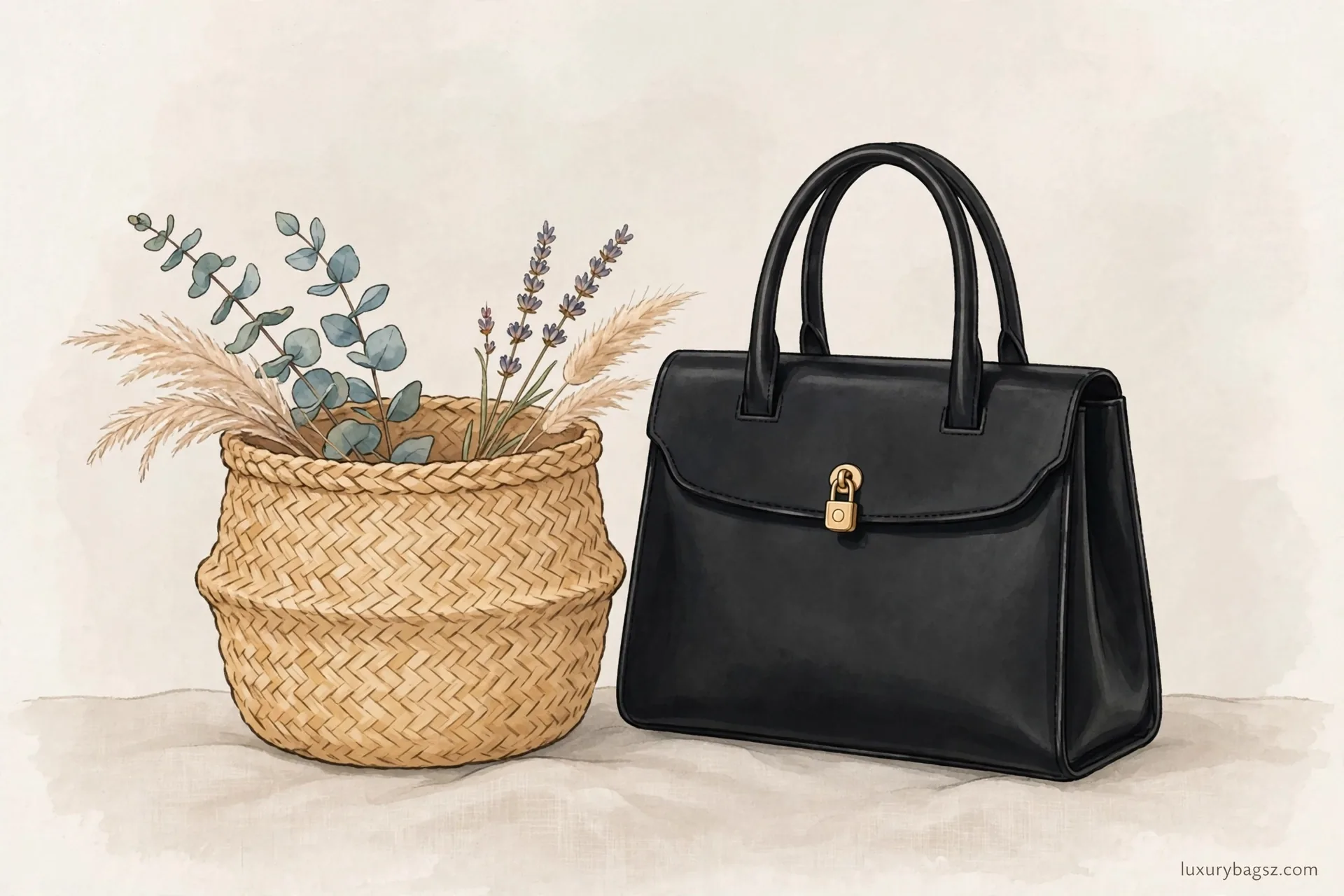
Long before any luxury bag carried her name, Jane Birkin's everyday bag was a wicker basket. Photographs from the period show her carrying it as a handbag, not as a picnic prop, and it became part of her public image.
The basket suited her style, but it failed as a working bag. It had no secure close, no useful pockets, and no way to keep small things from falling out when it tipped.
That flaw matters to the Birkin story, because the bag that replaced it was designed to solve exactly those problems. It was meant to be roomy like the basket, but closed, organised, and strong.
Birkin was a working mother travelling with scripts, baby things, and daily essentials. She wanted a bag that could hold all of that without looking formal or fussy.
Part 3: The Flight, the Spill, and the Sick-Bag Sketch
The famous meeting happened on an Air France flight from Paris to London, when Birkin was upgraded to first class and found herself seated beside Jean-Louis Dumas, then head of Hermès.
As she tried to stow her wicker basket overhead, its contents spilled onto the seat and aisle. Dumas helped her gather her things, and she told him she could not find a leather bag that was both practical and stylish.
Here the sources split, and the split is worth knowing. Some accounts, including Farfetch and Setdart, date the flight to 1984. Others, including 29Secrets, date it to 1983, with the bag following a year later.
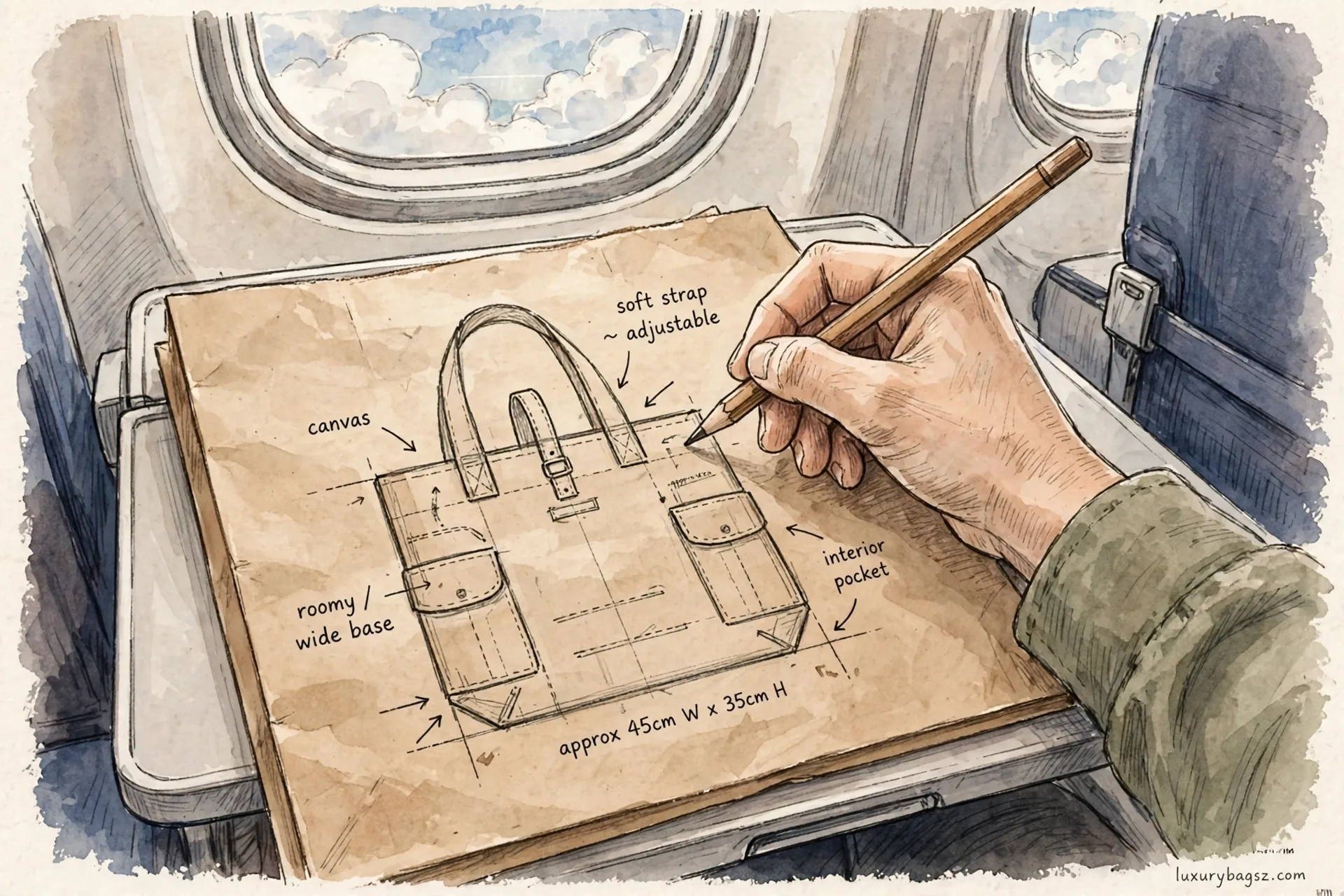
What all versions agree on is the sketch. During the flight, Birkin described her ideal bag and drew it on an airsickness bag, with Dumas suggesting pockets. Her size rule was memorable: bigger than a Kelly, smaller than Serge Gainsbourg's suitcase.

Part 4: The Design Was Not Invented From Nothing
Jane Birkin did not design the Birkin alone, and the shape did not appear from nowhere. Hermès already made the Haut à Courroies, a tall equestrian carry bag first created in 1892 for riders' boots and saddles.
Dumas and the Hermès workshop adapted that older shape to Birkin's brief. The new bag was made shorter and easier to reach into, with a longer handle drop so it could sit in the crook of the arm.
That is why old forum debates about a "1950s Birkin" miss the point. Similar-looking Hermès carry bags existed long before, but the Birkin as a named, reworked design dates to this commission.
Birkin supplied the problem and the size idea. Hermès supplied the saddlery craft, the construction, and the finished prototype. Both halves of that story are needed to explain the bag.
Part 5: The Original Bag She Received
About a year after the flight, Dumas presented Birkin with the first bag. Accounts agree it was made of supple black leather, deep and rectangular, with a flap that sealed so nothing could spill out.
Sotheby's, which sold that very bag in Paris in July 2025, describes it in more detail. It blends elements of the later Birkin 35 and Birkin 40, with gilded brass hardware, closed metal rings, and a fixed shoulder strap.
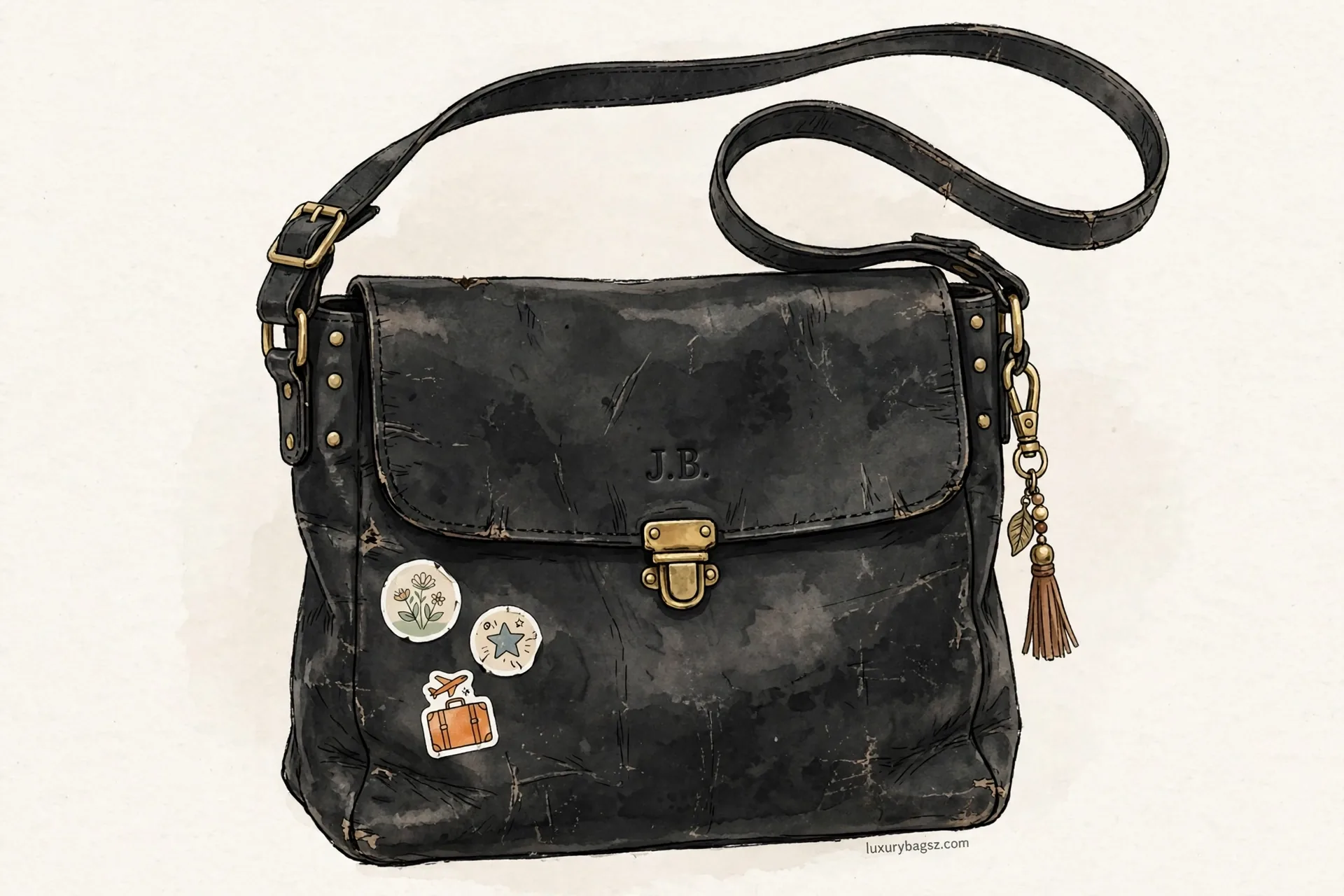
It also carries her initials, "J.B.", embossed beneath the front flap. Inside, Sotheby's notes the nail clipper she famously kept attached, and marks left by stickers supporting Médecins du Monde and UNICEF.
That mix of grand and ordinary is the whole story of the original. It was a luxury prototype, and it was also a daily work bag, filled to the brim and decorated without ceremony.
Part 6: How She Actually Used It
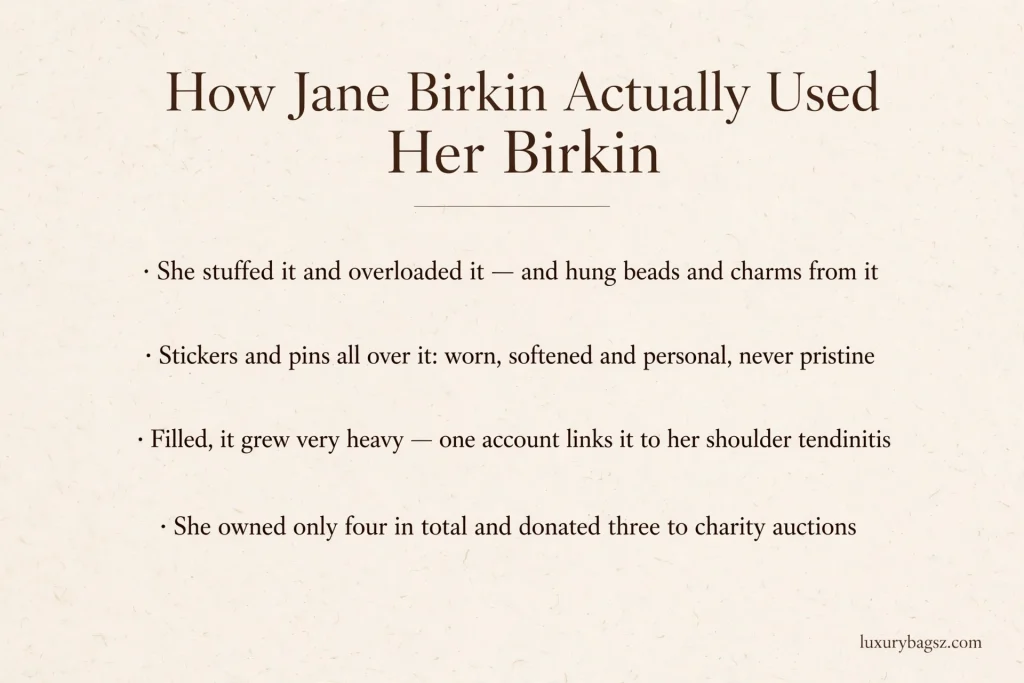
Jane Birkin did not treat her Birkin the way collectors do today. She stuffed it, overloaded it, hung beads and charms from it, and stuck stickers and pins all over it.
She later said the bag became very heavy when filled, and one account reports it caused her shoulder tendinitis. She was photographed carrying Birkins that looked worn, softened, and personal rather than pristine.
She also gave bags away for good causes. She reportedly owned only four Birkins in total, and donated three of them to charity auctions, with the last such auction reported in 2011.
The original bag itself left her hands in 1994, when she donated it to an auction supporting an AIDS charity. It later passed through private hands before its record sale in 2025, covered in the companion article on record prices.
Part 7: What Changed as the Birkin Evolved
The production Birkin kept the core of the prototype and dropped its most personal quirks. The fixed shoulder strap of the original, for example, did not become a standard production feature.
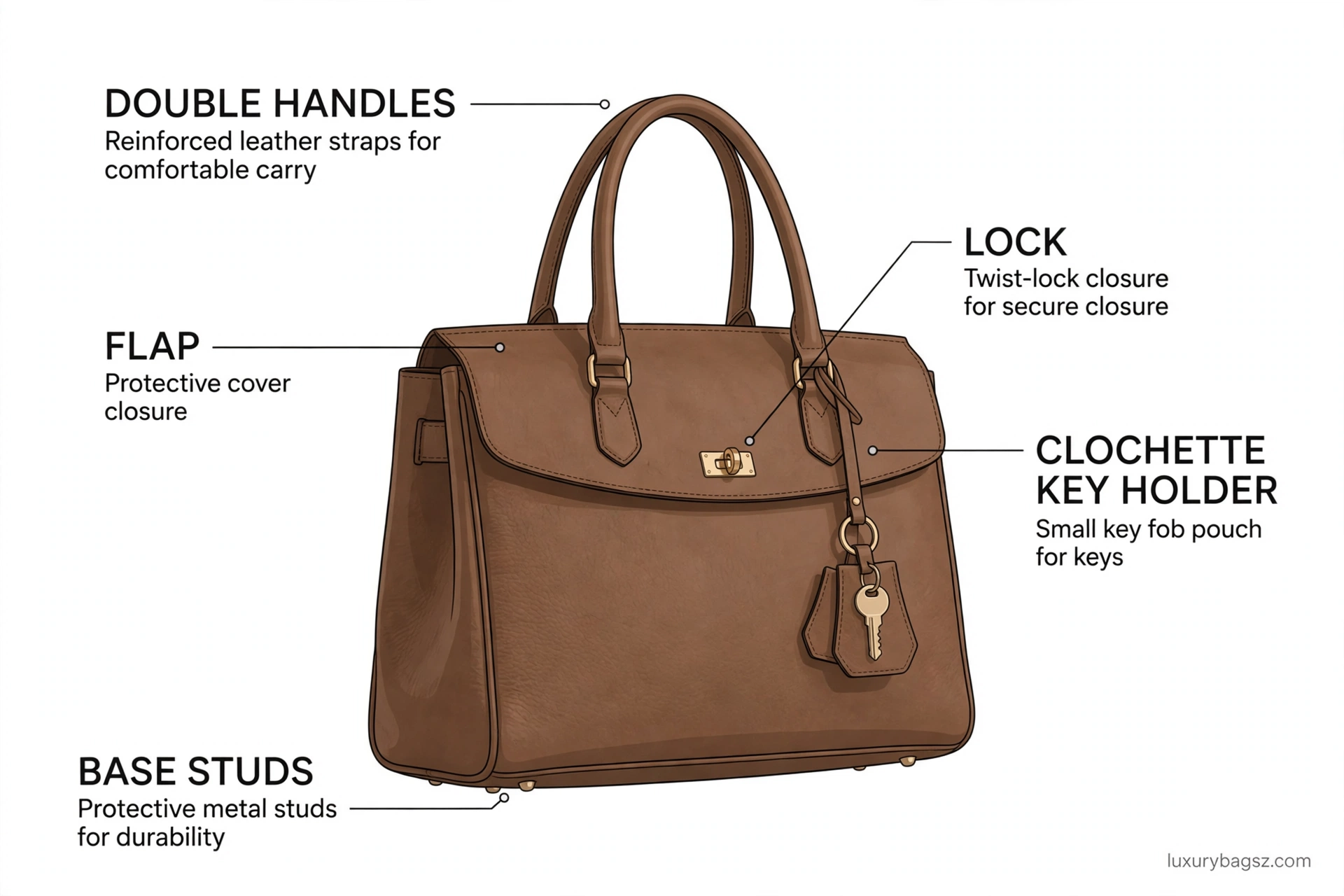
What stayed was the rectangular tote shape, two rolled top handles, a fold-over flap, a lock with a clochette key holder, side straps, and four protective studs on the base. The saddle stitching from Hermès' leather tradition stayed too.
Sizes settled into the familiar range of 25, 30, 35, and 40 centimetres, with larger 50 and 55 travel versions. Early production leaned on supple calf leathers in muted tones such as black, brown, and navy.
Later decades added the full Hermès palette, exotic skins, and limited editions. But the brief never changed: a roomy bag that closes securely, carries in the hand or on the wrist, and survives daily use.
Part 8: The Slow Start, Then the It-Bag Years
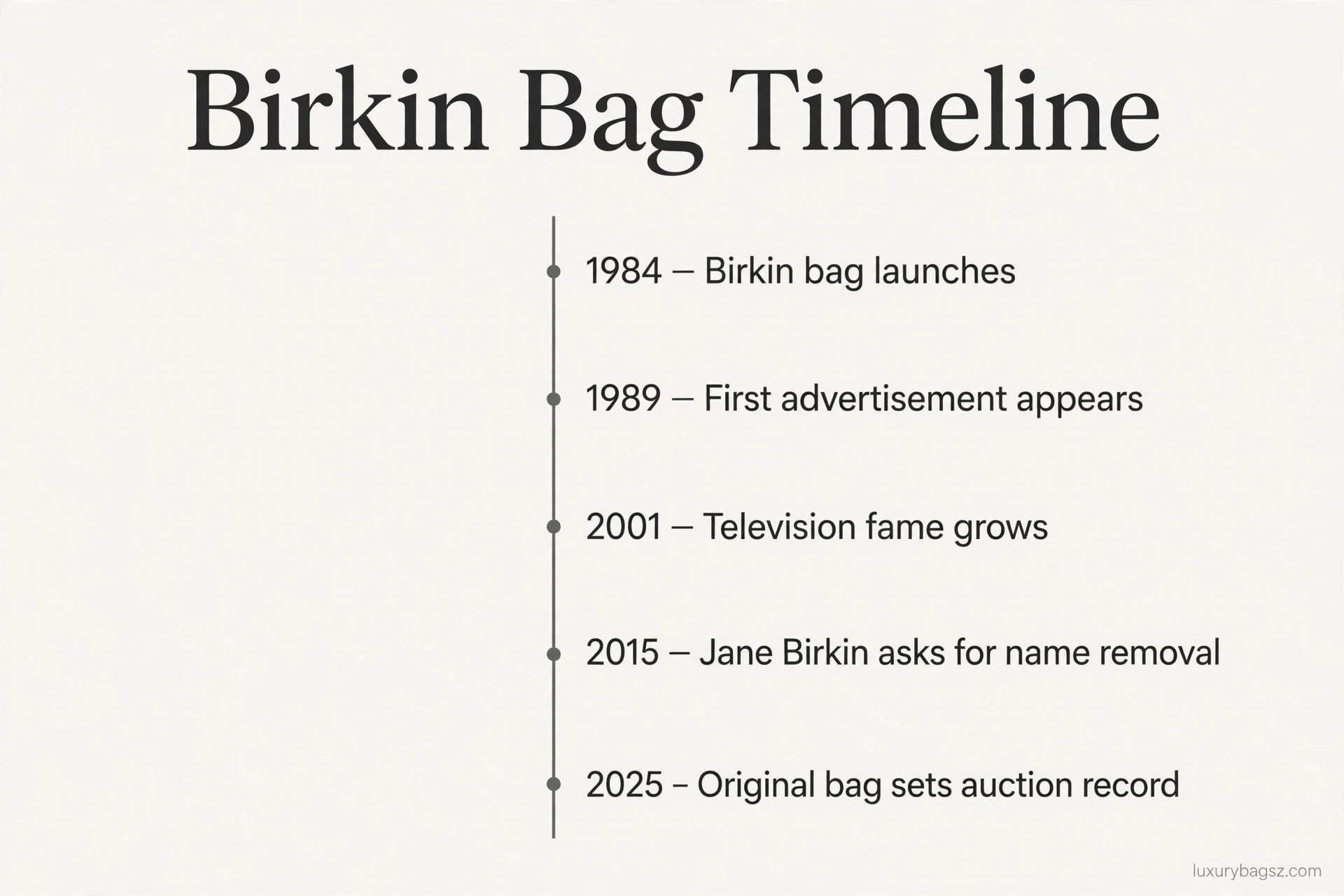
The Birkin was not an instant hit. Through the 1980s it stayed relatively quiet, while Chanel dominated the designer handbag market, and its first advertisement did not appear until 1989.
That slow start is a useful correction to the myth. The bag did not sell out on day one because a famous name was attached to it. It took a decade of steady production and growing word of mouth.
The turn came in the late 1990s, at the start of the it-bag era. Television fixed the Birkin in popular culture, above all the Sex and the City episode "Coulda, Woulda, Shoulda" in 2001, in which Samantha name-drops her way past a five-year waiting list.
From there, limited production and rising demand fed each other. The bag that began as a practical fix became a status symbol, a resale object, and a shorthand for luxury itself.
Part 9: The Complicated Later Relationship
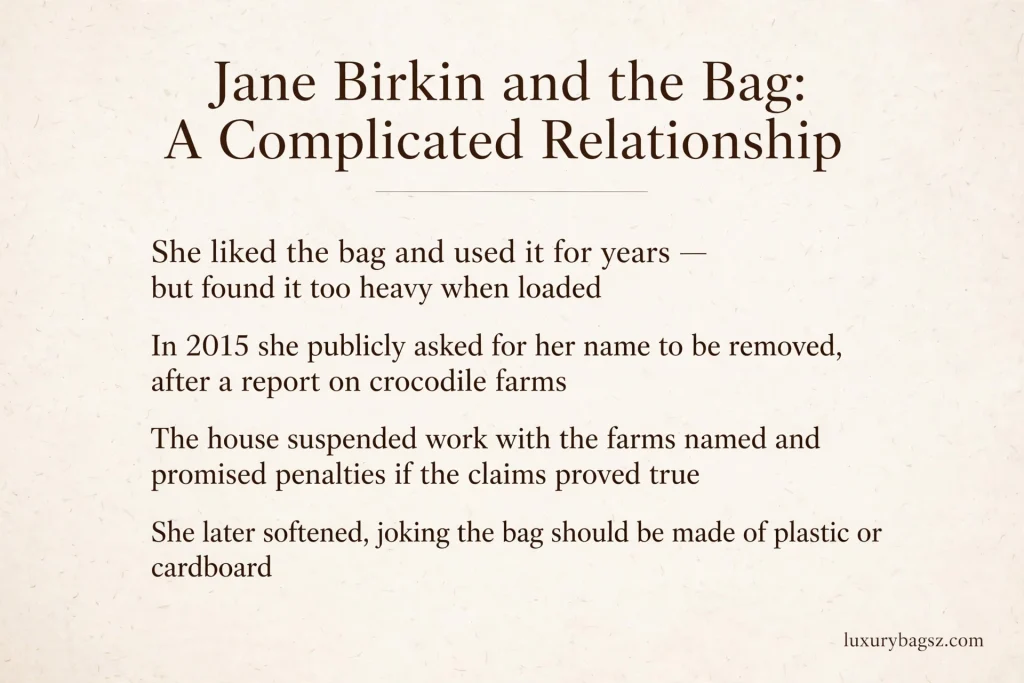
Birkin's feelings about the bag were mixed, and competitors that skip this part give a tidier story than the real one. She liked the bag, used it for years, and also found it too heavy when loaded.
In 2015 she publicly asked Hermès to remove her name from the bag, after a PETA report alleged cruelty at a crocodile farm linked to the house. Hermès said it respected her feelings, suspended work with the farms named, and promised penalties if the claims proved true.
She later softened that stance, joking that Hermès should make the bag from plastic or cardboard so it would not be so heavy. She also said she did not mind if people bought copies.
That complicated affection is part of why the story lasts. The bag was never just an endorsement deal. It was a working object she argued with, decorated, donated, and occasionally complained about.
Part 10: Craft Facts, With the Numbers Stated Carefully
Every Birkin is made start to finish by a single artisan in France, a rule Hermès calls "one craftsman, one bag". Each artisan trains for a long period before being allowed to make a Birkin at all.
Sources disagree on the exact hours, so this article does not pick one number silently. Setdart and 29Secrets give 15 to 20 hours per bag, while another detailed history gives 18 to 20 hours.
The difference is small, but it shows why round craft claims should be treated with care. The safe statement is that a single artisan spends the better part of two working days on one bag.
Hermès does not publish how many Birkins it makes each year. One often-quoted estimate puts about 200,000 Birkins in circulation, but that figure is an estimate, not an official Hermès number, and this article flags it as such.
Part 11: Buying a Birkin Today, Without Repeating the Buying Guides
The world Birkin complained about in the 1980s no longer exists. A Birkin is now allocated rather than simply bought off the shelf, and the buying process has its own vocabulary and waiting game.
Readers who want that process in full should start with the guide to what a Hermes quota means, which explains the purchase limits that shape every boutique visit. It is the single most misunderstood part of buying a Birkin.
Then look at how to get a Hermes bag appointment, which walks through the boutique visit, the wishlist conversation, and what to bring. That guide covers the appointment itself, so this article does not repeat it.
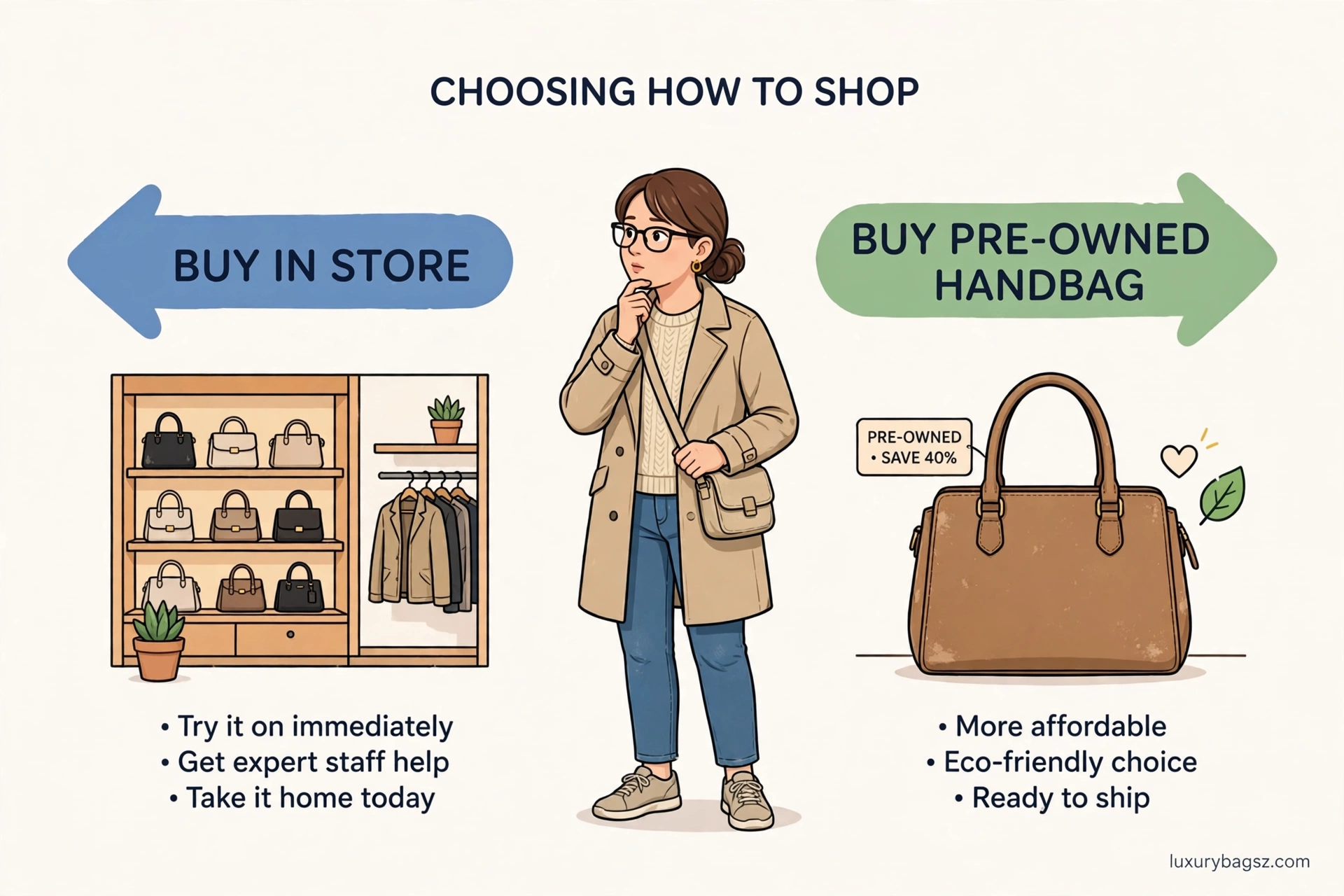
For shoppers weighing channels, the comparison of how to buy Hermes online vs in store sets out the trade-offs between a boutique purchase and a vetted pre-owned purchase. Pre-owned is often the faster route to a specific size and colour.
Part 12: What to Check Before Buying a Birkin With Her Name On It
A pre-owned Birkin is where most buyers meet Jane Birkin's story in real life, and it is also where mistakes cost the most. Buy only from a seller who shows clear, dated photographs of the actual bag, not stock images.
Check that the size, leather, colour, and hardware in the listing match each other. A listing that calls a bag one size in the title and another in the measurements should be treated as a warning, not a bargain.
Ask for the bag's condition in plain language: corner wear, handle darkening, interior marks, and whether the lock, keys, clochette, and dust bag are included. Missing accessories do not prove a fake, but they should lower the price.
Finally, remember what Birkin herself proved. A well-used Birkin with stickers and scuffs can be the most historic bag of all, as the 2025 record sale showed. Wear is not the same as damage, and a used bag is not automatically a bad bag.
Frequently Asked Questions
Who was Jane Birkin?
Jane Birkin (14 December 1946 – 16 July 2023) was an Anglo-French actress and singer, born in London and based in France from the late 1960s. She is best known today as the namesake of the Hermès Birkin bag, though her acting and music career spanned more than five decades.
Did Jane Birkin design the Birkin bag herself?
No, not alone. She described her ideal bag and sketched it with Jean-Louis Dumas on a plane, but Hermès adapted its existing Haut à Courroies shape and built the prototype. She supplied the brief; Hermès supplied the design and craft.
When did Jane Birkin meet Jean-Louis Dumas?
On an Air France flight from Paris to London, when her wicker basket spilled and she sat beside the Hermès chief. Sources disagree on the year, giving 1983 or 1984, and this article does not hide that disagreement.
What did Jane Birkin ask for in the bag?
A bag bigger than a Kelly and smaller than Serge Gainsbourg's suitcase, roomy enough for a young mother's daily things, with pockets and a secure close so nothing would spill out again.
What was the original Birkin made of?
Supple black leather, according to the early accounts, with gilded brass hardware, a fixed shoulder strap, and her "J.B." initials under the flap, according to Sotheby's description of the prototype it sold in 2025.
Why did Jane Birkin stop carrying a Birkin?
She did not stop entirely, but she said she used it less because she overfilled it and it became very heavy. One account reports shoulder tendinitis from carrying a loaded Birkin, which fits her habit of filling the bag to the brim.
Did Jane Birkin sell her Birkins for charity?
Yes. She reportedly owned only four Birkins and donated three to charity auctions, including the original bag in 1994 to an AIDS charity auction. She also said the bags were useful because selling them raised money for causes she supported.
Why did Jane Birkin ask Hermès to remove her name in 2015?
After a PETA report alleged cruelty at a crocodile farm linked to Hermès, she publicly asked for her name to be removed from the crocodile versions. Hermès said it respected her feelings and suspended work with the farms named while it investigated.
How much did Jane Birkin's original Birkin sell for?
It sold at Sotheby's Paris on 10 July 2025 for €8.582 million including fees, about $10.1 million, setting the world auction record for any handbag. The hammer price before fees was €7 million.
Is the Birkin still made the same way today?
The core design and the one-artisan rule remain, but materials, colours, sizes, and limited editions have expanded far beyond the original black leather prototype. The production bag also lacks the original's fixed shoulder strap and personal details.
Conclusion
Jane Birkin was not a handbag designer, and that is exactly why the Birkin story works. She was a working mother with a basket that kept spilling, who told the one man on the plane who could fix the problem what she actually needed.
Hermès turned that complaint into a bag, and she turned the bag into a life: filled, decorated, worn out, given away, and argued with. The luxury came later, and it came from other people wanting what she had simply used.
If you remember one thing from her story, make it the brief itself. Bigger than a Kelly, smaller than a suitcase, with pockets and a close that works. Everything the Birkin became started with a bag that did not spill.