How to Choose a Men’s Card Holder Wallet
Start With What You Actually Carry
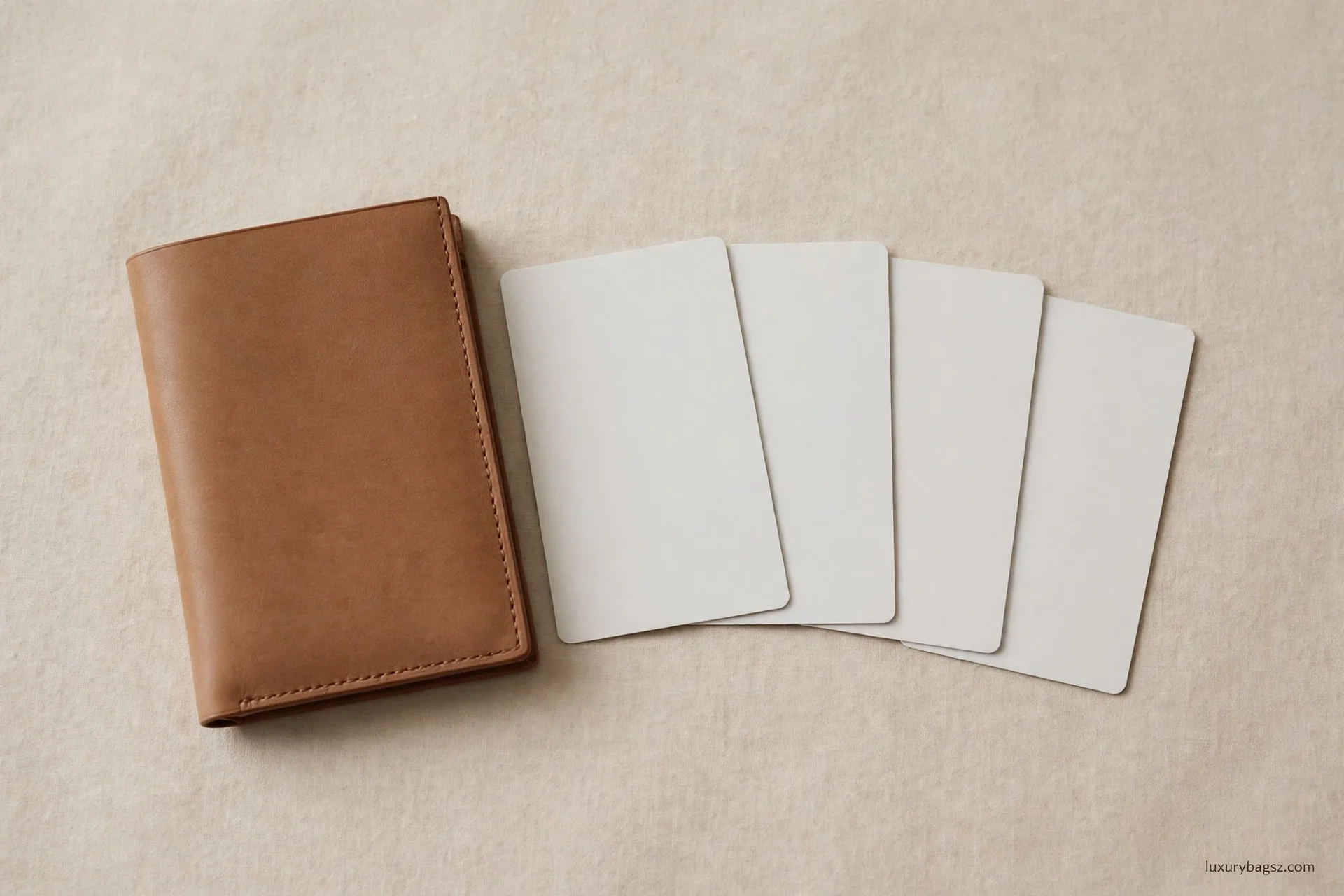
Begin by tipping out your current wallet and tallying what genuinely travels with you each day. Most men rely on four to eight cards, typically bank cards, ID and a travel pass, plus perhaps folded notes or a key. Anything used only monthly can live elsewhere instead of adding bulk.
Pick capacity with breathing room, allowing one extra slot beyond that daily total so leather is not stretched tight. Judge any holder loaded rather than empty: it should close flat, slip into a front pocket and stay around 15 millimetres thick when full.
Only then weigh layout, leather and price against that fit. A bifold, sleeve, zip or pop-up style suits different habits, while full-grain leather offers the longest life and the richest ageing.
The Card Holder in Brief
A men's card holder wallet is a deliberately small wallet: a slim case designed to carry cards, a little cash and sometimes a key, without the bulk of a traditional bifold or trifold. The right one disappears into a front pocket, keeps cards accessible, and lasts for years. The wrong one is either too small for your real carry, so cards bend and spill, or too large for its promise, so you have bought a bifold with a different name.
This guide walks through that decision in order, so you end with a holder that fits your pocket, your cards and your budget — and that you will still like in two years.
Key Takeaways
- Count your real daily carry first: cards, cash, coins and extras, then add one spare slot for growth.
- A card holder should stay slim when full; if it bulges like a bifold, the layout or the leather is wrong for your carry.
- Full-grain leather ages best and costs most; good top-grain is a sensible middle ground, while bonded leather is a short-life compromise.
- Layout matters more than brand: bifold, sleeve, zip and pop-up styles suit different carries, pockets and habits.
- RFID blocking is useful only if your cards actually use contactless payment and you want the extra layer; it is not a reason to buy an otherwise wrong wallet.
Part 1: Count Your Real Daily Carry
Empty your current wallet onto a table and sort it honestly. How many cards do you carry every day, not occasionally? Most men carry between four and eight: a debit card, a credit card, an ID or driving licence, a travel card and one or two loyalty or membership cards. Add any card you use weekly, and set aside cards you use monthly — those can live elsewhere, in a desk drawer or a second wallet, rather than bulking up your daily carry.
Now count cash, coins and extras. Do you carry folded notes, a key, a SIM tool, a business card or a receipt? Each extra changes the layout you need. A holder with no cash pocket forces notes into a card slot, which stretches it; a holder with a coin pocket you never use adds bulk for nothing.
Write down your count before shopping, and use it as a filter: any holder that cannot hold your daily carry comfortably, or that holds far more than you need, is the wrong holder however attractive it looks.
Part 2: Capacity — The Spare Slot Rule
Capacity is where most card holder purchases go wrong, because buyers choose for today's minimum rather than real life. A holder rated for six cards will hold six cards, but tightly, and tight slots stretch leather, make cards hard to remove and wear out faster. The practical rule is simple: buy one spare slot beyond your daily count. If you carry six cards daily, buy a holder that comfortably holds seven or eight.
Test capacity honestly before committing where you can. Load the holder with your actual cards, close it, and check three things: does it close flat, can you remove the middle card without pulling out its neighbours, and does the holder still fit your pocket comfortably? If any answer is no, the holder is too small for your carry, even if the product page says otherwise.
Manufacturer capacity figures are often optimistic, counting cards stacked two per slot or counting a slot that also holds cash. Your own test, with your own cards, is the only capacity figure that matters.
Part 3: Slimness When Full, Not When Empty
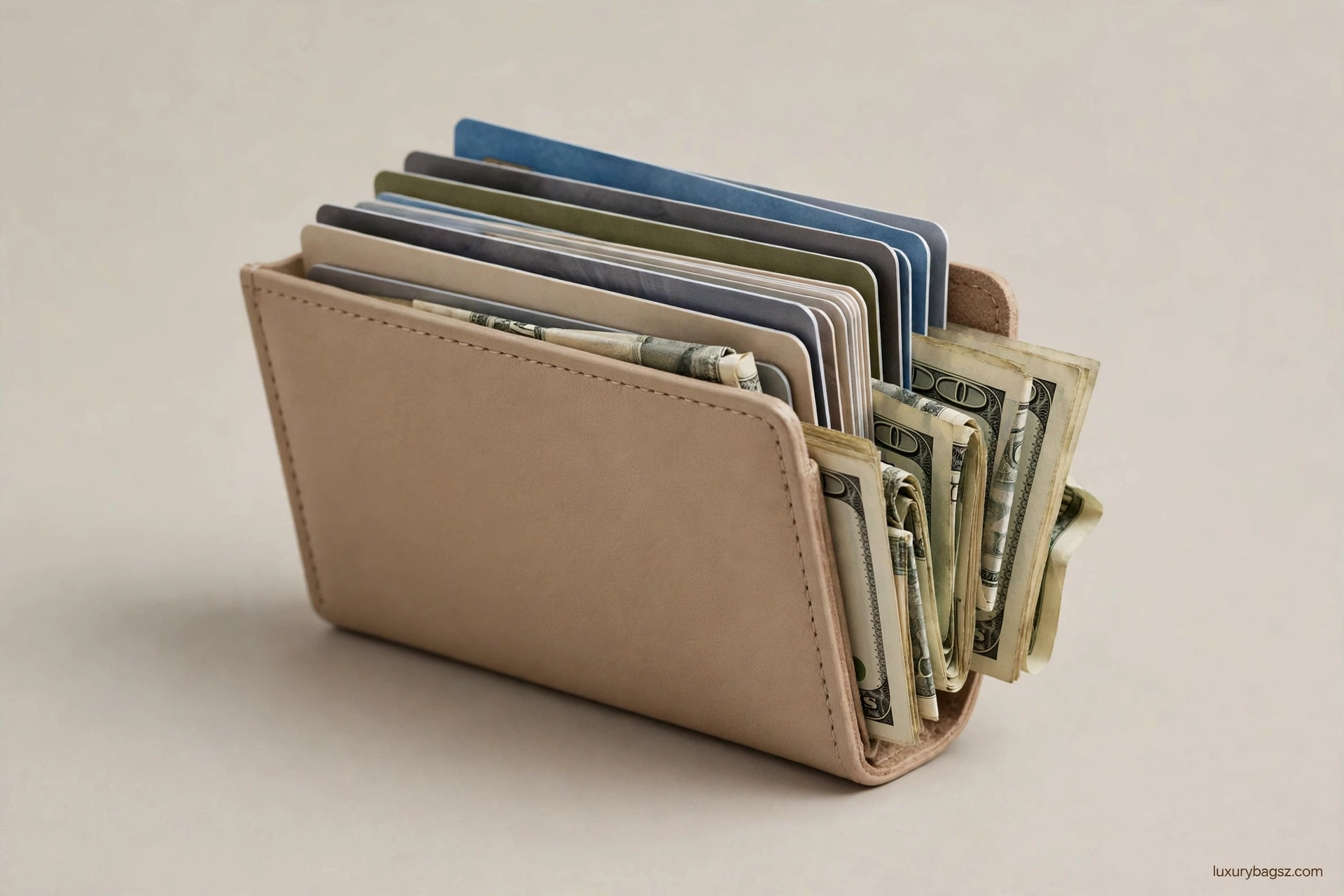
Every card holder looks slim empty. The honest measure is slimness when full, loaded with your daily carry, measured at its thickest point. A good slim holder stays under about 15 millimetres thick when full for a typical four-to-six-card carry, and still slips into a front pocket without printing visibly through trousers.
A holder that doubles in thickness when loaded, or that bulges in the middle while staying thin at the edges, is either overfilled or poorly designed.
Pocket choice changes the slimness you need. Front-pocket carriers need the slimmest, flattest holders, since a front pocket shows bulk more readily and sits against the leg. Back-pocket carriers can tolerate a slightly thicker holder, but should still avoid a holder so thick it distorts the pocket or becomes uncomfortable to sit on. Jacket-pocket carriers have the most freedom, since a jacket pocket hides bulk and distributes weight better.
Choose slimness for the pocket you actually use, not for a photograph of an empty holder.
Part 4: Size, Dimensions and Pocket Fit
Dimensions matter more than product names, since "slim" and "minimal" mean different things to different makers. A typical card holder measures roughly 10 to 11 centimetres wide and 7 to 9 centimetres tall when closed, but sizes vary, and a centimetre in either direction changes pocket fit noticeably.
Check the stated dimensions, then compare them with your current wallet and with your pocket: measure your pocket's usable width and depth, not just its opening.
Also consider card orientation. Some holders store cards vertically, some horizontally, and some in a mix. Vertical holders tend to be narrower and taller, suiting deeper pockets; horizontal holders tend to be wider and shorter, suiting shallower pockets. Neither is inherently better, but the wrong orientation for your pocket makes cards harder to remove and the holder harder to pocket.
If you wear slim trousers, prioritise a flatter, narrower holder; if you wear relaxed trousers or jackets, you have more freedom to prioritise capacity or layout.
Part 5: Layout Styles — Bifold, Sleeve, Zip and Pop-Up
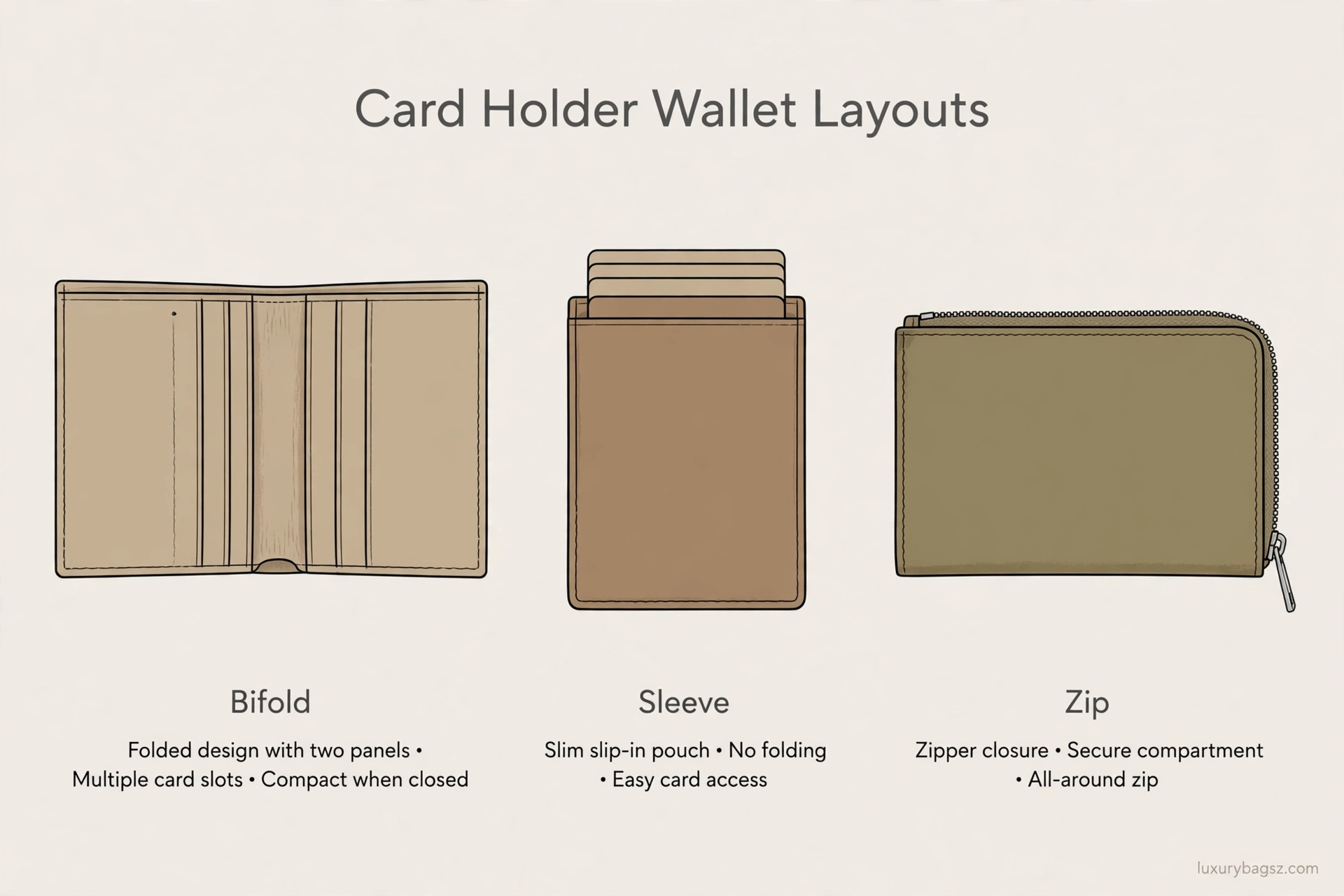
Card holder layouts fall into a few families, and each suits a different carry. A bifold card holder folds in half, offering card slots on both sides and often a cash pocket; it suits men who carry six to ten cards plus notes and want a familiar wallet feel in a smaller package. A sleeve holder is a single flat pocket or a few stacked slots with no fold; it suits minimal carriers with three to six cards who prioritise slimness above all.
A zip card holder adds a zipped compartment for coins, a key or folded notes, suiting men who still carry coins or want everything secured. A pop-up or ejector holder uses a mechanism to fan cards out at the press of a lever; it suits men who value fast access and a tech-forward feel, but it adds mechanism bulk and a potential failure point.
A wrap or band holder uses an elastic or leather band to hold a stack of cards; it is the slimmest option but offers the least protection and organisation. Match the layout to your carry and habits, not to a trend: a pop-up holder is a poor choice if you carry coins, and a sleeve is a poor choice if you carry ten cards.
Part 6: Leather Types and What They Mean for Longevity
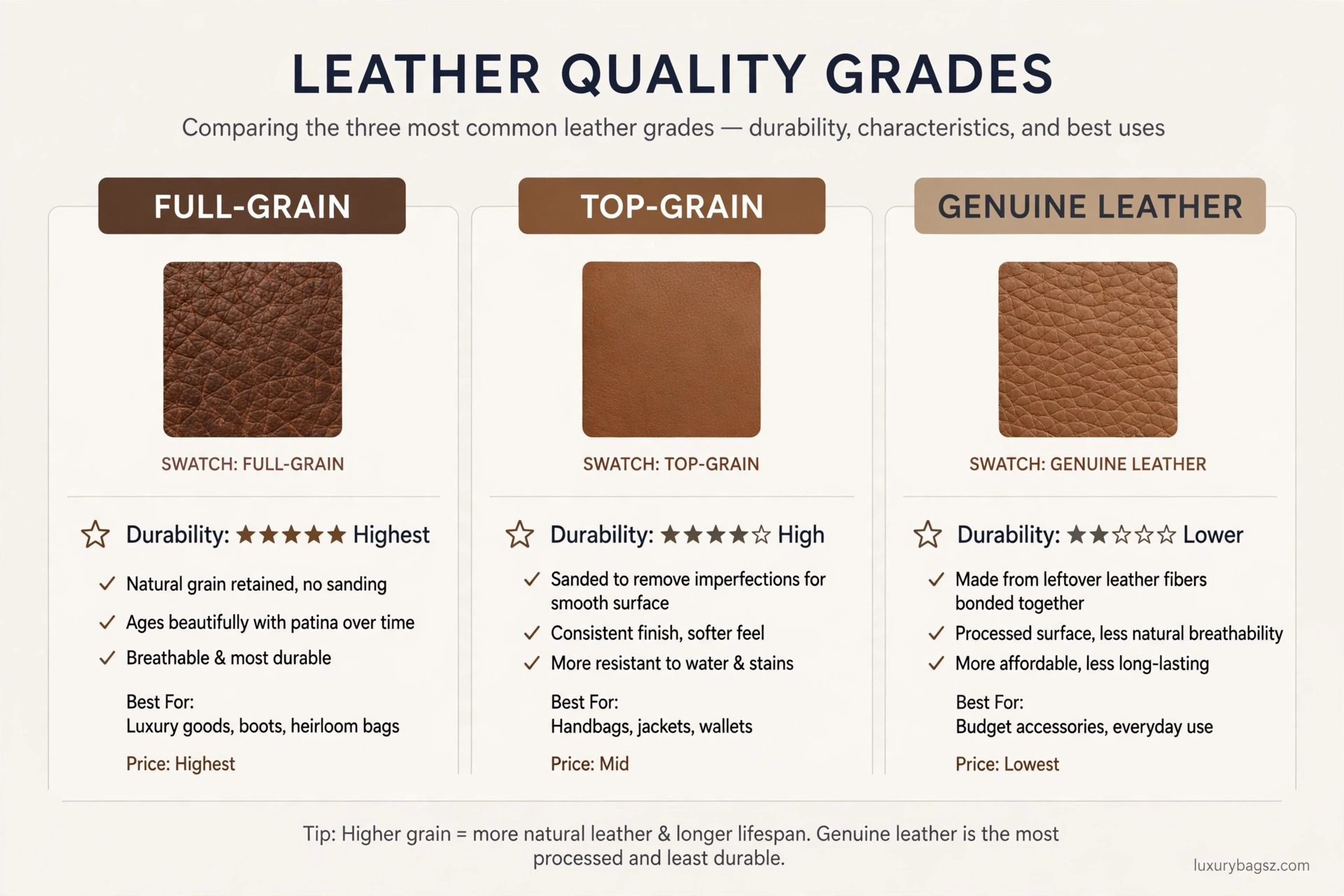
Leather quality decides how a holder ages, and the terms matter. Full-grain leather is the top layer of the hide with its natural grain intact; it is the most durable, develops a rich patina with use, and costs most. Top-grain leather is sanded and refinished, giving a more uniform look at a lower price and with slightly less durability and patina.
Genuine leather, despite its reassuring name, is a lower grade made from split layers, and it wears faster and ages less attractively. Bonded leather is reconstituted leather fibres bonded with resin; it is the cheapest, peels and cracks with use, and is a poor choice for a daily-carry item.
Non-leather options have their own place. Nylon and canvas holders are light, water-resistant and inexpensive, suiting active or outdoor use. Metal holders, usually aluminium or steel, offer rigid protection and a modern look, but add weight and can feel cold and bulky in a front pocket. Vegan leather varies widely in quality: good vegan leather feels substantial and wears well, while cheap vegan leather feels plasticky and peels.
Judge any material by feel, stitching and edge finishing, not by its label alone, and remember that a well-made top-grain holder outlasts a poorly made full-grain one.

Part 7: Stitching, Edges and Construction Quality
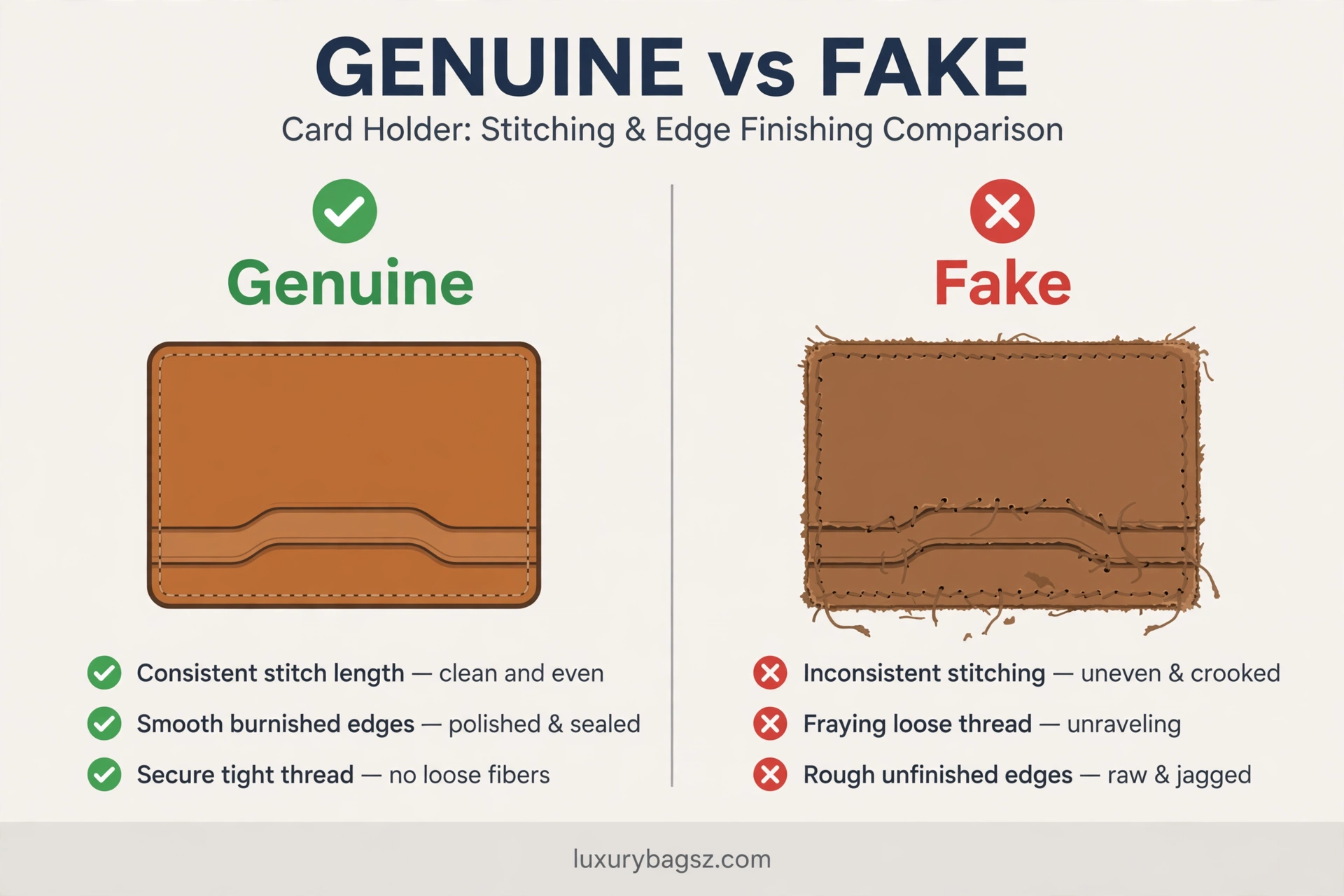
Construction quality is visible if you look for it. Stitching should be even, tight and consistent, with constant stitch length and no loose loops, skipped stitches or frayed ends. Edge finishing should be smooth and even, without rough fibres, drips or peeling paint, and edges should feel sealed rather than raw. Card slots should be cleanly cut, evenly sized and stitched firmly at their openings, since slot openings take the most stress.
Test construction where you can. Gently flex the holder and check that slots do not gape, stitching does not pull and edges do not crack. Pull a card in and out several times and check that the slot grips firmly without requiring force, and that neighbouring cards do not slide out with it. A holder that already shows loose threads, uneven stitching or rough edges when new will only deteriorate faster with daily use.
Good construction costs little more at purchase and saves a replacement within a year.
Part 8: Card Access — How Fast Can You Get the Right Card?
A card holder is used dozens of times a week, so access speed matters more than buyers expect. The best holder lets you find and remove the right card in one motion, without fumbling, pulling out neighbours or turning the holder over.
Features that help include a thumb cut-out or notch on the outer slot, staggered slot heights so each card's edge is visible, a quick-access outer slot for your most-used card, and a pull tab for a stack of less-used cards.
Think about your most frequent transaction. If you tap a travel card every morning, that card belongs in the fastest slot, ideally an outer slot you can tap without removing the card. If you pay by card at a till, you need a slot that releases the card cleanly one-handed. If you show ID regularly, that card needs its own accessible slot rather than burial in a stack.
A holder that looks elegant but forces a two-handed fumble every time is a daily annoyance, however good its leather. Test access with your own cards before committing, since slot tightness varies with card thickness and embossing.
Part 9: Cash, Coins and Extras — Plan for Them or Leave Them Out
Cash handling separates card holders more than any other feature. Some holders include a central cash pocket for folded notes, some include a money clip, some include a zip coin pocket, and many include none of these. Decide honestly whether you still carry cash daily. If you do, choose a holder with a dedicated cash feature that fits your notes folded once, not crammed into a card slot where they stretch it and slow card access.
Coins need a deliberate decision. Most slim card holders have no coin storage, and adding a coin pocket adds bulk and weight. If you regularly receive coins, consider a holder with a small zip pocket, or carry coins separately in a pocket or a small coin pouch rather than forcing them into a card holder that was never designed for them.
The same logic applies to keys, USB drives and other extras: a holder with a key pocket suits a man who wants one pocket item, but a holder without one suits a man who carries keys separately. Do not buy capacity for extras you never carry, and do not buy a holder that cannot hold the extras you always carry.
Part 10: RFID Blocking — Useful, Overrated or Unnecessary?
RFID blocking, also called RFID shielding, uses a metallic lining to block radio signals from contactless cards. It protects against a specific, relatively uncommon form of theft: an attacker reading a contactless card wirelessly at close range. Whether you need it depends on your cards and your habits. If you carry contactless payment cards and travel on crowded public transport, the extra layer may give peace of mind.
If your cards are chip-and-PIN only, or you already use a phone wallet for payments, RFID blocking adds little practical value.
Weigh the trade-offs honestly. RFID lining can add slight thickness and stiffness, can interfere with tapping a travel card if you tap the whole holder rather than removing the card, and is sometimes used as a marketing feature to justify a higher price on an otherwise ordinary holder. It should never be the deciding factor: a well-made holder without RFID blocking beats a poorly made holder with it.
If you want RFID protection, choose it as an extra on a holder that already fits your carry, layout and leather preferences, not as a substitute for them.
Part 11: Durability, Patina and Care
A good card holder should last years, not months, and its ageing should be part of its appeal. Full-grain leather develops a patina — a gradual darkening and softening that reflects use — and many buyers choose full-grain precisely for that character. Top-grain leather ages more uniformly and shows less patina, which suits buyers who prefer a consistent look.
Nylon and metal holders show wear differently: nylon frays at edges over time, while metal scratches and dents but rarely fails structurally.
Care is simple but matters. Keep leather holders away from prolonged water exposure, condition them occasionally with a suitable leather conditioner, and avoid overstuffing, which stretches slots permanently. Empty the holder occasionally and check stitching and edges for early wear, since a loose stitch repaired early saves a slot failing later.
A holder that is cared for and not overfilled will outlast one that is stuffed and neglected, whatever its price. Budget accordingly: a holder that lasts five years at a higher price costs less per year than a cheap holder replaced annually.
Part 12: Price, Value and When to Spend More
Card holder prices range from a few pounds or dollars for basic holders to several hundred for luxury brands, and price alone does not predict satisfaction. The value question is cost per year of good use: a well-made holder at a mid-range price that lasts five years is better value than a luxury holder that does not suit your carry, or a cheap holder that fails in six months.
Set a budget before shopping, then judge holders inside it by carry fit, leather, construction and layout, not by brand alone.
Spend more when the extra money buys something you will notice daily: better leather that ages well, stronger stitching, a layout that fits your exact carry, or a size that fits your pocket perfectly. Do not spend more for a logo, a box or a feature you will never use, such as a coin pocket for a man who never carries coins, or RFID blocking for cards that do not use contactless payment.
Also consider warranty and returns: a maker offering a repair service or a solid warranty signals confidence in construction, and a retailer with easy returns lets you test the holder with your real cards before committing.
Part 13: The Decision Framework — Five Questions, One Holder
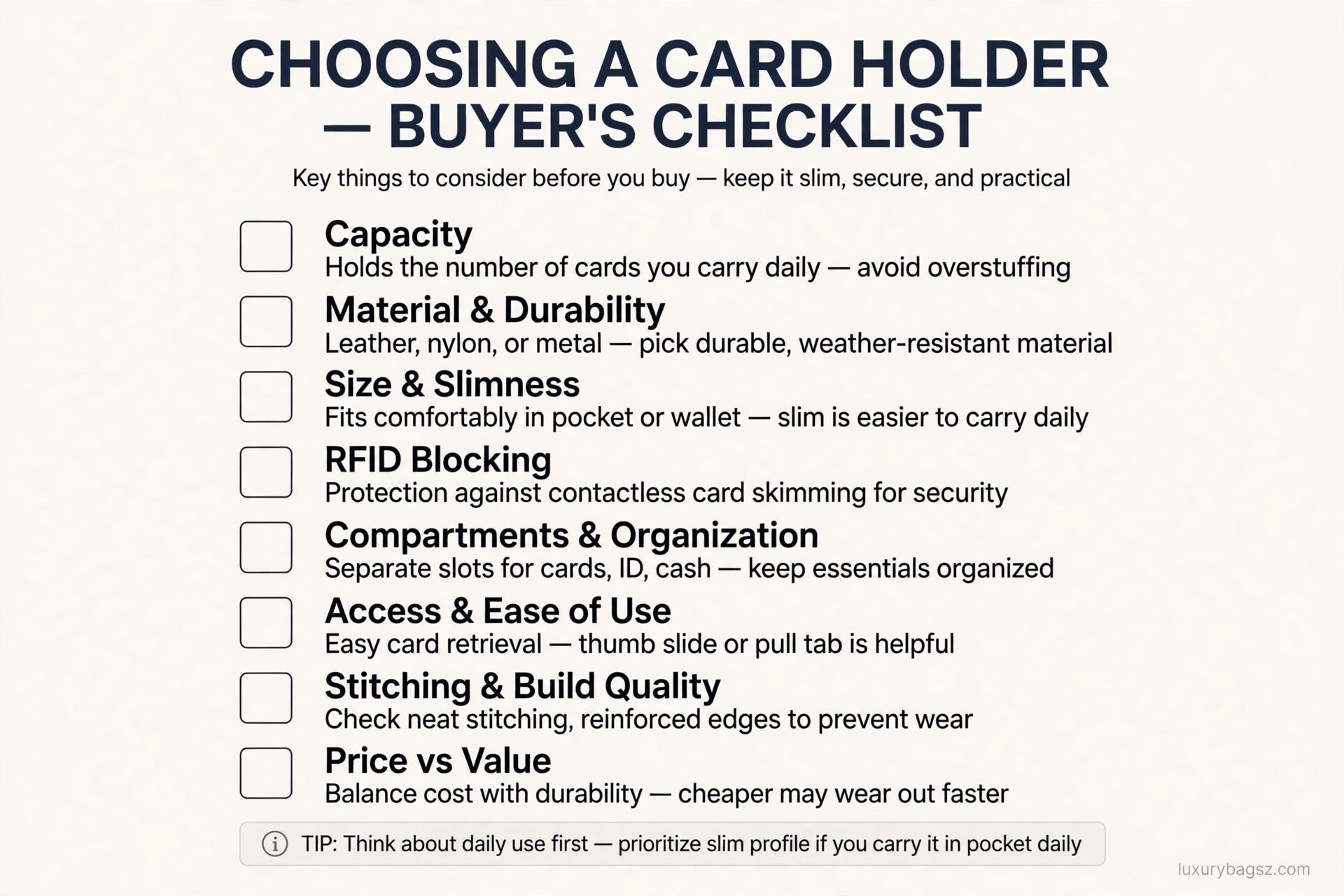
Use this framework to narrow any shortlist quickly. First, how many cards do I carry daily, plus one spare slot? Second, do I carry cash, coins or extras, and which layout holds them without bulk? Third, which pocket do I use, and what dimensions fit it flat? Fourth, which material suits my life — leather for everyday character, nylon for active use, metal for rigid protection?
Fifth, what is my budget for cost per year of good use, not just purchase price?
Apply the framework in order, eliminating holders that fail each question, and you will usually be left with two or three options. Choose between those by access: which holder lets you reach your most-used card fastest, with one hand, without fumbling? If still tied, choose by construction: even stitching, clean edges and firm slots beat a prettier holder with weaker construction.
This framework prevents the two commonest mistakes — buying for brand rather than carry, and buying for empty slimness rather than full slimness — and it works whatever your budget or style.
Part 14: Common Mistakes and How to Avoid Them
The commonest mistake is buying too small. A holder that barely fits today's cards will stretch, fumble and fail as soon as you add a card, so always include the spare slot. The second mistake is buying too large: a holder rated for twelve cards when you carry five is not a card holder but a small bifold, and it will bulk up your pocket for no benefit.
The third mistake is ignoring cash: notes crammed into card slots stretch them and slow access, so either choose a holder with cash storage or commit to carrying cash separately.
Other mistakes are subtler. Buying bonded leather for daily use guarantees peeling within a year. Buying a pop-up mechanism without testing it guarantees frustration if the mechanism jams or adds bulk. Buying for a photograph rather than your pocket guarantees a holder that looks slim empty and bulges full. Buying without checking returns guarantees being stuck with a holder that fails your own card test.
Avoid all of these by counting first, testing with your own cards, checking construction, and buying from a retailer that allows returns.
Part 15: Card Holders for Specific Lifestyles
Different lives need different holders, and a holder that suits one lifestyle can frustrate another. A frequent traveller needs a holder with space for a passport card or travel card in a quick-access slot, a cash pocket for foreign notes, and a layout that works one-handed at a barrier or a till.
A holder with a pull tab for less-used cards and an outer slot for the travel card suits this life better than a tight sleeve that requires two hands at every gate.
An office worker who carries an access card, a debit card, a credit card and ID needs a holder with a dedicated access-card slot that can be tapped without removing the card, where the workplace system allows it, plus a separate slot for payment cards so the wrong card is never tapped by accident.
A tradesperson or outdoor worker needs a durable, water-resistant holder — nylon, canvas or rugged leather — with a zip or secure closure, since an open sleeve in a work pocket risks losing cards. A minimalist who carries three cards and no cash needs the slimmest sleeve available, with no unused pockets adding bulk.
Students and young professionals on a budget need a holder that prioritises construction over brand: good stitching, clean edges and a layout that fits a student card, a debit card and ID, at a price that allows replacement if tastes change.
Parents carrying family cards, loyalty cards and children's cards as well as their own need a larger bifold-style holder or a second holder for family cards, rather than forcing ten cards into a six-card sleeve. Match the holder to the life, not to an idealised version of it, and re-count your carry when your life changes — a new job, a move or a new travel pattern often changes the right holder with it.
Part 16: Buying a Card Holder as a Gift
A card holder is a popular gift, and gift buying has its own pitfalls. The giver rarely knows the recipient's exact card count, pocket habits or material preferences, so a gift holder chosen for appearance alone often misses on capacity or layout. If you can, learn the recipient's carry discreetly: how many cards they use daily, whether they carry cash or coins, which pocket they use, and whether they prefer leather, nylon or metal.
A holder that fits those answers will be used daily; a holder that does not will sit in a drawer, however beautiful.
When you cannot learn the carry, choose a safe middle ground: a bifold-style holder in a neutral colour — black or dark brown full-grain or good top-grain leather — with capacity for seven or eight cards, a cash pocket and clean, even stitching. Neutral colours suit the most outfits and pockets, bifold layouts suit the widest range of carries, and quality leather ages well even if the recipient's tastes change.
Avoid novelty layouts, bright colours, pop-up mechanisms and bonded leather for gifts unless you know the recipient wants them specifically, since each narrows the chance of a good fit.
Presentation and returns matter for gifts too. Keep the box, receipt and tags intact, and buy from a retailer with a generous returns or exchange policy, so the recipient can swap size, layout or colour without awkwardness. A gift receipt, where available, makes that swap easy.
Finally, consider pairing the holder with a small care item — a leather conditioner sample or a note about the spare-slot rule — so the recipient can keep the holder in good condition from the start. A thoughtful gift is not just the object; it is the object plus the freedom to get the fit right.
Part 17: Replacing a Card Holder, and What to Do With the Old One
Even a good holder eventually wears out, and recognising the signs early saves cards and frustration.
Replace a holder when slots no longer grip cards firmly, so cards slide out or fall when the holder is tipped; when stitching unravels at slot openings or edges, since further use will widen the failure; when edges crack, peel or split, exposing fibres or inner layers; or when the holder has stretched so much from overfilling that it no longer closes flat or fits its pocket.
A holder that smells persistently of damp, shows mould, or has a broken zip, clip or mechanism that cannot be repaired has also reached the end of its useful life.
Before replacing, consider repair. A cobbler or leather repairer can often restitch a slot, reseal an edge or replace a zip for far less than a new holder, and repair is the sustainable choice for a quality leather holder with localised damage.
If repair is not worthwhile — for bonded leather that is peeling throughout, or a mechanism that has failed structurally — replace with a holder chosen by the same framework in this guide, using your current carry count rather than the count you had when you bought the old holder, since carries change over time.
Dispose of the old holder thoughtfully. Remove all cards, notes and personal items, and check hidden pockets and zip compartments before discarding, since forgotten cards and receipts are a privacy risk. Leather holders in good structural condition can be donated, while worn-out holders should be recycled where facilities accept leather or textile waste, or disposed of with general waste where they do not.
Do not pass on a holder with your personal details, cards or documents still inside it, and do not keep a failed holder "just in case" — a holder that drops cards will drop them again, and the cost of a lost card far exceeds the cost of a replacement.
Frequently Asked Questions
How many cards should a men's card holder hold?
Most men need six to eight slots including one spare. Count your daily cards honestly, add one spare slot, and choose a holder that holds that total comfortably, not tightly.
Is a card holder better than a bifold wallet?
It depends on your carry. A card holder is better if you carry mainly cards and little cash, and value slimness. A bifold is better if you carry many cards, substantial cash, coins and receipts daily.
What is the best leather for a card holder?
Full-grain leather lasts longest and develops the best patina, but costs most. Good top-grain leather is a sensible middle ground. Avoid bonded leather for daily use, since it peels and cracks quickly.
Do I need RFID blocking in a card holder?
Only if you carry contactless cards and want the extra layer. RFID blocking protects against a relatively uncommon form of wireless theft, and should never outweigh carry fit, layout and construction in your decision.
How slim should a card holder be when full?
A good slim holder stays under about 15 millimetres thick when full for a typical four-to-six-card carry, and fits your usual pocket without visible bulging. Measure when full, not when empty.
Can a card holder hold cash and coins?
Some can, with a central cash pocket, a money clip or a zip coin pocket. Most slim holders hold folded notes poorly and coins not at all, so decide whether you need cash storage before choosing a layout.
How do I stop cards falling out of a card holder?
Choose slots that grip firmly without force, avoid overfilling, and check that removing one card does not pull out its neighbours. A holder that already drops cards when new will only get looser with use.
How long should a good card holder last?
A well-made leather holder, cared for and not overfilled, should last several years, with full-grain examples often lasting five years or more. Cheap bonded leather holders may fail within a year.
Are metal card holders practical for everyday use?
They offer rigid protection and fast access, but add weight and can feel bulky in a front pocket. They suit men who prioritise card protection and a modern look over the soft feel of leather.
What should I check before buying a card holder online?
Check dimensions, capacity with your real card count plus one spare, layout for cash and coins, leather type, stitching and edge quality in photographs, and the retailer's returns policy so you can test it with your own cards.
Summary
The best men's card holder is not the slimmest, the most expensive or the most famous — it is the one that fits your real daily carry, your real pocket and your real habits, and keeps fitting them after a year of use. Count first, add a spare slot, choose a layout that holds your cash and extras honestly, judge leather and construction by feel and stitching rather than labels, and test access with your own cards before committing.
Get those decisions right, and a small, quiet object will make every day slightly easier, which is exactly what a card holder is for.