How to Care for Bottega Veneta Intrecciato Leather
Weave First, Leather Second
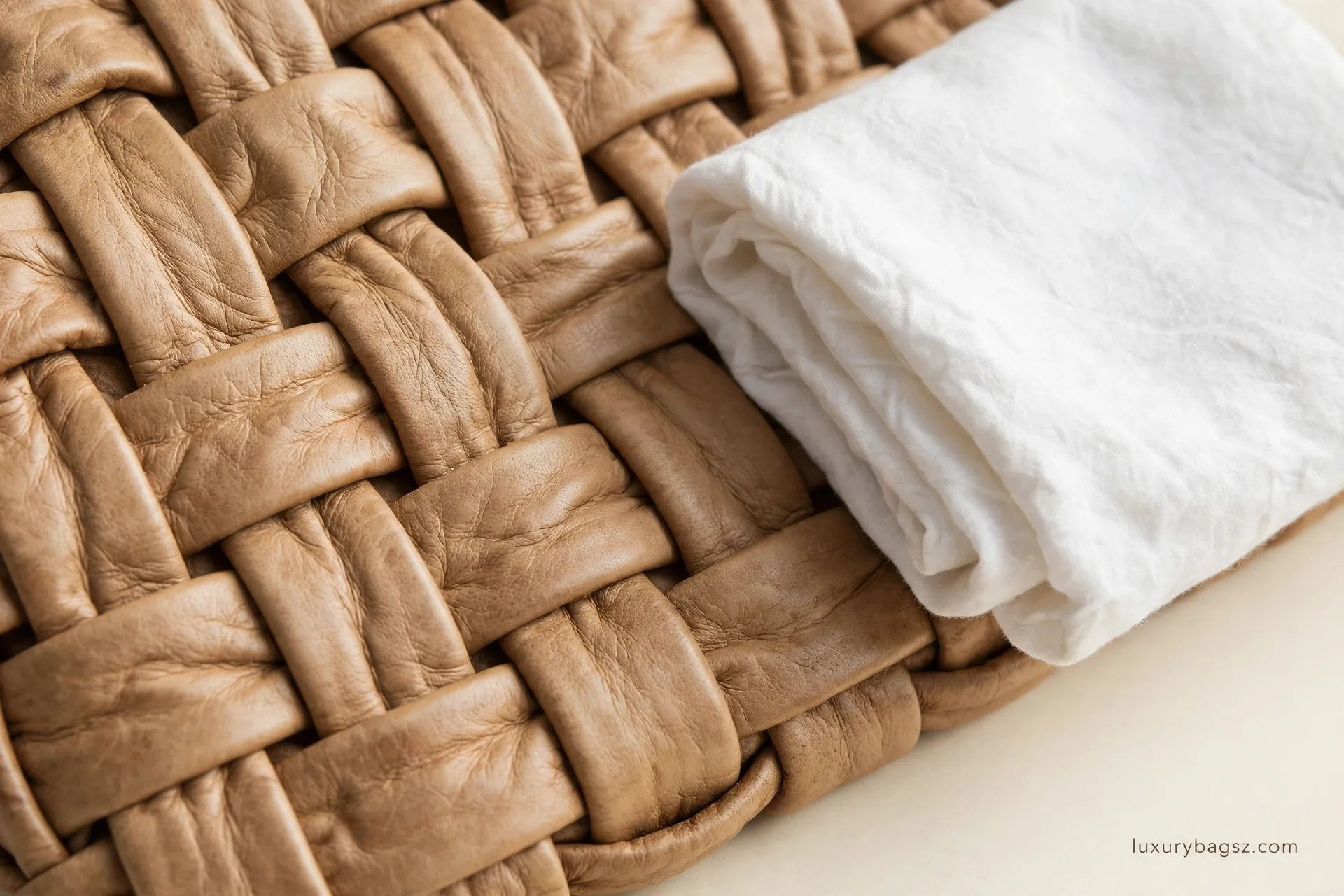
The single rule that governs all Intrecciato care is this: Intrecciato is a weaving technique, not a leather type. GLOWBAG, the only care source that addresses Intrecciato directly, puts it plainly: what matters is the actual leather and its finish, not the woven pattern. A lambskin weave and a suede weave need different care even though both are Intrecciato.
The second rule follows from the weave itself. Strips and edges are exposed to mechanical stress, so work gently, never rub hard, and never brush soft woven leather. Product goes on sparingly, because excess cleaner or conditioner collects between the strips, where it dries unevenly and attracts dirt.
Key Takeaways
- Identify the leather before you clean anything: lambskin, calfskin, suede, padded lambskin, Tech nylon and patent all need different handling.
- Clean first, then condition, both thinly and evenly, with product on the cloth, never sprayed straight onto soft woven leather.
- Never brush soft woven leather, never use harsh chemicals or steam, and never over-condition: pooling between strips is the classic Intrecciato mistake.
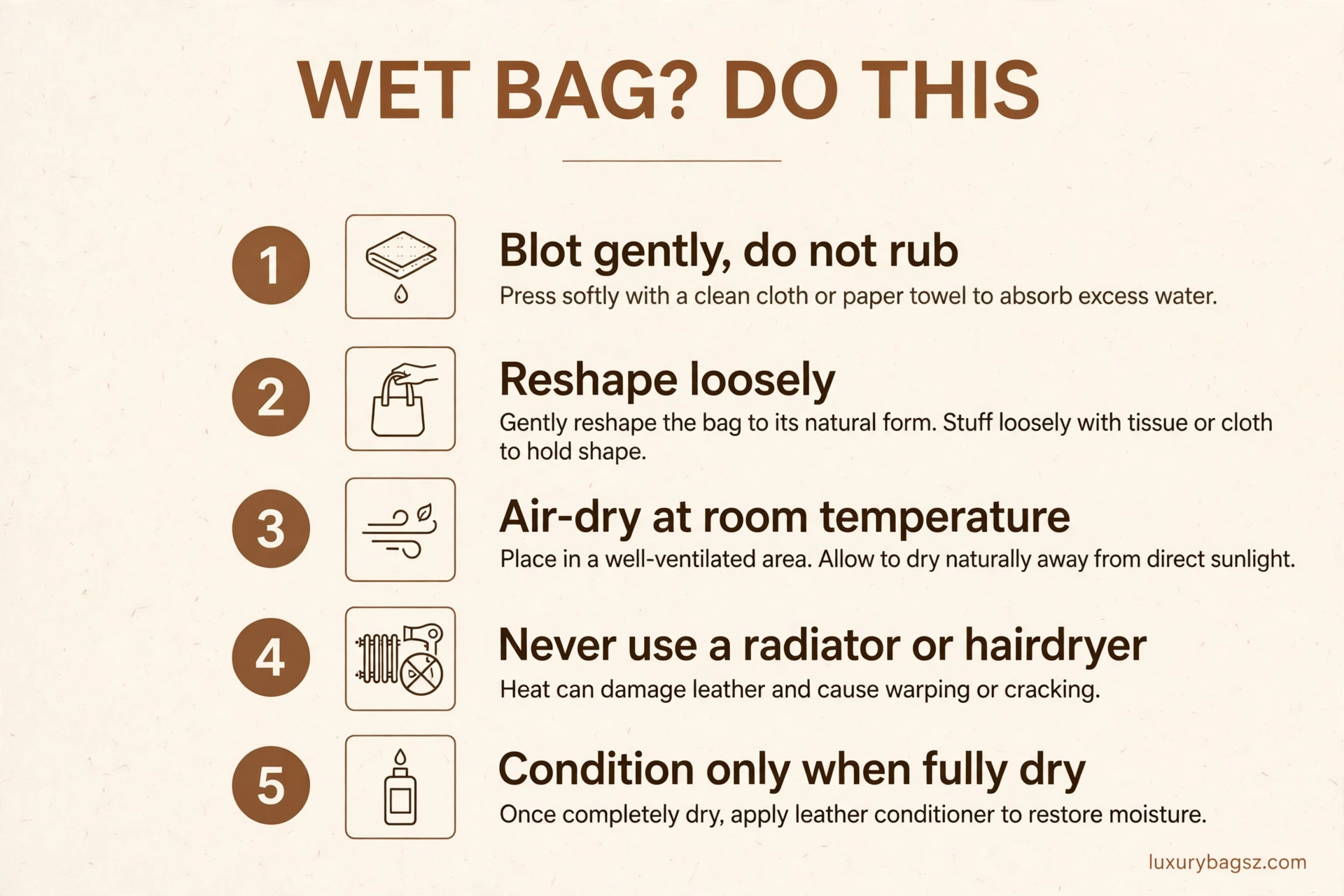
- Wet bag protocol: blot, reshape loosely, air-dry at room temperature, never on a radiator or with a hairdryer.
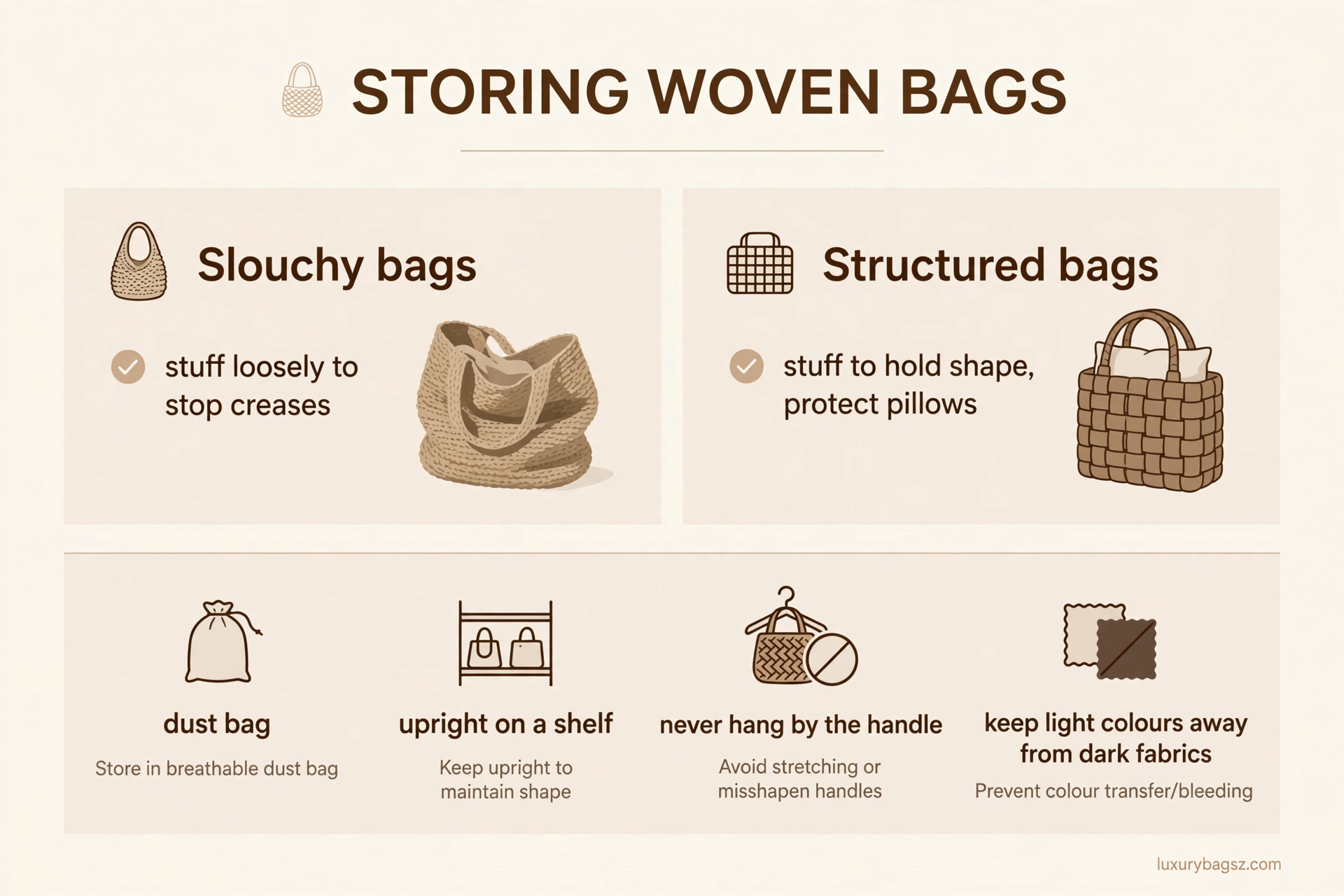
- Store slouchy bags stuffed loosely and structured bags stuffed to hold their shape, both in dust bags, away from sun, heat and dark denim.
The First Rule: Weave Is Not Leather
Every care mistake with Intrecciato starts from treating it as one material. Product pages give one generic blurb — soft cloth, avoid sun and water, dust bag, conditioner periodically — and that blurb is wrong for at least half the bags it is printed on, because it ignores which leather was woven.
Before any cleaning, find your bag's material. Check the original listing, the interior tag and the feel: lambskin is buttery and soft, calfskin firmer, suede napped and matte, patent glossy and sealed, Tech nylon woven fabric rather than leather at all. If you cannot identify it, treat it as the most delicate plausible option, test everything on a hidden spot first, and stop if colour transfers to the cloth.
This guide gives one routine per material, because that is the guide no competitor has written. Use only the part that matches your bag, and skip the rest: the wrong part's advice can damage a different material.
Know Your Material at a Glance
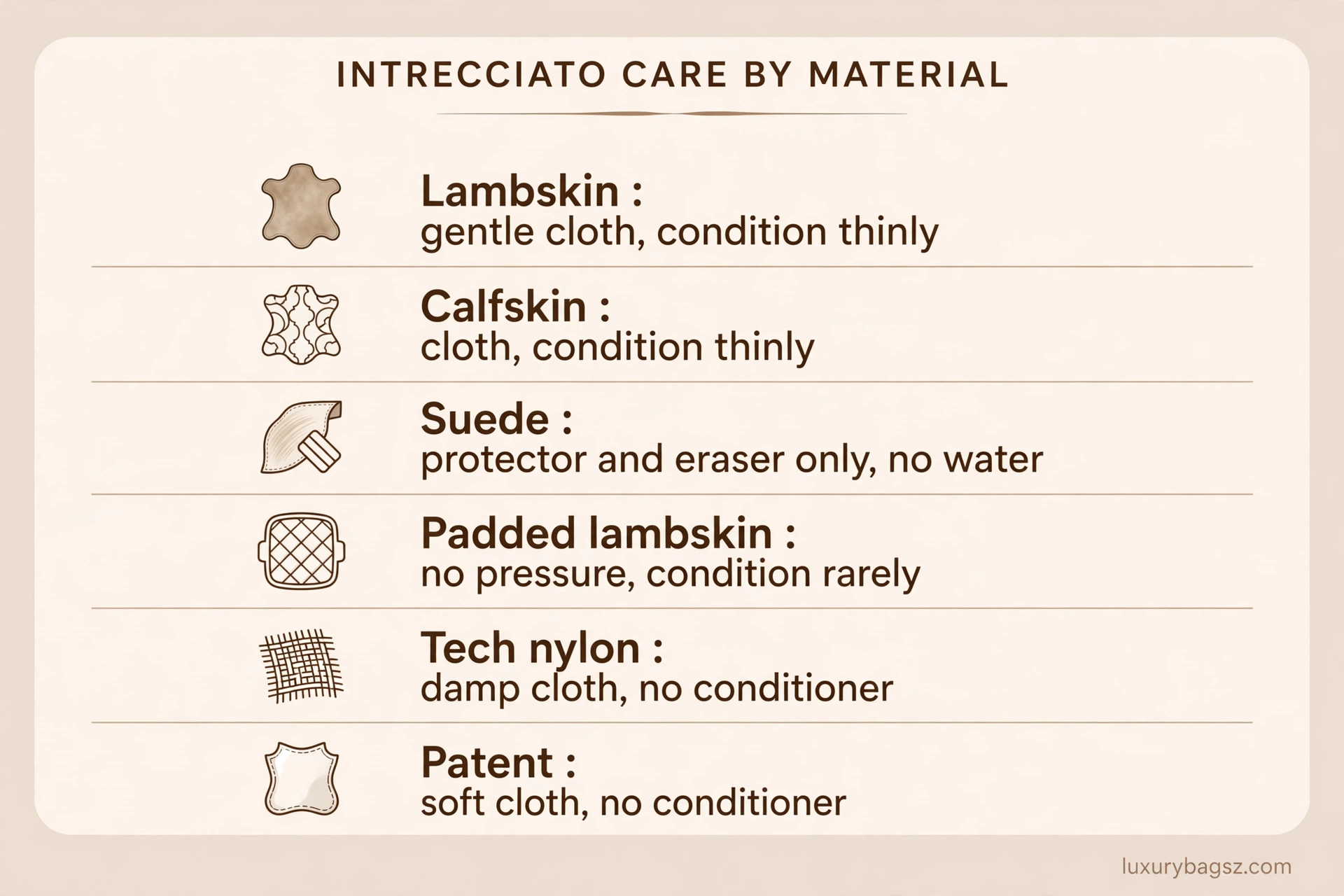
| Material | Clean with | Condition? | Never use |
|---|---|---|---|
| Lambskin Intrecciato | Barely damp soft cloth, mild cleaner on cloth | Thinly, only when dry | Brushes, harsh chemicals, steam |
| Calfskin / Nappa Intrecciato | Soft cloth, mild cleaner on cloth | Thinly and evenly | Abrasives, solvents |
| Suede Intrecciato | Suede eraser and protector only | No | Water, conditioner, brushes on weave |
| Padded lambskin (Cassette) | Barely damp soft cloth | Very thinly, rarely | Pressure, stacking, steam |
| Tech nylon Intrecciato | Damp cloth, mild soap | No | Leather conditioner |
| Patent Intrecciato | Soft cloth, mild cleaner on cloth | No | Conditioner, heat, contact with coloured materials |
Two warnings apply to every row. First, GLOWBAG's products are not suitable for suede, nubuck, velour, highly porous aniline or exotic leathers, and the same exclusion applies to most general leather cleaners: if a product does not name your material, do not use it. Second, test on a hidden spot every time, because colouring, finish, age and previous treatments change how a leather reacts.
The Daily Routine: Two Minutes That Prevent Most Damage
After each wear, wipe the bag with a soft, dry cloth. That single habit removes dust, skin oils and surface dirt before they work into the weave gaps, where they are far harder to remove later. Pay attention to handles and knots, which collect oils fastest, and to the base, which picks up dirt from every surface the bag sits on.
Empty the bag once a week and check it in daylight: strip edges for lifting, corners for scuffing, handles for darkening, and the interior for loose threads or marks. Catching a lifted strip early means a specialist can secure it before it curls, frays and spreads. Ignoring it for a season turns a small fix into a visible repair.
Keep liquids, pens and make-up in pouches inside the bag. An unlined or lightly lined woven bag shows every leak, and a pen mark that reaches the weave gaps is one of the hardest stains to reduce. Prevention beats every cleaning method in this guide.
Step-by-Step Cleaning for Smooth Leather
This routine covers lambskin and calfskin/Nappa Intrecciato. Do not use it on suede, patent or Tech nylon; those have their own parts below.
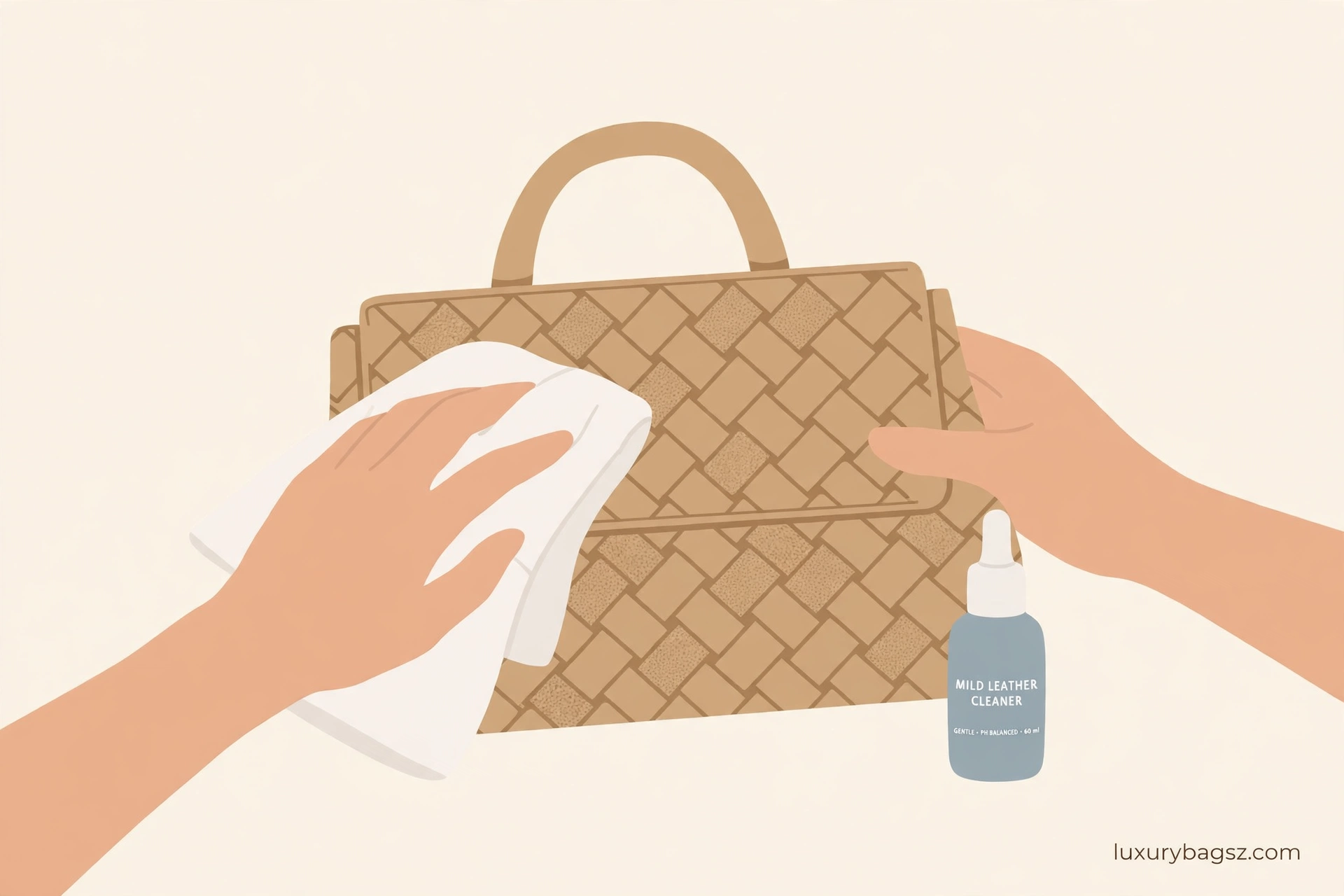
First, dust with a soft, dry microfibre cloth, working along the strips rather than across them, so you do not catch an edge. Second, put a small amount of mild leather cleaner on a clean, soft cloth — never sprayed directly onto soft woven leather — and wipe gently over one continuous panel at a time, not in isolated spots, so the finish stays even.
Third, wipe away residue with a second clean, barely damp cloth, again along the strips. Fourth, let the bag dry completely at room temperature before conditioning or storing it. If colour transfers to the cloth, or the surface changes after drying, stop: that leather is telling you the product or the method does not suit it, and a specialist should take over.
For dirt sitting in the weave gaps, use the corner of a damp cloth with light pressure, never a brush on soft woven leather and never a sharp tool. GLOWBAG allows a brush only on robust grained leather and coated canvas, not on soft weave, and that distinction matters: bristles catch strip edges and lift them.

Conditioning: Thin, Even, and Only When Needed
Conditioning keeps smooth leather supple and the colour fresh, but over-conditioning is the classic Intrecciato error. Excess product pools between the strips, dries unevenly, darkens patches and attracts dirt, leaving the weave looking blotchy. Thin and even is not a suggestion; it is the whole technique.
Apply conditioner to a soft cloth, not to the bag, and work it thinly and evenly across a continuous panel. Let it absorb and dry completely before handling the bag or putting it away. No polishing is needed, and a second coat should only follow if the leather still looks and feels dry after the first has dried.
How often? No house frequency could be verified from sources read, so treat this as practical guidance, not a house rule: a regularly carried smooth-leather bag typically needs conditioning only a few times a year, when the leather looks or feels dry, while a rarely carried bag stored well may need it once a year or less. Conditioning on a calendar, whether the leather needs it or not, is how pooling happens.
The guide on how to use Saphir Renovateur covers one widely used conditioner in detail, and its cautions apply here too: Renovateur suits smooth leather, so use it only on the smooth-leather parts of this guide, tested first on a hidden spot, and never on suede, patent or Tech nylon.
Lambskin Intrecciato: The Softest, the Most Careful
Lambskin is the signature Jodie leather: buttery, soft and quick to show marks. Clean it only with the step-by-step cleaning routine, with the lightest pressure in the guide, and never use a brush on it — GLOWBAG singles out very soft lambskin for exactly that warning. Condition thinly and rarely, since lambskin absorbs product fast and darkens easily if overfed.
Colour transfer is lambskin's biggest everyday risk, especially on light colours. Keep pale lambskin away from dark denim, new leather jackets and coloured straps, particularly when the bag is new.
If transfer happens, do not scrub: a gentle wipe with a barely damp cloth may reduce surface transfer, but transfer that has penetrated the finish often cannot be removed by surface cleaning, and scrubbing will damage the weave while failing to lift the mark.
Handle darkening deserves its own note. Skin oils darken lambskin handles and knots first, and the change is gradual enough to miss until it photographs badly. Wiping handles after heavy use and rotating with another bag slows it, but it cannot be reversed by cleaning once the oils have soaked in.
Calfskin and Nappa Intrecciato: Firmer, More Forgiving
Calfskin and Nappa weaves — the firmer Intrecciato used on many structured bags — tolerate the same step-by-step routine with slightly more confidence than lambskin, but the weave rules still apply: gentle pressure, product on the cloth, thin and even conditioning, no brushes on soft weave. Firmer does not mean invulnerable; strip edges still lift under rough handling.
Nappa needs one extra caution from GLOWBAG: highly porous or very absorbent Nappa, and delicate full-aniline Nappa, can absorb liquid quickly and change shade. If your Nappa darkens noticeably when barely damp, treat it as absorbent: use less product, work faster, and test more carefully. Pigmented or semi-aniline Nappa, by contrast, usually handles the standard routine well.
Calfskin's advantage is recovery. Light scuffs on firm calfskin often soften with gentle cleaning and a thin conditioning coat, where the same scuff on lambskin may stay visible. That does not make calfskin maintenance-free; it makes regular light care more rewarding, since the leather responds to it.
Suede Intrecciato: A Different Bag Entirely
Suede Intrecciato follows none of the smooth-leather routine. Do not use water, general leather cleaner or conditioner on it: GLOWBAG states plainly that its products are not suitable for suede, nubuck or velour, and that exclusion reflects the material, not the brand. Suede's open, napped surface absorbs liquid and mats under pressure, and woven suede adds strip edges that catch and fray.
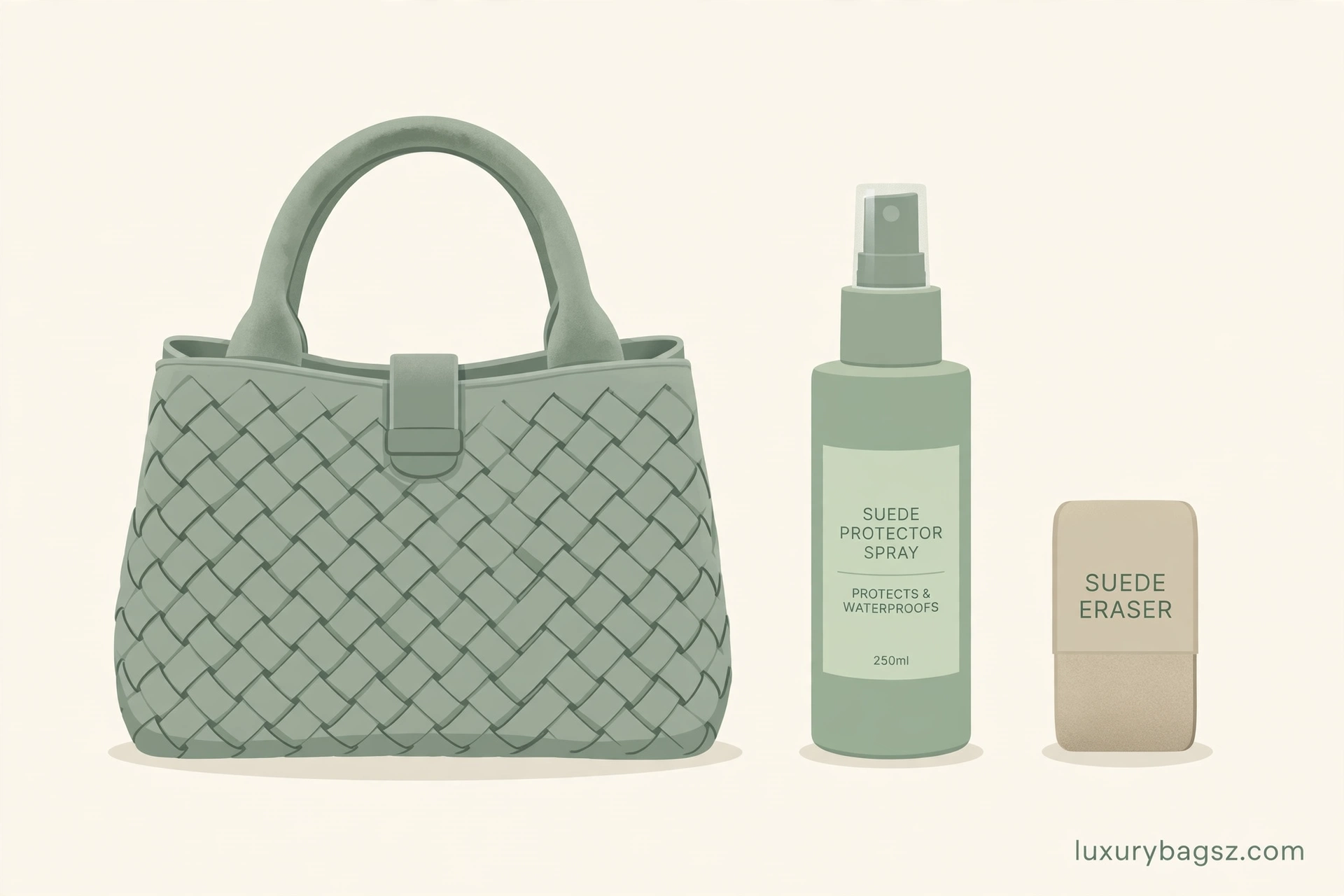
Care for suede weave starts before first wear: apply a suede protector, following the protector's own instructions, and reapply after the bag has been out in damp conditions.
For surface dirt, use a suede eraser with the lightest touch, working along the strips, and never a stiff brush across the weave. For anything deeper than surface dust — water marks, oil, dye transfer — use a suede specialist rather than a home method, since woven suede is easy to make worse.
Store suede away from light colours and dark denim alike, since suede both gives and takes colour transfer readily. If suede gets wet, blot gently and air-dry at room temperature, then restore the nap only once fully dry, with a soft suede brush used lightly and along the strips, never scrubbed across them.
Padded Lambskin: The Cassette Problem
Padded lambskin — the Cassette's puffy maxi weave — needs the lambskin routine plus one overriding rule: no pressure. Pillows dent under stacking, squeezing and leaning, and a dented pillow rarely recovers fully. Never put anything on top of a padded bag, never cram it into a tight space, and never carry it pressed hard against the body for hours if you can avoid it.
Clean padded weave with a barely damp soft cloth and the lightest pressure in this guide, and condition very thinly and rarely, since product pools in the valleys between pillows. Check pillows in daylight after cleaning: uneven darkening between pillow tops and valleys means too much product, and the bag should be left to dry fully before any further coat is considered.
Cracked glaze on pillow tops is the damage to watch for. It appears as fine cracking on the most exposed pillow surfaces, usually from sun, heat or over-handling. It cannot be fixed by conditioning, and home attempts to "seal" it usually make it worse. A specialist can advise whether the glaze can be stabilised, but a cracked pillow top is generally a wear mark to live with, not a fixable flaw.
Tech Nylon, Patent and Deerskin
Tech nylon Intrecciato is woven fabric, not leather, so leather care does not apply. Clean it with a damp cloth and a little mild soap, applied sparingly and blotted, never soaked, and let it air-dry completely.
GLOWBAG's cleaner can suit suitable nylon surfaces, but its conditioner is for genuine leather only and must not be used here. Watch strap ends for fraying, which is Tech's characteristic wear, and trim nothing yourself: a fraying strap end belongs with a repairer.
Patent Intrecciato has a sealed, glossy surface that needs different handling again. Clean it with mild cleaner on a soft cloth, never sprayed directly on, and do not condition it: GLOWBAG states the closed patent surface does not absorb conditioner the way uncoated leather does. Protect patent from heat and from prolonged contact with coloured materials, since colour transfer can penetrate the coating and become unremovable.
Deerskin, where it appears in Bottega weaves, is soft and suede-like in handling: gentle, dry-first cleaning, no harsh products, and specialist advice for stains. If you cannot confirm whether a soft, matte weave is suede or deerskin, treat it as suede: the suede routine is safe for both, while the smooth-leather routine is not.
When the Bag Gets Wet, Stained or Marked
Rain is the most common emergency, and the protocol is simple. Blot excess moisture gently with a clean cloth — never rub, since rubbing drives water into the weave gaps and across strip edges. Reshape the bag loosely, leave it open, and let it air-dry at room temperature away from sun. GLOWBAG repeats the heat warning for good reason: radiators and hairdryers dry the outside first, stiffen strips and set water marks.
For make-up and surface grime on smooth leather, the step-by-step cleaning routine usually lifts fresh marks: cleaner on a cloth, gentle wiping, full drying, then a thin conditioning coat only if the leather needs it. Make-up that has penetrated absorbent leather, and deeply absorbed stains generally, often cannot be removed completely by surface cleaning, and that limit should be accepted rather than scrubbed past.
Ballpoint pen is the hardest common stain. Fresh surface marks may reduce with careful cleaning, but ink that has penetrated deeper or discoloured the leather usually cannot be fully removed, and aggressive solvents or alcohol-based removers risk the finish and colour as well as the ink. For a valuable bag or a deep ink stain, professional cleaning is the better option from the start, not the last resort.
Damage: What You Can Fix, What Needs a Specialist
Lifted or curling strips are the signature Intrecciato damage. A strip that has just started to lift, with no fraying, can sometimes be secured by a leather repairer before it curls further; a strip that has curled, frayed or torn needs a specialist, and a home glue attempt risks stiffening the weave and staining neighbouring strips. Do not cut a lifted strip off, since the weave pattern cannot be patched invisibly by trimming.
Frayed edges, scuffed knots and worn handles follow the same rule: surface scuffs on smooth leather may soften with gentle cleaning and thin conditioning, but structural wear — a knot going soft, a handle thinning, an edge unravelling — belongs with a repairer.
Bottega's own spa or restoration service is the obvious question here, and it must be stated plainly: costs, turnaround times and what the house will and will not restore could not be verified from sources read for this guide, so ask the boutique directly before budgeting for it, and do not trust any guide that quotes a spa price without a source.
Colour transfer, water marks and cracked pillow glaze are covered in Parts 6, 9 and 11: all three are largely irreversible once set, which is why prevention dominates this guide. A bag with honest, even wear is normal; a bag with one deep, localised damage is a repair candidate, and the difference is worth a specialist's opinion before you spend anything.
Storage: Slouchy vs Structured
Storage is where woven bags are won or lost, and the rule splits by shape. Slouchy bags like the Jodie should be stuffed loosely — enough to stop the slouch collapsing into permanent creases, not enough to stretch the weave. Structured bags like the Cassette should be stuffed to hold their shape, with particular care for the pillows: fill the interior so the walls stand, but do not overstuff, since pressure dents pillows from the inside too.
Both shapes go in their dust bags, upright where possible, away from direct sun, heat and humidity extremes. Never hang a woven bag by its knot handle or a single strap for months: the handle takes the whole weight at one flex point, and knots and strap ends wear fastest exactly there. A shelf, not a hook, is the right home.
Light colours need separation from dark ones in storage as well as in wear. Do not store a pale woven bag touching dark denim, a dark leather jacket or a coloured dust bag that is not its own. Colour transfer in a closed, warm wardrobe happens slowly and is noticed late, when it is hardest to reduce.
The Never-Do List
Never brush soft woven leather. Never use harsh chemicals, solvents, bleach or abrasive pads on any Intrecciato. Never use steam, never dry on a radiator or with a hairdryer, and never soak a woven bag, since water collects in the weave gaps and dries unevenly.
Never over-condition, never spray product directly onto soft woven leather, and never clean isolated spots on smooth leather without blending across the panel, since spot cleaning leaves visible edges. Never use a smooth-leather product on suede, a conditioner on patent or Tech nylon, or a suede method on smooth leather: the material, not the weave, decides the product.
Never stack anything on a padded bag, never hang a woven bag by its handle long-term, and never ignore a lifted strip, a failing magnet or a fraying strap end. Small woven damage spreads along the weave, and the cheapest repair is always the earliest one.
Frequently Asked Questions
Can I use normal leather cleaner on Intrecciato?
Only if it suits your bag's actual leather. Intrecciato is a weave, not a leather type, so a cleaner fine for calfskin may be wrong for suede. Identify the leather first, test on a hidden spot, and never use a general cleaner on suede, patent or Tech nylon.
How often should I condition my woven bag?
Only when the smooth leather looks or feels dry — typically a few times a year for a regularly carried bag, less for a stored one. No house frequency could be verified, so condition on need, not on a calendar, and always thinly and evenly.
Can I brush my Intrecciato bag?
Not soft woven leather. Brushes catch strip edges and lift them. A brush is acceptable only on robust grained leather and coated canvas, not on soft lambskin, calfskin or padded weave.
What do I do if my woven bag gets wet?
Blot gently, reshape loosely, and air-dry at room temperature away from sun. Never rub, never use a radiator or hairdryer, and never condition until the bag is completely dry.
How do I clean suede Intrecciato?
With a suede protector before wear and a suede eraser for surface dirt, used lightly along the strips. Never use water, leather cleaner or conditioner on suede weave; deeper stains belong with a suede specialist.
Why does conditioner darken my bag in patches?
Excess product pools between the strips and dries unevenly. Apply conditioner to the cloth, not the bag, work thinly across a whole panel, and let it dry fully before judging the result or adding more.
Can a lifted weave strip be repaired?
A strip that has just lifted can often be secured by a repairer before it curls. A curled, frayed or torn strip needs a specialist, and home glue risks stiffening the weave and staining neighbouring strips. Never cut a lifted strip off.
How should I store a Jodie versus a Cassette?
Stuff a slouchy Jodie loosely to prevent creasing without stretching the weave, and stuff a structured Cassette to hold its shape without denting the pillows. Both go in dust bags, upright on a shelf, never hung by the handle.
Does Bottega offer a spa service for woven bags?
The house is known for restoration services, but costs, turnaround and what it will and will not restore could not be verified from sources read for this guide. Ask the boutique directly rather than relying on an unsourced price.
What is the single biggest Intrecciato care mistake?
Over-conditioning, followed closely by brushing soft weave. Both damage the weave itself rather than the surface, and both are easy to avoid: thin product on a cloth, gentle wiping along the strips, and nothing else.
Conclusion
Intrecciato care is not one routine but six, chosen by leather, and one discipline applied to all of them: gentleness. Work along the strips, use product sparingly on a cloth, condition only when the leather needs it, and store the bag stuffed, dust-bagged and unhung.
The weave rewards that discipline visibly. A woven bag cared for this way keeps its tension, its edges and its colour far longer than one cleaned hard and conditioned often, and it arrives at resale with the even, honest wear buyers pay for. A woven bag cleaned like flat leather, by contrast, shows it in lifted strips, blotchy panels and dented pillows.
Identify your leather, use only its part of this guide, and stop at the first sign of colour transfer or damage you cannot explain. The cheapest Intrecciato repair, as with every part of this guide, is the one you never need.