

Do Prada Bags Hold Their Value?
The Short Version: Some Do, Most Do Not — the Model Matters Most
Prada bags, as a group, do not hold their value the way the very strongest resale names do. That is the honest headline, and it surprises buyers who assume every famous luxury house behaves the same way. Within Prada, though, the range is wide.
A classic Galleria or a sought-after Re-Edition in excellent condition can retain a respectable share of its retail price, while a seasonal, trend-led piece can fall much further, much faster.
The reason is not quality. Prada construction, materials, and design are widely respected, and that respect is part of why the bags sell well in the first place. Retention is driven by something narrower: how many buyers want that exact bag, in that colour and condition, at a given moment. Classic shapes with steady demand hold up. Loud, one-season shapes depend on a smaller, faster-moving buyer pool, and their prices reflect that risk.
So the useful question is not whether Prada holds value in general. It is whether the particular Prada bag in front of you, at its particular price, is likely to hold value for you. This guide answers that question model by model, material by material, and condition by condition, with the caveats stated plainly where sources disagree.
Key Takeaways
- Prada retention is mixed. Classic, neutral, well-kept models retain more than seasonal or heavily trend-led designs.
- Galleria and Re-Edition styles are among the stronger Prada resale performers, though neither is immune to price falls.
- Nylon Prada bags sell well as everyday bags, but their lower retail prices and wide availability limit how much value they can retain in absolute terms.
- Condition, completeness, colour, and size move a Prada price more than the brand name alone.
- Retail price rises do not automatically lift resale prices. Resale follows buyer demand for the pre-owned piece, not the boutique price tag.
- Buying pre-owned, in excellent condition, is often the best value route for a Prada bag, because the first owner has already absorbed the steepest fall.
Part 1: What "Holding Value" Actually Means
Holding value is a ratio, not a feeling. It compares what a bag sells for pre-owned with what it cost at retail, usually at the time it was bought, though some comparisons use the current retail price instead. Those two bases give different answers, and sellers sometimes mix them up, accidentally or otherwise, so always ask which basis a figure uses.
A bag bought for 2,000 and sold pre-owned for 1,000 has retained 50 percent of its original price. A bag bought for 2,000, whose current retail price has risen to 2,500, and which sells pre-owned for 1,000, has retained 50 percent of its purchase price but only 40 percent of current retail. Both statements are true, and the second one looks worse.
Neither tells you whether the seller did well, because condition, timing, and selling fees also sit between the figures.
Fees matter just as much. A private sale at 1,000 banks close to 1,000 before any payment or delivery costs, while a consignment sale at 1,000 banks 1,000 minus commission and fees. When you compare retention claims from different sellers, compare net amounts where you can, and treat any claim that ignores fees as incomplete.
Time matters too. A bag that sells quickly at 60 percent retention is often a better outcome than a bag listed for a year at 80 percent that never sells. Retention figures quoted without a timescale describe hope, not a market. The figures in this guide are therefore described as broad, observed ranges for comparable pre-owned sales, not as promises for any single bag.
Part 2: Prada's Position in Resale — Strong Brand, Mid-Pack Retention
Prada sits in an interesting middle position in resale. It is a major luxury house with global recognition, strong design identity, and a loyal buyer base, which keeps demand alive for its bags. It does not, however, benefit from the same scarcity-driven resale dynamics as houses that restrict supply, run waiting lists for core bags, or raise prices sharply while limiting availability.
That difference explains much of the gap. When a bag is readily available new, buyers have less reason to pay close to retail for a pre-owned example. They can simply buy new, with full packaging, a boutique experience, and a warranty route. Pre-owned Prada must therefore compete on price, and that competition pushes values down, especially for current, widely available models.
Prada's design breadth also affects retention. The house produces classic leather bags, nylon bags, playful seasonal pieces, and runway-led experiments side by side. That range is a strength at retail, because it offers something for many tastes, but it dilutes resale demand, because buyers looking for a classic bag are not the same buyers looking for a novelty piece.
Resale rewards narrow, repeated demand, and Prada's catalogue is broad by design.
None of this makes Prada a poor purchase. A bag bought to be carried, loved, and kept for years does not need to retain 80 percent of its price to be good value. Retention matters most when you plan to resell soon, when you are choosing between two bags at similar prices, or when you are buying pre-owned and want to know how much further a price might fall. For those decisions, the model-level detail below matters more than any brand-level label.
Part 3: The Galleria — Prada's Steadiest Resale Performer
The Galleria, Prada's structured top-handle tote in Saffiano leather, is usually the first name mentioned in any Prada retention discussion, and for good reason. It is a long-running, recognisable, work-friendly shape, produced in practical colours and sizes, with a buyer pool that includes professionals, collectors, and first-time luxury buyers alike. That breadth of demand is exactly what supports resale value.
In excellent condition, with its dust bag, cards, and lock accessories where applicable, a Galleria commonly retains a higher share of its retail price than most other Prada styles. Broadly, well-kept, neutral-coloured examples in popular sizes are often seen selling at roughly half to two-thirds of their original retail price, though individual sales fall outside that range in both directions.
Smaller or less popular colours, heavy wear, or missing accessories push the figure lower.
Size matters within the Galleria range. Medium sizes that suit daily use tend to attract more buyers than very small or very large versions, which suit fewer people. Colour matters just as much. Black, dark brown, and other neutrals sell more reliably than bright or seasonal colours, which appeal to fewer buyers and can sit longer.
A bright Galleria is not a bad bag, but it is a narrower resale proposition, and its price should reflect that from the start.
Saffiano leather itself helps retention, because it resists scratches and scuffs better than softer leathers and keeps its structure over time. A Galleria that still looks crisp, with clean corners, even stitching, and hardware without deep scratches, photographs well and reassures buyers. A Galleria with sagging sides, stained lining, or worn handles tells a different story, and buyers price that story in without hesitation.

Part 4: Re-Edition, Cleo, and the Revival Effect
Prada's revived designs, led by the Re-Edition range, show how fashion cycles can lift resale value for a time. When a house reissues a beloved older design, demand rises from both nostalgic buyers and new buyers who missed the original. For a period, pre-owned examples of the reissued style, and sometimes of the original vintage versions, can sell strongly.
The Re-Edition nylon bag, with its small, shoulder-friendly shape and accessible retail price, became a visible everyday bag, and its resale market reflects that visibility. Because its retail price is lower than a leather Galleria, its absolute resale price is also lower, but as a share of retail it can hold up reasonably well when the style is in fashion. The risk is fashion itself: when the revival wave passes, demand cools, and prices soften.
A Re-Edition bought at the peak of a trend, at full retail, is more exposed to that cooling than one bought pre-owned after the wave has settled.
The Cleo, a sleeker, more sculptural shoulder bag, follows a similar pattern with a different buyer. Its appeal is style-led, and style-led bags depend on current taste more than classic totes do. Early demand can be strong, especially for popular colours, but style-led retention is harder to predict over several years. Buyers who love the shape and plan to carry it for a long time need not worry about that uncertainty.
Buyers who plan to resell within a year or two should watch current listings closely, because a style-led bag's price can move quickly in either direction.
Vintage Prada, including original versions of revived designs, adds another layer. Genuine vintage pieces in good condition can attract collectors, and scarcity can lift prices above those of current reissues. Vintage condition is often more variable, though, with older nylon, linings, and hardware showing age in ways that modern pieces do not yet.
A vintage premium applies to the right piece in the right condition, not to every old Prada bag by virtue of age alone.
Part 5: Nylon Bags — Everyday Value, Modest Retention
Nylon is central to Prada's identity, and nylon bags deserve a fair assessment rather than a dismissive one. Prada nylon is durable, light, water-resistant in a practical sense, and easy to carry daily, which is why so many owners love these bags.
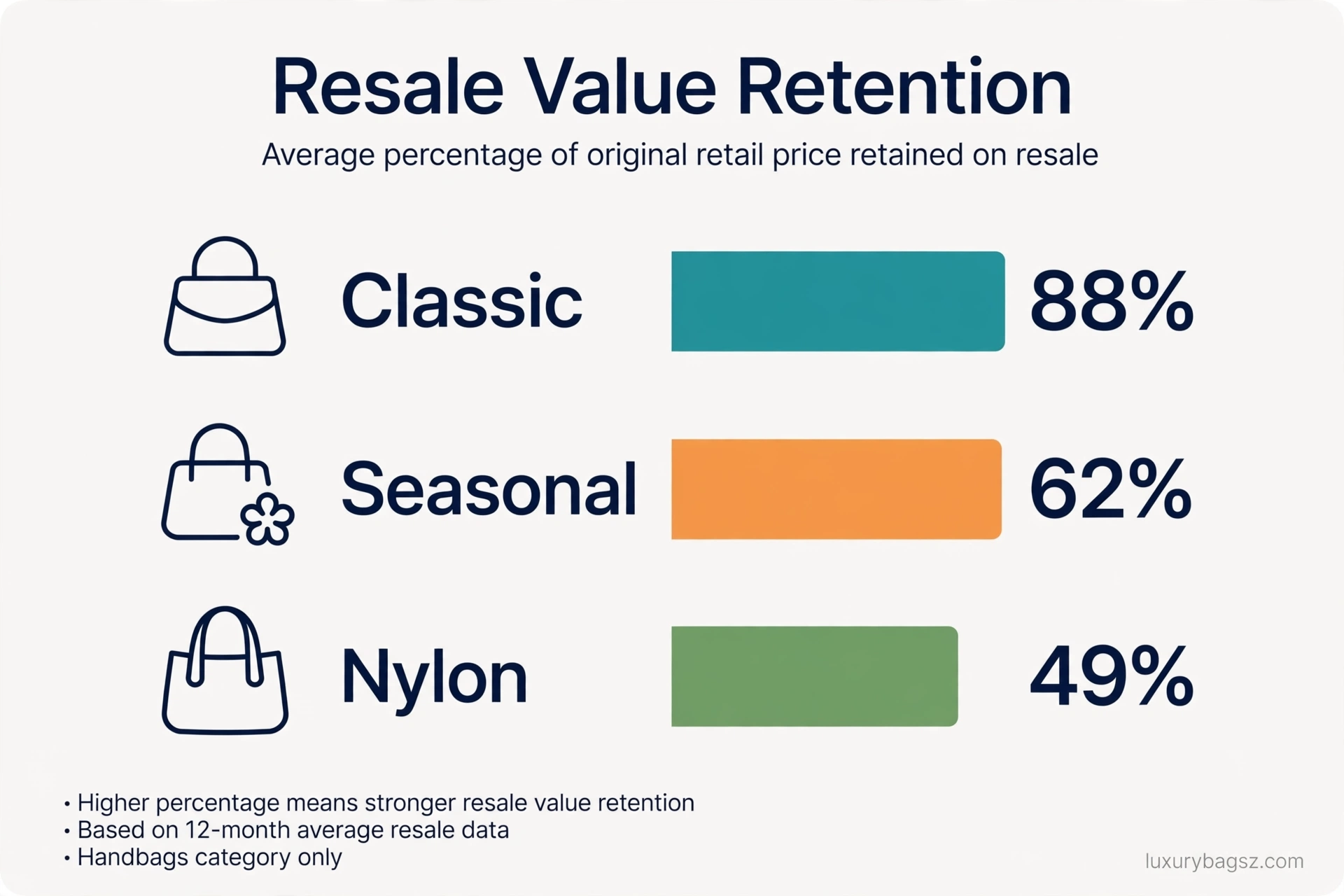
Those same qualities, however, limit resale retention in a specific way: nylon bags are widely available, often at lower retail prices than leather bags, and buyers treat them as practical purchases rather than collectible ones.
A nylon bag that cost far less at retail cannot retain as much money in absolute terms, even if its percentage retention looks respectable. A bag bought for 800 and sold for 400 has retained 50 percent, but the seller has still lost 400. A leather bag bought for 2,500 and sold for 1,250 has also retained 50 percent, but the cash loss is larger.
Percentage and cash loss answer different questions, and buyers should look at both before deciding which figure matters to them.
Nylon condition is judged differently from leather condition. Fraying at handles, staining, fading, and damage to the lining or zips matter more than the fine scratches that dominate leather assessment. A nylon bag with clean fabric, intact stitching, and working hardware sells far better than one with visible wear, even if the wear seems minor to the owner.
Photographs in strong daylight show nylon wear honestly, and buyers reward that honesty with faster sales.
Limited or collaboration nylon pieces can break the pattern, because scarcity adds a collector layer on top of practical value. Those pieces are the exception, not the rule, and their premiums depend on the collaboration's popularity and on how many pieces reach the resale market. A standard nylon bag should never be bought in the hope of a collaboration-style premium.
Part 6: Saffiano, Leather, and Other Materials
Material choice runs through every Prada retention discussion, because different materials age differently and attract different buyers. Saffiano leather, with its crosshatch texture and coated finish, is the workhorse of Prada retention. It resists scratches, holds shape, and cleans more easily than soft, uncoated leathers, which helps a bag look newer for longer. That visible durability translates directly into buyer confidence.
Softer leathers, including nappa and similar finishes, feel more luxurious in hand but show wear sooner. Scratches, darkening on handles, and corner rubbing appear faster, and buyers discount for them. A soft-leather Prada bag in excellent condition can still sell well, especially in a classic shape, but it needs more careful ownership to reach the same resale condition as a Saffiano equivalent.
Owners who carry a soft-leather bag daily without protection should expect that reality to show in the price.
Exotic or special materials, and heavily embellished designs, sit at the far end of the retention range. They appeal to a narrow buyer pool, they can be harder to authenticate and maintain, and their retail prices are often high, which leaves more room to fall. A special-material bag bought for personal pleasure can be a wonderful purchase, but it should not be bought as a value store.
The same logic applies to bags with prominent seasonal prints or logos that date quickly.
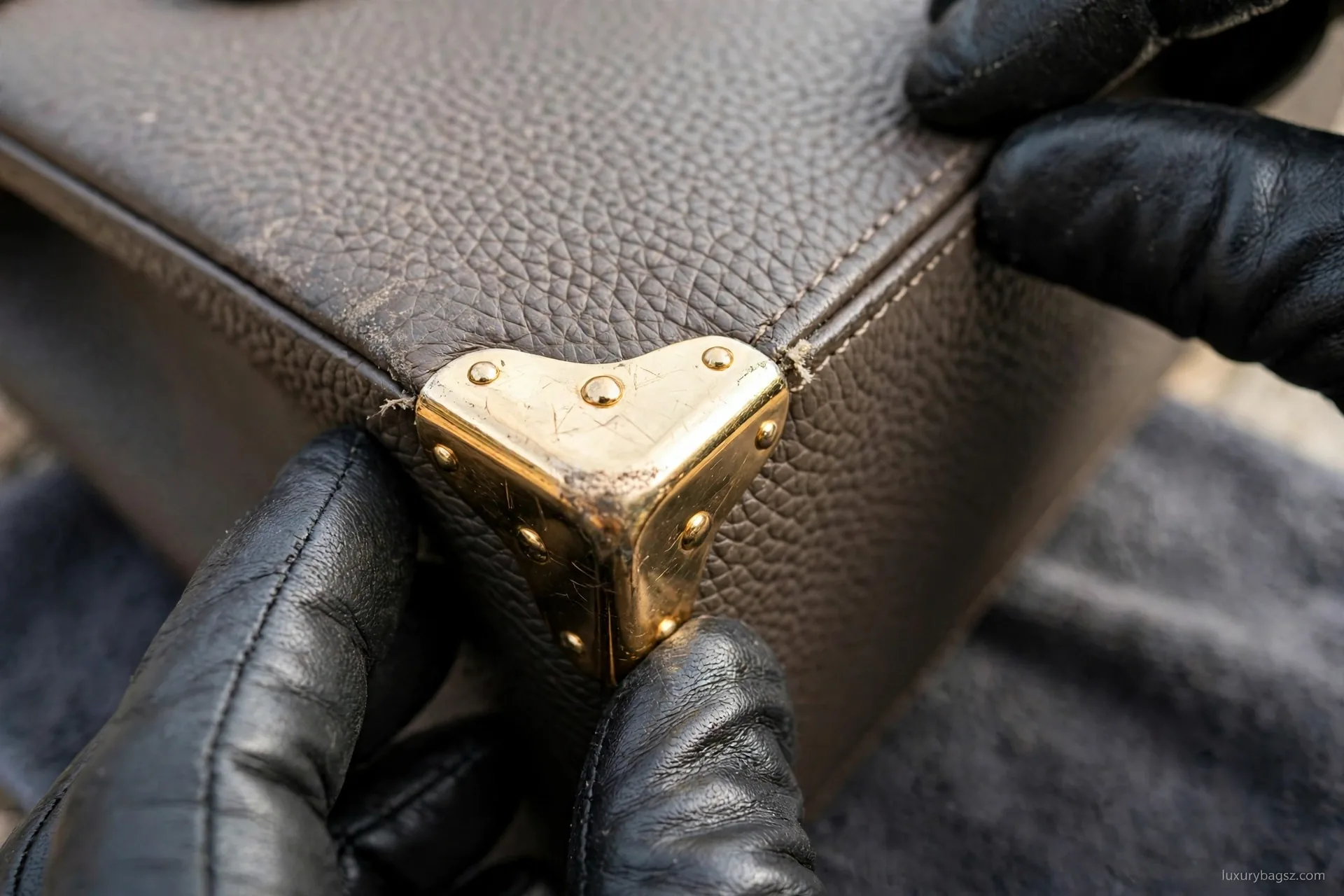
Hardware and lining also affect material-level value. Gold-tone hardware that has lost plating, zips that catch, and linings with stains or tears all reduce a price, whatever the outer material. A bag that looks excellent outside but disappoints inside will still face a discount, because buyers inspect interiors closely and because lining repair is rarely cheap or invisible.
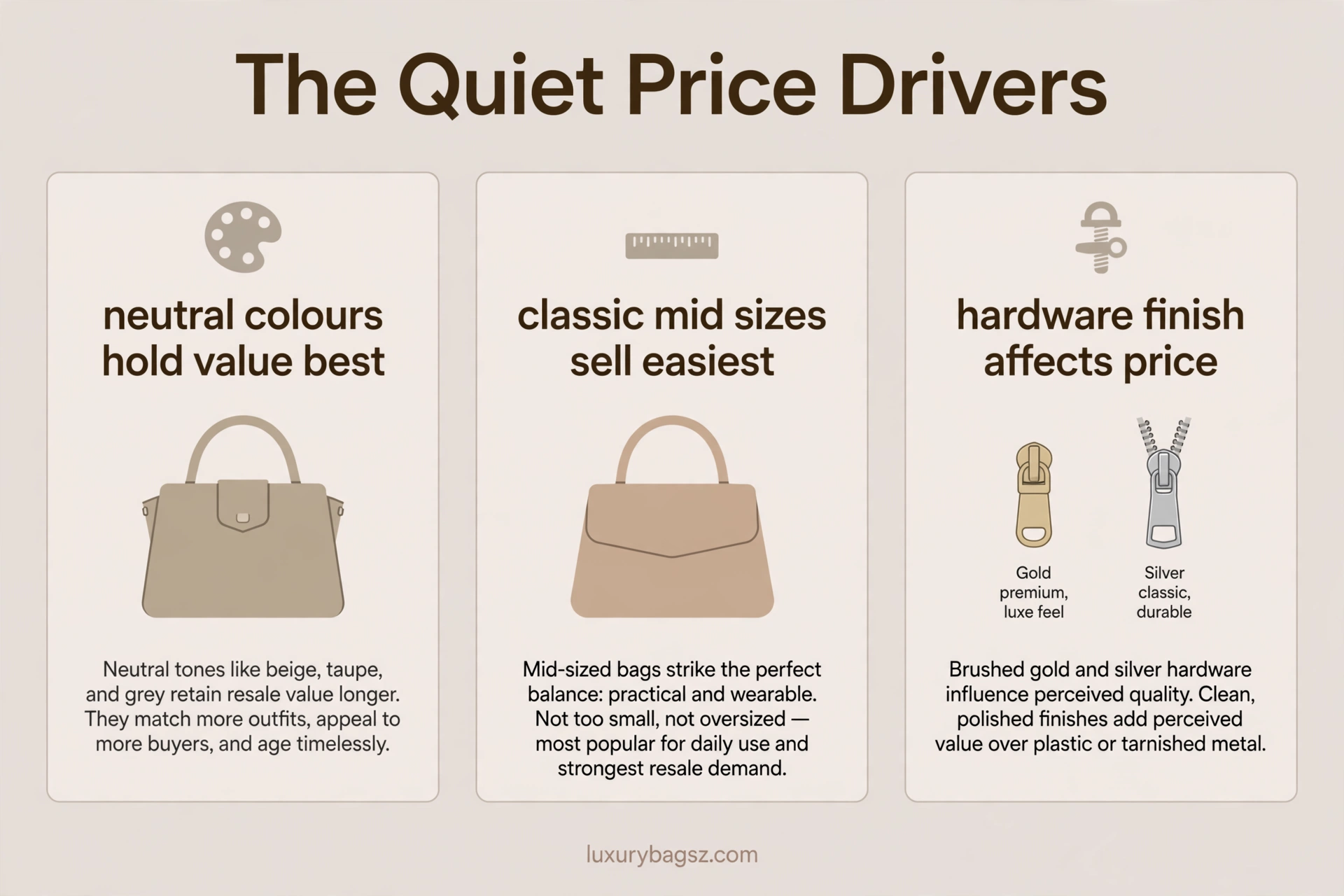
Part 7: Colour, Size, and Hardware — The Quiet Price Drivers
Colour is one of the strongest quiet drivers of Prada resale value. Neutrals such as black, dark brown, beige, and navy attract the widest buyer pool, because they suit work, travel, and everyday wear without clashing. They also photograph reliably, which helps online sales. Bright colours, pastels, and bold prints attract fewer buyers, and their prices reflect that narrower demand, even when the bag itself is in perfect condition.
Seasonal colours deserve special care. A colour tied to one fashion season can feel dated quickly, and buyers know it. That does not mean seasonal colours never sell, because a collector or a buyer who loves that exact shade will pay well for it. It means the seller may wait longer for that buyer, and may need to price for patience rather than for a quick sale. If you need a fast sale, a neutral bag is simply easier to move.
Size follows the same logic. Medium, everyday sizes suit the most people and therefore hold value best. Very small bags suit a fashion-led buyer who values the look over capacity, while very large bags suit a buyer who needs to carry a great deal. Both extremes have buyers, but fewer of them, and their prices move more with fashion than with steady demand.
Before buying a Prada bag at an extreme size, check how many comparable pre-owned examples are currently listed and how long they have been sitting.
Hardware colour, usually gold-tone or silver-tone, matters less than colour and size, but it still influences buyers. Some buyers strongly prefer one finish, and a bag in the less popular finish for its model may sit longer. Hardware condition matters more than hardware colour in every case. Scratched, chipped, or replaced hardware raises questions about authenticity and care, and buyers discount for that uncertainty even when the bag is genuine.
Part 8: What Actually Lowers a Prada Price
Several factors lower a Prada price predictably, and knowing them helps both sellers and buyers. Wear is the first. Corner rubbing, handle darkening, hardware scratches, and lining marks are all priced in by buyers, and the discount grows with visibility. A flaw on a handle, which every buyer sees, costs more than a flaw inside a pocket, which few buyers will notice in daily use.
Missing accessories are the second factor. Dust bags, authenticity cards, booklets, straps, and locks, where applicable, all contribute to buyer confidence. A bag missing its strap, in particular, can lose a large share of its value, because a replacement strap may be hard to source and may not match. Sellers should state exactly what is included, and buyers should check that statement against the photographs before paying.
Repairs and restoration form the third factor. A well-done, disclosed repair may have little effect on price, especially if it restores function without changing appearance. An undisclosed repair, a redye, or a hardware replacement can reduce value sharply, because buyers cannot tell how much of the bag is original.
Disclosure protects the seller as much as the buyer, because a buyer who discovers a hidden repair after purchase is far more likely to return the bag than a buyer who knew about it and priced it in.
Market timing is the fourth factor. A bag listed during a period of heavy discounting at retail, or when many similar bags flood resale platforms, will face more competition and lower prices. A bag listed when supply is thin and demand is steady will do better. Sellers cannot control the market, but they can control whether they list into a crowded moment or wait for a quieter one.
Part 9: Buying Pre-Owned Prada for Value
Buying pre-owned is where Prada retention works in the buyer's favour. The first owner has already absorbed the steepest fall from retail, so a second owner who buys well, in excellent condition, at a fair pre-owned price, faces a much smaller further fall. In some cases, a well-bought classic may hold steady for years, because its pre-owned price already reflects realistic demand.
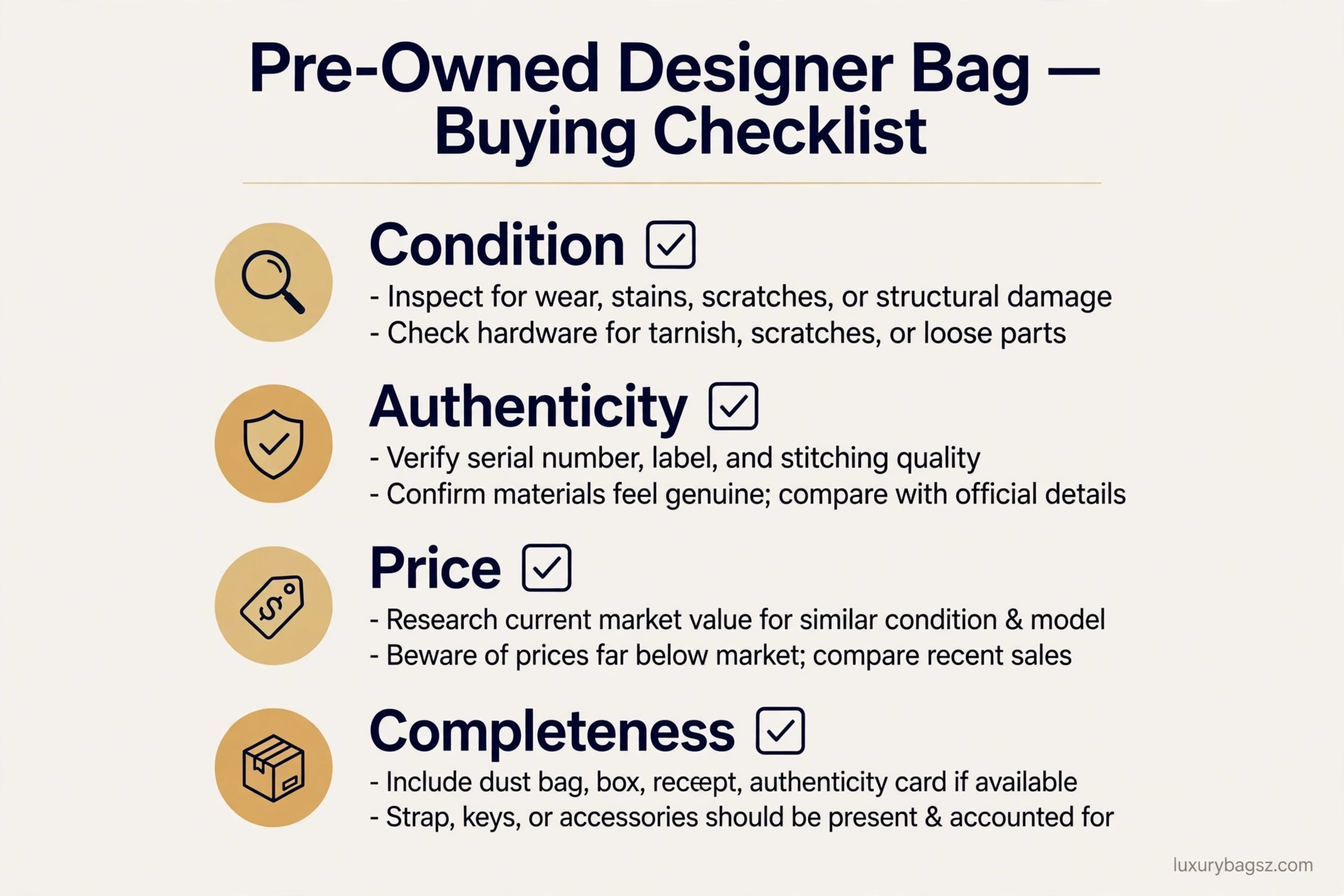
Start by comparing the pre-owned price with current retail and with other pre-owned examples of the same model, colour, size, and condition. A price far below comparable examples deserves scrutiny, not celebration, because it may signal a condition issue, missing accessories, or an authenticity problem.
A price far above comparable examples needs a reason, such as exceptional condition, a rare colour, or a full set of accessories, and that reason should be visible in the listing.
Check authenticity with the same care you would for any luxury bag. Prada bags carry date codes, hardware details, stitching patterns, and material finishes that vary by era, and a specialist check is worthwhile for valuable pieces. A seller who provides clear photographs of codes, hardware, and interior details, and who answers questions plainly, is a better prospect than a seller who offers only glamour photographs and vague assurances.
Condition photographs matter most for nylon and Saffiano bags, where wear shows in specific places. Ask for photographs of corners, handles, base, hardware, interior, and zips, and do not accept a listing that hides any of them. If a seller refuses a reasonable photograph request, treat that refusal as information and move on. There are many Prada bags on the market, and no single bag is worth a risky purchase.
Part 10: Selling Prada for the Best Return
Sellers who achieve the best Prada returns usually do the same few things well. They present the bag honestly, with many clear photographs and a complete description. They include every accessory they hold, and they state plainly what is missing. They price by comparing recent sales of comparable bags, not by adding a hopeful margin to what they paid. And they choose a selling route that matches the bag's value and their deadline.
Timing a sale helps too. Listing a classic bag when demand is steady, rather than during a retail sale period when new bags are discounted, can protect the price. Listing a seasonal bag while its style is still visible in fashion coverage, rather than after it has faded, can also help, though it requires the seller to act while the trend is live.
Waiting for a perfect moment is rarely wise, because trends are only clear in hindsight, but listing into an obviously crowded or discounted moment is avoidable.
Selling fees should be calculated before listing, not discovered after a sale. A private sale may bank more but take longer and carry more risk. A consignment sale may reach more buyers but cost commission. An auction sale may achieve a strong result for a rare piece but take months and cost fees on the result. The best route is the one that leaves the most money, after fees, in the seller's hands, within a timescale the seller can accept.
Finally, keep expectations realistic. A Prada bag that retains half its retail price after several years of enjoyable use has done well by resale standards for this house. A bag that retains more is a bonus, often explained by a classic model, a neutral colour, excellent condition, and good timing. A bag that retains less is not necessarily a failure, especially if it was bought for daily pleasure rather than as a financial asset.
Luxury bags are purchases first and investments only in rare, specific cases, and Prada is no exception to that rule.
Part 11: Retail, Outlet, and Sale Prices — How They Change the Maths
A bag's retail history changes how its resale value should be judged, and Prada buyers need to understand the difference between full retail, outlet, and sale prices. A bag bought at full price in a boutique and a bag bought at a discount in an outlet or during a sale are the same bag in resale terms, but the sellers' experiences of retention will differ sharply.
The outlet buyer paid less, so the same pre-owned sale price represents a higher retention share for them, even though the bag itself has not changed.
This matters when you read retention claims online. A seller who reports retaining 70 percent may have bought at a discount, while a seller who reports retaining 40 percent may have bought at full price. Both can be telling the truth about different purchases. When you compare claims, ask what the seller paid, not just what they sold for, and when you set your own expectations, base them on your purchase price, not on someone else's bargain.
Outlet and past-season Prada bags also enter resale in larger numbers, which affects supply. A model that appears frequently in outlets will usually have more pre-owned examples competing with each other, and that competition holds prices down. That is not a criticism of outlet buying, which can be excellent value for a bag you plan to keep.
It is a warning against buying an outlet bag in the hope of reselling it at a premium, because the same outlet route that gave you a discount is available to other buyers too.
Sale periods at retail have a similar effect, though shorter-lived. When a current model is discounted new, pre-owned sellers must compete with that discounted new price, not with the original full price. A pre-owned bag priced above a discounted new equivalent will struggle, however good its condition. Sellers who need to move a bag during a retail sale should price against the sale price, not against the price they remember paying.
Finally, remember that currency and region affect Prada prices as well. Retail prices differ by country, and resale platforms serve buyers across regions, so a bag that looks cheap in one currency may look expensive in another after conversion and shipping. If you buy pre-owned from another country, factor in duties, taxes, and delivery costs before judging whether the price is genuinely good value.
A bargain that becomes expensive at the border was never a bargain at all.
Frequently Asked Questions
Do Prada bags hold their value?
Some do, reasonably well, and many do not. Classic models in neutral colours and excellent condition retain more than seasonal or trend-led designs. As a group, Prada retention sits below the strongest resale houses, but well above fashion brands with no collector base.
Which Prada bag holds its value best?
The Galleria is usually the strongest Prada performer, thanks to its long-running classic shape, practical sizes, and durable Saffiano leather. Re-Edition styles can also perform well while their revival demand lasts, though their retention is more fashion-dependent.
Do Prada nylon bags hold their value?
Nylon bags hold value modestly in percentage terms, but their lower retail prices mean the cash retained is smaller than for leather bags. They sell well as everyday bags, yet wide availability and practical-buyer expectations limit how much premium they can command pre-owned.
How much do Prada bags lose in value?
It varies widely by model, colour, size, and condition. Well-kept classic examples are often seen at roughly half to two-thirds of original retail, while seasonal, worn, or incomplete examples can fall well below half. Individual sales fall outside any broad range, so check comparable recent sales for the exact bag.
Does a Prada price rise increase its resale value?
Not automatically. Resale follows demand for the pre-owned bag, not the boutique price. A retail rise can help if it makes pre-owned examples look better value, but it can also push buyers towards new bags on sale, which weakens pre-owned prices.
Is it better to buy Prada new or pre-owned?
For value, pre-owned in excellent condition is usually better, because the first owner has absorbed the steepest fall. Buying new makes sense when you want a full set, a warranty route, a specific new colour, or a boutique experience that pre-owned cannot offer.
What colour Prada bag holds value best?
Neutrals such as black, dark brown, beige, and navy usually hold value best, because they attract the widest buyer pool. Bright, pastel, and seasonal colours can sell well to the right buyer, but they typically take longer and achieve lower prices on average.
Does condition affect Prada resale value a lot?
Yes, greatly. Corner wear, handle darkening, hardware scratches, lining marks, and missing accessories all reduce price, and visible flaws cost more than hidden ones. A bag in excellent condition with a full set can command a clear premium over a worn example of the same model.
Are vintage Prada bags worth more?
Some are, especially genuine vintage versions of revived designs in good condition, where scarcity adds collector interest. Age alone does not add value, and vintage pieces with heavy wear, damaged linings, or replaced parts can sell for less than modern equivalents.
Should I buy a Prada bag as an investment?
No, not as a general rule. Prada bags are purchases to enjoy, and only rare, classic, excellent-condition examples bought well pre-owned have a realistic chance of holding steady. Buy a Prada bag because you want to carry it, and treat any resale return as a bonus.
Conclusion
Prada bags hold their value selectively, not universally. The Galleria and other classic, neutral, well-kept models retain a respectable share of their price, while seasonal, bright, worn, or incomplete bags fall further and faster.
That pattern gives buyers a clear strategy. Buy classic shapes, in neutral colours, in excellent condition, preferably pre-owned, and you limit your downside. Buy trend-led pieces at full retail for short-term resale, and you accept the risk that fashion moves before you do.
Prada remains a house worth buying from, for design, quality, and everyday pleasure. Just do not buy it on a promise of value retention that its resale market, honestly read, does not make for every bag. Buy the bag you will carry happily, at a price that reflects its real resale standing, and let retention be a welcome bonus rather than the reason for the purchase.
A classic Galleria bought pre-owned, in a neutral colour, in excellent condition, is about as safe a Prada purchase as resale allows, and it is a good place to start for any buyer who cares about value as well as style.






