

2026 Luxury Price Increases: Chanel, Hermès, Louis Vuitton and Cartier Explained
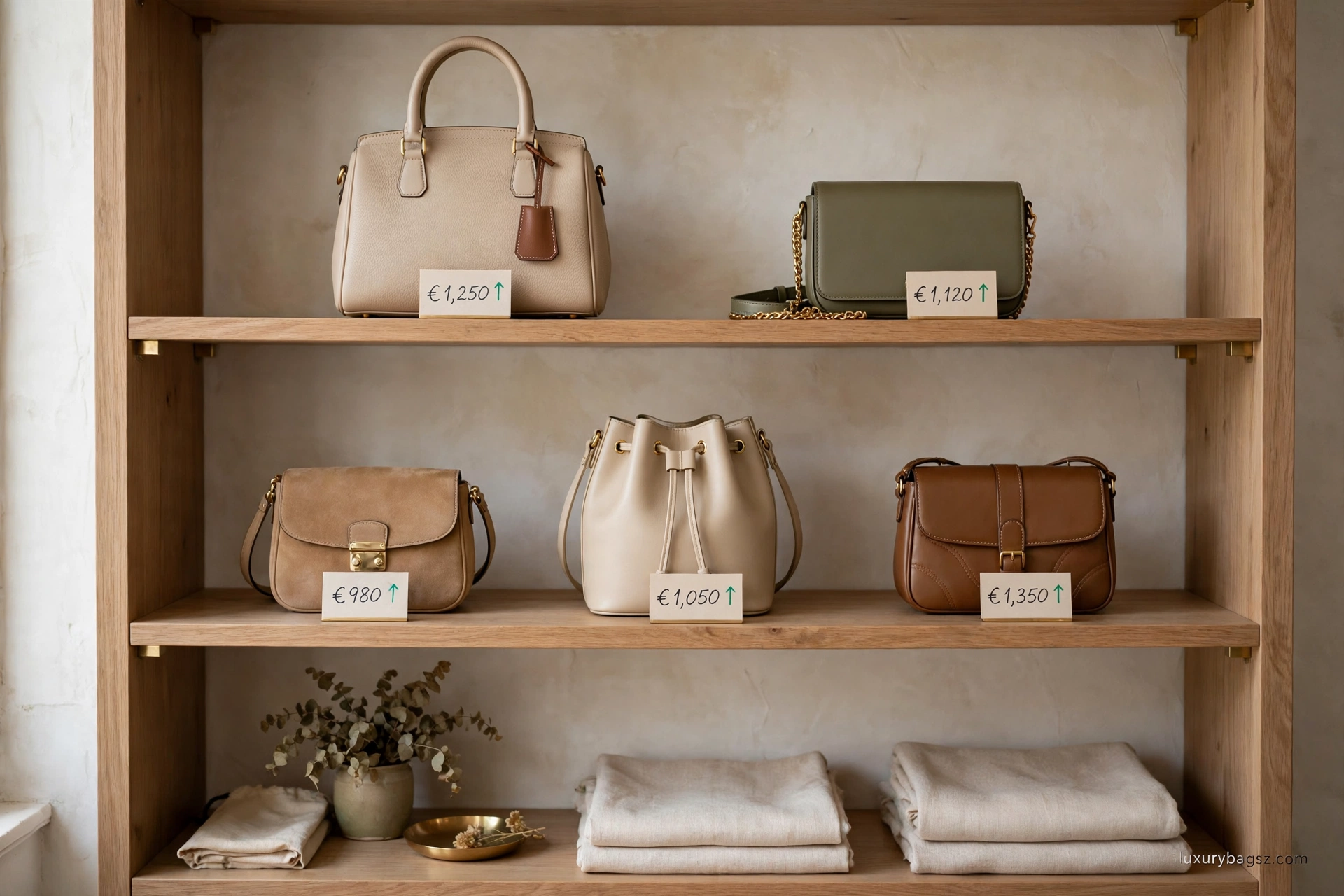
2026: The Year Every House Moved
Every major luxury house raised prices in 2026, but not together and not equally. Trackers reported Hermès moving first on 1 January, Chanel twice in spring and autumn, and Louis Vuitton and Cartier in May.
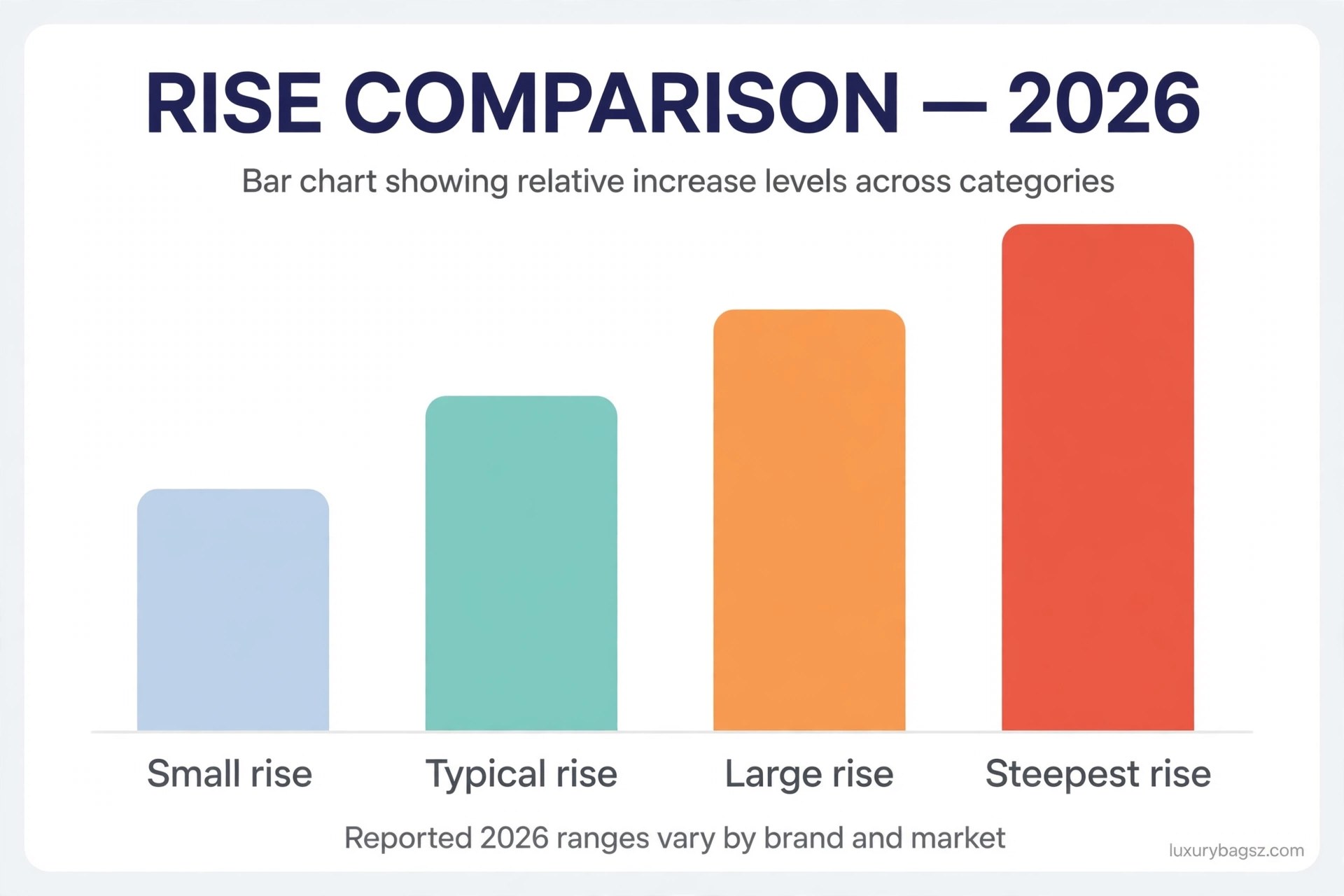
Most rises landed between about 2% and 11% depending on house and category. This guide sets out what was reported for each house, why the pattern keeps repeating, and how buyers can plan around it.
Key Takeaways
- Hermès opened the year: trackers reported US bag prices up about 4–11% from 1 January 2026.
- Chanel moved twice, in April and again in September, with reported rises around 2–5% and flat increases on some lines.
- Louis Vuitton's May rise was reported at about 2.1–5.7% on handbags; Cartier's May rise covered watches at about 4–9.9%.
- All figures here are as reported by price trackers and retailers, not audited brand data.
- The practical defence is timing: buy before known rounds, and never let a rumoured rise rush a wrong purchase.
The 2026 Pattern at a Glance
The year's rises shared a shape. Each house moved on its own traditional date, kept the change quiet in advance, and applied it overnight so yesterday's price simply stopped existing.
Percentages looked modest individually. Compounded over a few years, they are the reason bags that cost four figures a decade ago now cost five, and why resale prices keep being pulled upwards behind them.
A worked example makes it real. A bag rising 5% a year for five years ends up about 28% dearer, even though no single year's headline sounded dramatic. The 2026 rises sit on top of exactly that kind of staircase.
It is also why "waiting for a better price" has been a losing strategy at the top houses for a decade. The direction has not reversed in any recent year; only the steepness changes.
It also matters where you buy. The same rise lands differently by market, because currency movements sit on top of the headline percentage.
A second pattern is worth naming: the rises were announced to almost no one. Houses rarely confirm dates or percentages in advance, so the figures in circulation come from trackers, retailer staff and buyers comparing receipts.
That information gap is itself part of the system. Uncertainty keeps buyers attentive and slightly hurried, which suits a business model built on deciding quickly at the boutique counter.
The Calendar of Rises
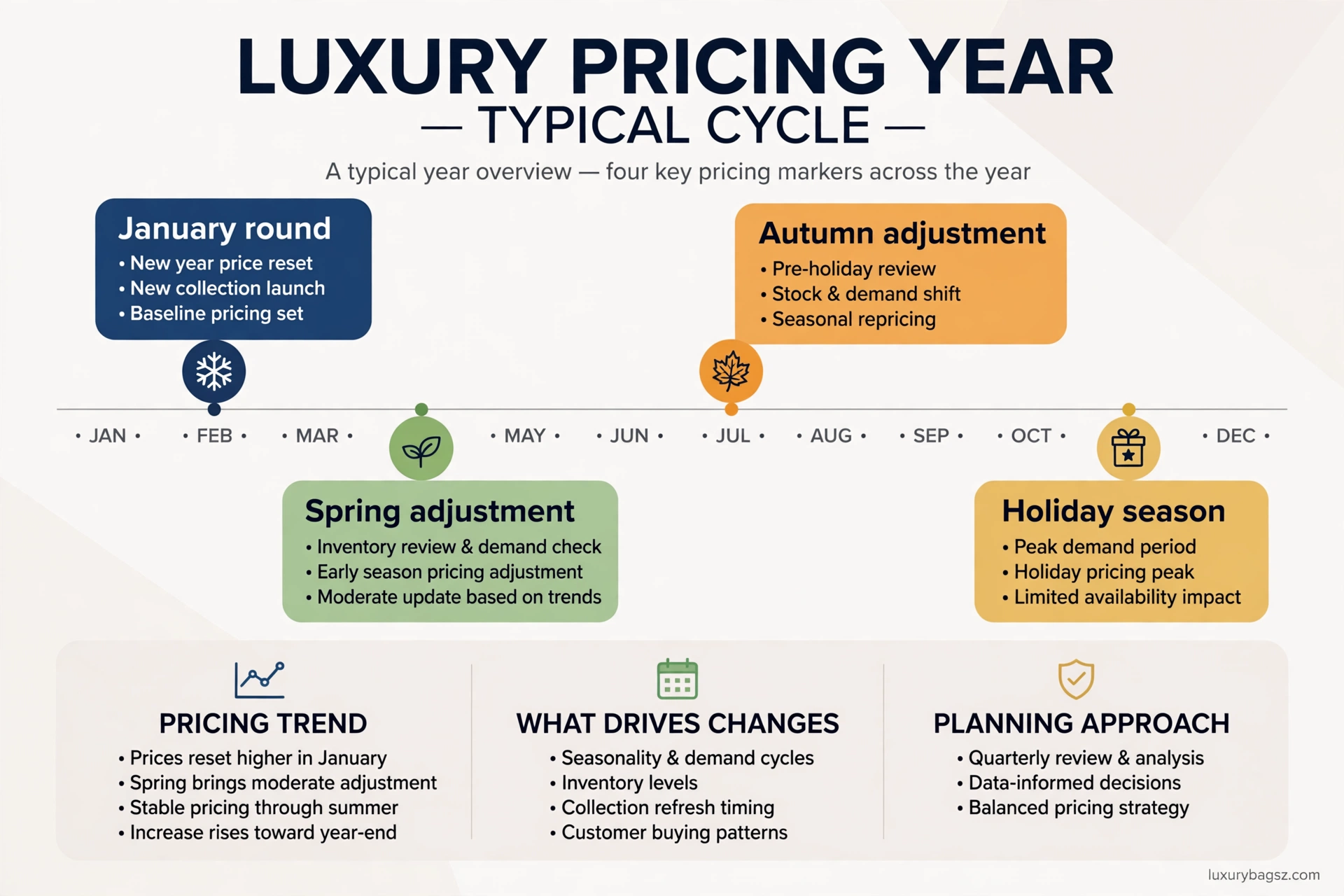
January belonged to Hermès, as it usually does. April and September belonged to Chanel. May saw both Louis Vuitton and Cartier move within days of each other.
That calendar is the buyer's best tool. Houses rarely publish dates in advance, but their habits are consistent enough that regular buyers plan around them.
Social media has shortened the secrecy. Tracker accounts now crowdsource new prices within hours of a round landing, comparing boutique tags across countries in public. The houses have not adapted their silence, but the silence no longer buys them a quiet week.
For the buyer, the practical effect is speed: the window between "rumoured" and "confirmed and global" is now measured in days, which rewards people who have already made their decision.
If a purchase matters to you, the months just before a house's usual round are when stock, choice and yesterday's price briefly align.
Boutiques feel the rhythm too. Staff cannot confirm rises in advance, but experienced buyers know that a sudden firmness about reservations and deposits often means a round is close.
The calendar also differs by region. A rise may land in the US in one month and in Europe in another, which is why travellers sometimes find yesterday's price still alive in another market — briefly.
Chanel: Two Rounds in One Year
Chanel's first 2026 adjustment was reported on 2 April, at roughly 2–5% across bags. Trackers reported the Classic Flap Medium and Large at $11,700 afterwards, with the Small at $11,300 and the Jumbo at $12,600.
A second round followed in September on parts of the range. Reporting described flat increases — around $300 on the newer flap line — rather than a single percentage.
Two rounds in a year is not new for Chanel, but it shortens the safe window for buyers. If you are saving towards a flap, assume the price you see is temporary.
The context is the decade behind it. The Classic Flap's price has climbed relentlessly for years, passing psychological barriers — $10,000, then $11,000 — that once seemed like natural ceilings. Each pass resets what buyers consider normal.
Chanel's stated logic over the years has been harmonisation: narrowing price gaps between markets so a bag costs roughly the same everywhere. The 2026 rounds fit that pattern, with different markets moving by different amounts towards alignment.
Hermès: The January Round
Hermès traditionally reprices in January, and 2026 was no exception. Trackers reported the US increase taking effect on 1 January, with bags up roughly 4–11% depending on style and leather.
The steep end of that range usually falls on smaller, high-demand pieces. Our guide to Hermès handbag prices tracks the headline numbers across the main lines.
Smaller pieces moved too, which matters for buyers building a purchase history. The Hermès Geta bag is one example of an accessible style whose price steps up with each January round.
Hermès buyers feel rises differently from other houses' clients. Because the most wanted bags are allocated rather than simply sold, a January rise changes the value of an offer you may wait a year to receive — the goalposts move while you queue.
The house's discipline is the point. One predictable round a year, applied broadly, keeps its pricing story boring, and boring pricing is a form of prestige in itself.
Louis Vuitton and Cartier in May
Louis Vuitton's rise was reported on 27 May, with handbags up about 2.1–5.7%. Canvas icons at the lower end moved least in cash terms; leather lines carried the larger steps.
Our tracker of Louis Vuitton handbag prices shows how the main lines now sit after the change.
Cartier moved on 21 May, but this was a watch story: reported increases of about 4–9.9% on watches, not a general jewellery rise. Buyers of the classic jewellery lines were not the target this time.
The two May moves show how differently houses aim. Louis Vuitton's was shallow and broad, touching a huge handbag range by a little. Cartier's was deeper and narrow, concentrated where gold and movement costs bite hardest.
For buyers, the practical read is category-specific: a headline that "Cartier raised prices" did not make a LOVE bracelet dearer in 2026, and a headline about handbags said nothing about watches.
Why Prices Keep Rising
Houses give three public reasons: materials and craft cost more, currency moves against them, and demand at the top stays strong. All three were plausibly true in 2026.
Gold's rise through the period fed directly into jewellery and watch pricing. Leather, hardware and skilled labour all cost more than they did five years ago.
There is also strategy. Higher prices protect the gap between the top houses and everyone else, and scarcity sells better at $11,700 than at $9,000.
Analysts who cover the sector make a further point: the top houses have learned that their best clients are the least price-sensitive people in retail. A 5% rise loses almost none of them, while funding the flagships and shows that keep the dream funded.
The risk sits lower down, with aspirational buyers who save for a first piece. Each round pushes their first purchase further away, and several houses spent 2026 talking about entry products for exactly that reason.
How to Buy Around a Rise
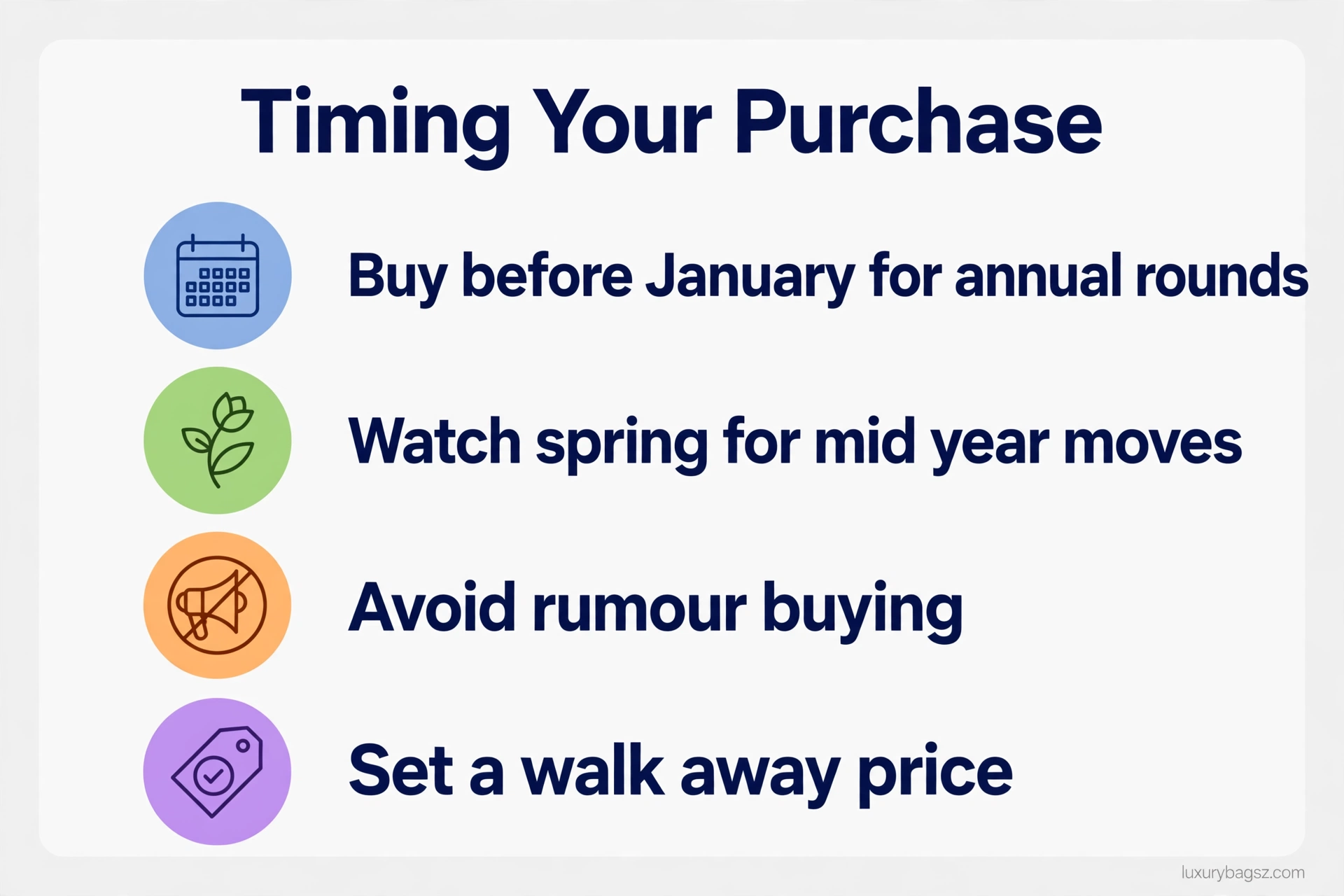
Buy in the quiet months before a house's usual round, when stock is better and staff are less rushed. For Hermès that means autumn; for Chanel, late winter and late summer.
Currency deserves a line of its own. If you are travelling, a rise in one market can coincide with a favourable exchange rate in another, and the combined effect — not the headline percentage — is your real price.
Keep a simple record for any bag you are saving towards: today's price, the house's usual round month, and your decision date. That small discipline converts anxiety about rises into a plan.
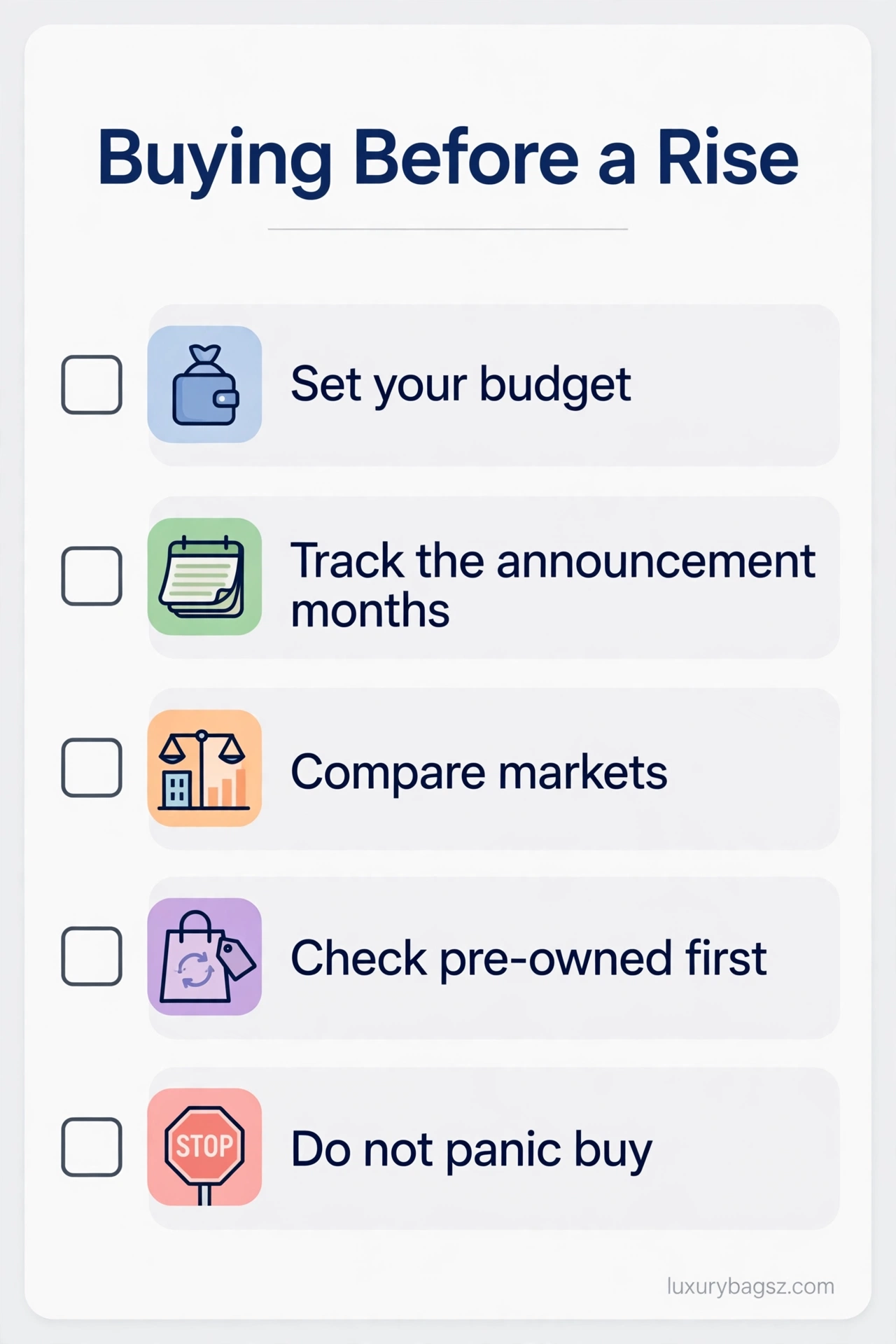
Compare markets before you travel. Our breakdown of Chanel bag cost in Paris versus elsewhere shows how much geography can change the final figure.
Above all, keep the discipline: a rise is a reason to advance a decided purchase, never a reason to make an undecided one. A wrong bag bought cheaply before a rise is still a wrong bag.
Two more tactics help. First, ask about stock honestly: boutiques often hold the exact bag in the back, and a polite, decided buyer in the week before a round is the easiest sale of the season.
Second, keep receipts and records from every purchase. If you later resell, a receipt dated before a famous rise is a small story that supports your asking price.
What It Means for Resale
Every retail rise lifts the resale ceiling. Sellers price against the current boutique figure, so a bag bought before a rise often looks better on paper afterwards.
Watch the lag, because it is the opportunity. Asking prices on platforms adjust over weeks, not overnight, and listings written before a round sometimes sit untouched while the boutique price has already moved.
Consignment pricing adjusts slower still. A bag consigned in December can be priced by January's logic at a house that repriced on the first of the month, which occasionally leaves value on the table for an alert buyer.
That is not the same as profit. Fees, condition and demand decide real returns, and plenty of styles still resell below retail despite the rises.
For buyers priced out of boutiques, the secondhand market a few months after a rise is often the sweet spot, before asking prices fully catch up.
Rises also redraw the map between houses. When one house moves 10% and another 2%, relative value shifts, and cross-brand shoppers — more common than loyalists admit — quietly re-rank their wish lists.
Finally, remember what a rise does not change: how much you love the bag. A piece bought at the old price that sits unworn was not a bargain, and a piece bought after a rise that you carry for a decade was not a mistake.
Frequently Asked Questions
Which luxury brands raised prices in 2026?
All four houses in this guide did, as reported by trackers: Hermès in January, Chanel in April and September, and Louis Vuitton and Cartier in May. Other houses moved during the year too.
How much did Hermès raise prices in 2026?
Trackers reported US bag prices up roughly 4–11% from 1 January 2026, varying by style and leather. Hermès does not publish a price list, so figures come from retailer and tracker reporting.
When did Chanel raise prices in 2026?
Twice, as reported: an April round of roughly 2–5%, and a September round with flat increases on parts of the range, including about $300 on the newer flap line.
Did Louis Vuitton raise prices in 2026?
Yes. A rise reported on 27 May put handbags up about 2.1–5.7%, with leather lines generally moving more than canvas in cash terms.
Did Cartier raise jewellery prices in 2026?
The May 2026 Cartier rise was reported on watches, at about 4–9.9%. It was not reported as a general rise across the classic jewellery lines.
Why do luxury prices rise every year?
Houses cite material and labour costs, currency movements and strong top-end demand. Gold's rise fed watch and jewellery pricing in 2026. Positioning also plays a part: high prices protect exclusivity.
Should I buy before a price rise?
If the purchase is already decided and the timing works, buying before a known round saves real money. Never let a rumoured rise push you into a bag you have not settled on.
Do price rises make bags a good investment?
Not by themselves. Rises lift resale asking prices, but fees, condition and demand decide what you actually get back. Buy for use first.
Are the reported figures official?
No. Brands rarely publish increase percentages. The figures here come from price trackers, retailers and resale platforms, and are presented as reported, not audited.
Will prices rise again in 2027?
History says the January and spring rounds will come again in some form. The size is unknowable in advance, so plan on direction, not on a number.
Final Verdict
The 2026 rises were broad but not wild: mostly single figures, applied on the usual dates, by houses that have made annual repricing a habit. Nothing about the pattern suggests 2027 will differ.
For buyers, the winning response is boring and effective: decide slowly, buy before the round you can predict, and let other people panic-buy the wrong bag at the old price.






