

Gucci Serial Numbers Explained: How to Read Them
Serial Numbers in Brief
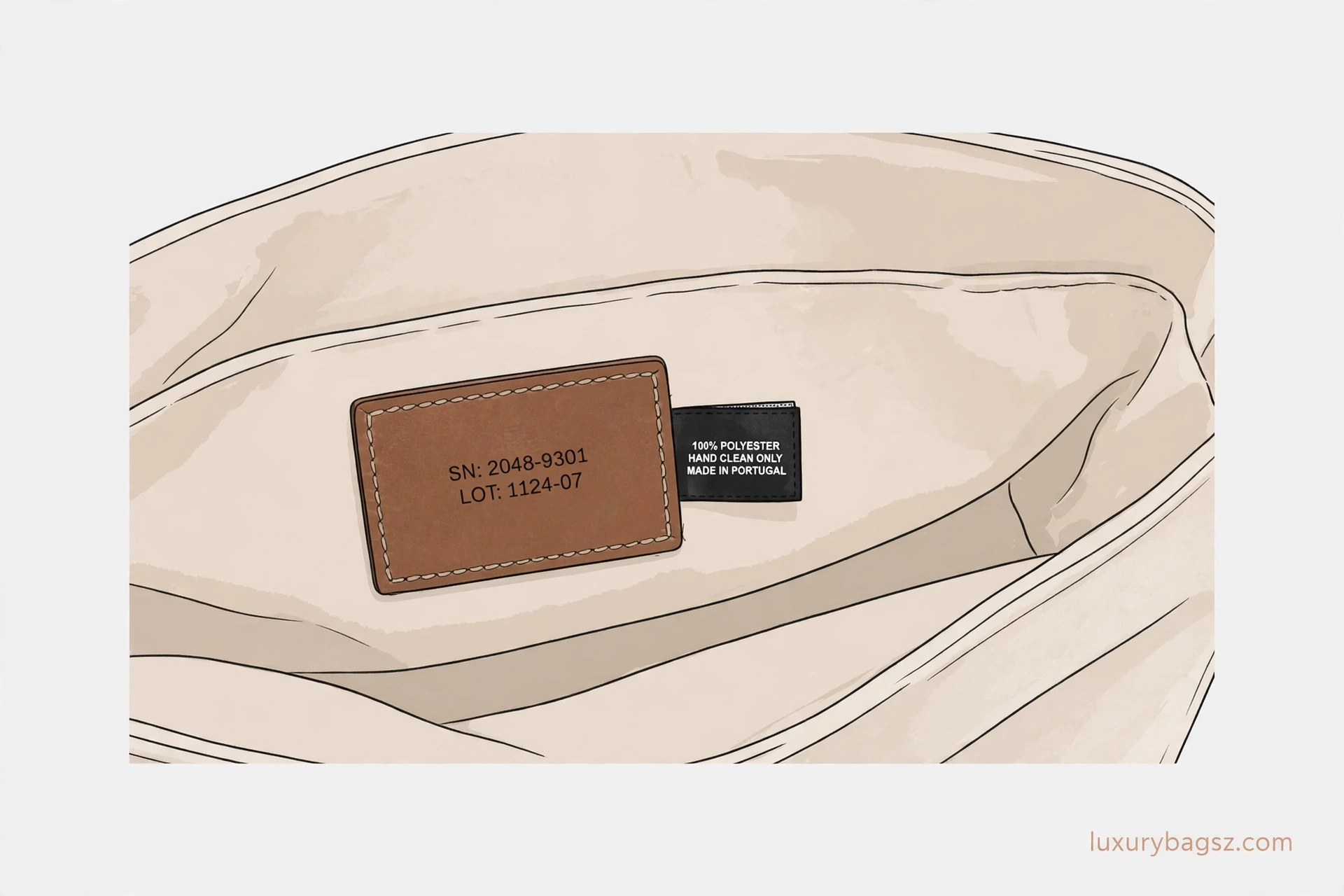
A Gucci serial number does not do what most buyers think it does. It does not identify your individual bag, it does not prove your bag is real, and on the leather tag, it does not give you a year. What it does is identify a style and a supplier, and confirm that a bag's format matches its claimed era.
The year, where it exists at all, lives on a different tag: the small black fabric label beside the QR code, introduced around 2014, whose first three digits are said to map to a production year. That map is third-party, not Gucci's, and its readings for 2023 and 2024 are disputed, so treat them as give-or-take a year.
Key Takeaways
- Leather tag serial: two rows of digits only, top row is the style number (usually 6 digits), bottom row is the supplier or batch code (4 to 6 digits).
- The leather serial gives no year, identifies no individual bag, and is shared by many authentic bags of the same style.
- Black fabric label: introduced around 2014, beside the QR code, first three digits are said to give the year from 2014 to 2024, but the chart is third-party and disputed above 2022.
- QR codes read only in the official Gucci App (My Gucci, then Gucci Tag), not in a standard phone scanner, and only on tags from roughly 2016 to 2021.
- No public Gucci serial lookup database exists; checkers can check format and style match, not authenticity.
- Letters on a serial tag mean fake; a correct-looking serial alone proves nothing, since counterfeiters copy real numbers.
The Two Tags, Kept Separate
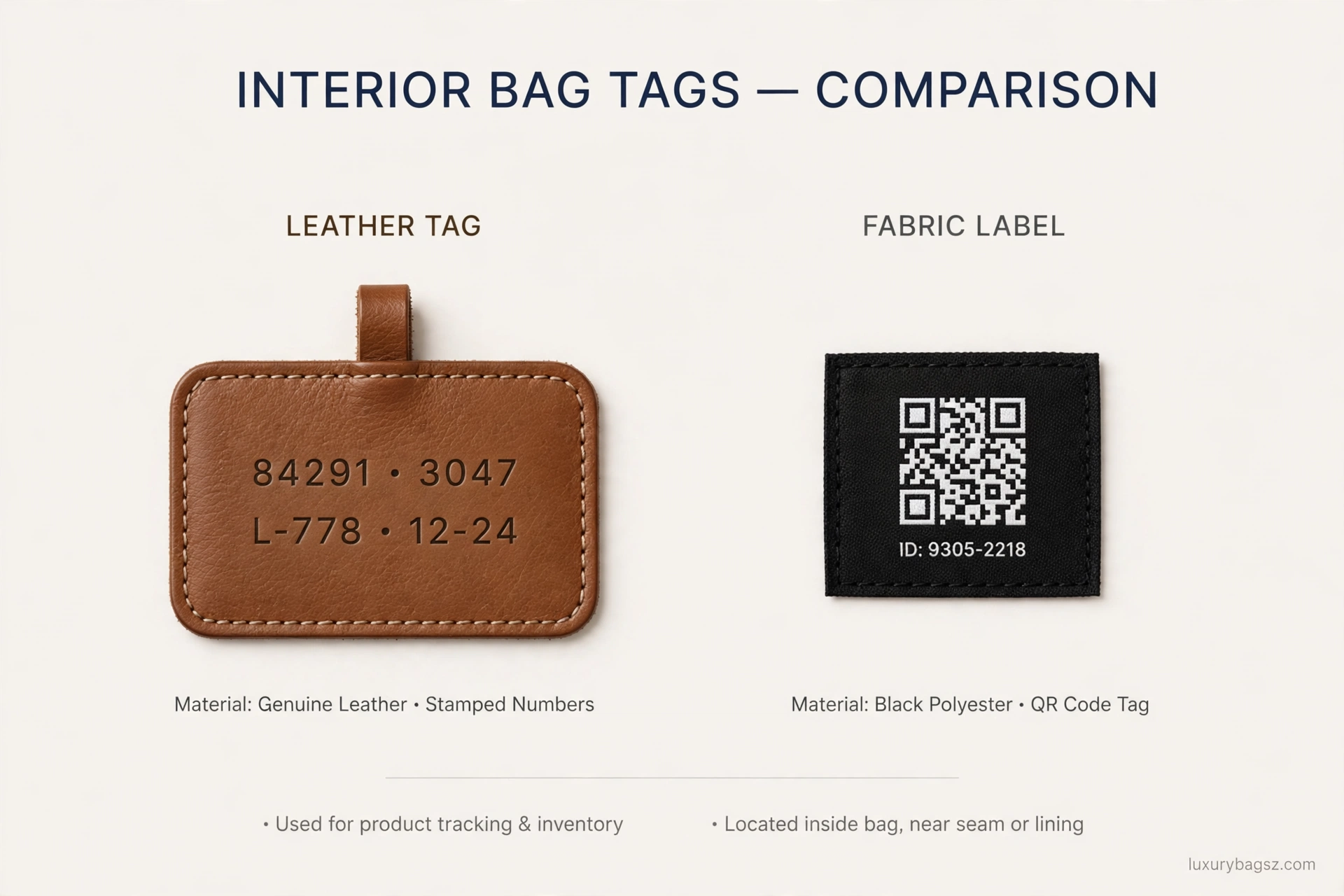
Almost every Gucci serial misunderstanding comes from conflating two different tags. The first is the leather tag inside the bag, near the interior zipped pocket, whose front carries the GUCCI stamp and whose back carries the serial number. The second is the small black fabric label, also inside the bag, carrying a QR code and a separate number beside it.
Where to Find Each Number
The leather tag sits inside the bag, sewn into the top seam of the interior back pocket area on most bags, including Marmont, Ophidia, Dionysus and Soho styles, near the interior zipped pocket and opposite the front closure. It is always stitched in, never loose or glued, and a flapping tag is a warning sign.
Reading the Leather Tag, Digit by Digit
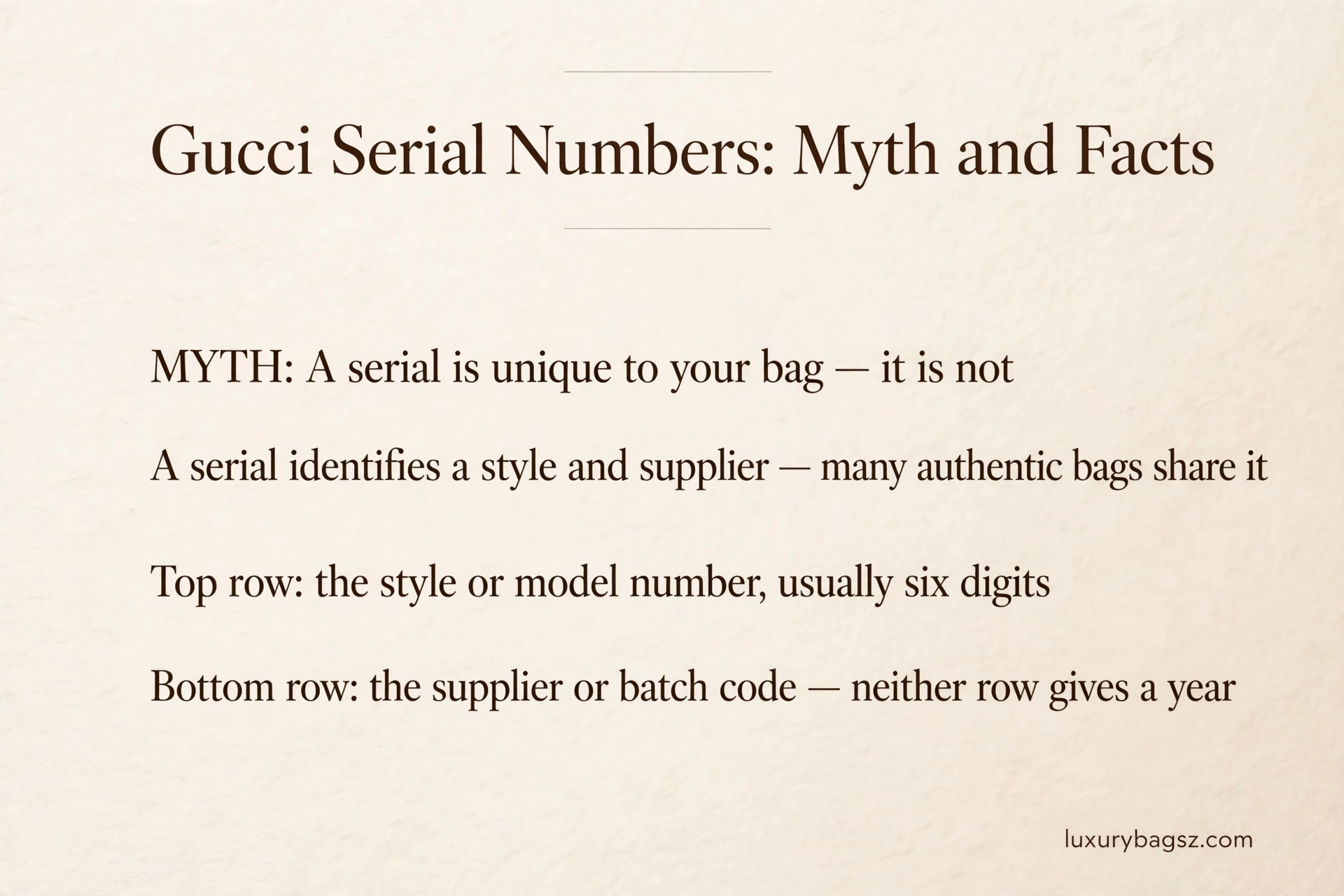
A modern leather serial has two rows of digits only, never letters. The top row is usually six digits and identifies the style or model number. The bottom row is usually four to six digits and identifies the supplier code, which is a batch or workshop reference shared by bags from the same batch.

What the Leather Serial Cannot Do
The leather serial cannot prove a bag real, and this is the most important limit in this guide. Because it identifies a style and supplier rather than an individual bag, a counterfeiter who copies a real bag's serial produces a tag that looks exactly right by number, and only the tag's font, stamping quality and agreement with the rest of the bag can betray it.
The Black Label Year Chart, With Its Caveats
The black label year chart is this guide's key table, and it comes with a caveat that no competitor prints in full. The chart below follows LuxeDetect's mapping, which LuxeDetect itself notes comes from third-party guides, not from Gucci, and LegitGrails notes that independent versions of the chart agree up to 2022 and disagree above it.
The chart's two-codes-per-year pattern also helps spot implausible readings. A black label reading that falls outside the chart's ranges for its claimed year disagrees with the chart and needs explaining. Newer bags beyond 2024 are outside this chart entirely, and this guide gives no mapping for them, so do not extrapolate the pattern forward and assume a higher code means 2025.
| Black label first three digits | Said production year |
|---|---|
| 019 to 020 | 2014 |
| 021 to 022 | 2015 |
| 023 to 024 | 2016 |
| 025 to 026 | 2017 |
| 027 to 028 | 2018 |
| 029 to 030 | 2019 |
| 031 to 032 | 2020 |
| 033 to 034 | 2021 |
| 035 to 037 | 2022 |
| 038 to 039 | 2023, disputed |
| 040 to 042 | 2024, disputed |
The Central Disagreement, Stated Plainly
Does any Gucci number give a year? The sources split, and this guide states the split rather than resolving it silently. B101revue and SellYourBags say Gucci has no date code and the serial cannot give the year, full stop. LuxeDetect and LegitGrails say the leather serial gives no year, but the black fabric tag beside the QR code does, from 2014 to 2024.
Why do sources disagree at all? Because Gucci does not publish its coding system, so every guide reverse-engineers it from observed bags, and different observers see different samples. That should make buyers cautious, not dismissive: the black label year chart is useful precisely because it is built from observation, but observation without a published standard always carries uncertainty.
Era Formats, With Their Disagreements
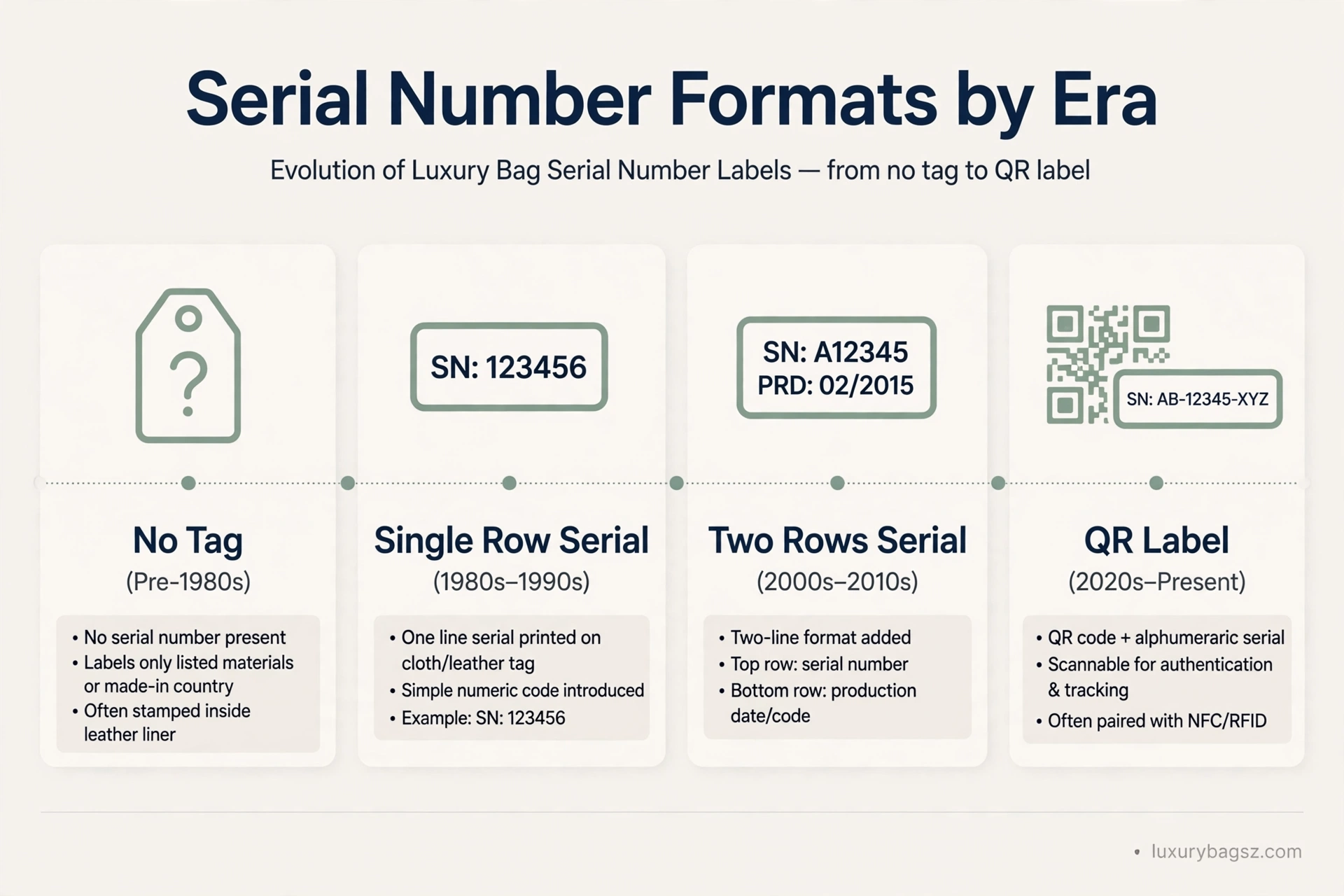
Gucci's serial formats changed across decades, and the sources disagree on the exact boundaries, so this table prints the main accounts side by side rather than blending them into one false timeline.
The Tom Ford era deserves special care, since its serif format is the most distinctive and the most copied. Real Tom Ford-era digits have small feet, oval zeros and curled twos and threes, and those details are hard to copy consistently. A Tom Ford-era tag in a clean modern sans-serif font is a warning sign, whatever its digit count.
| Era | LuxeDetect format | LegitGrails format | Fashionica note |
|---|---|---|---|
| Pre-1950s | No serial tag | Not covered | No standardised system, fabric tags only |
| Pre-1994 | No serial tag | 10 to 11 digits pre-2000s | Standardised from 1970s onward |
| Mid-1990s to early 2000s | Single row of 10 digits | Hyphen-separated, 2000s to 2015 | Two-line serif, 3 digits plus dash or dot plus 4 digits, Tom Ford era |
| 2000s to present | Two rows of 6 digits | Longer codes and QR, 2015 to present | Two lines of digits only, no letters, or 6 over 4 |
| 2016 onward | QR on select lines | QR from 2016 to 2017 | QR tag, official Gucci App only |
QR Codes and NFC: What They Actually Do
The QR code sits on the black fabric label, and it is encrypted. It reads only in the official Gucci App, under My Gucci and then Gucci Tag, where it shows an authenticity page and product details. It does not read in a standard phone camera or QR scanner, and a QR code that reads in a standard scanner, or that leads to a generic website, is not a Gucci QR check.
Non-Bag Items: Wallets, Belts, Eyewear and Watches
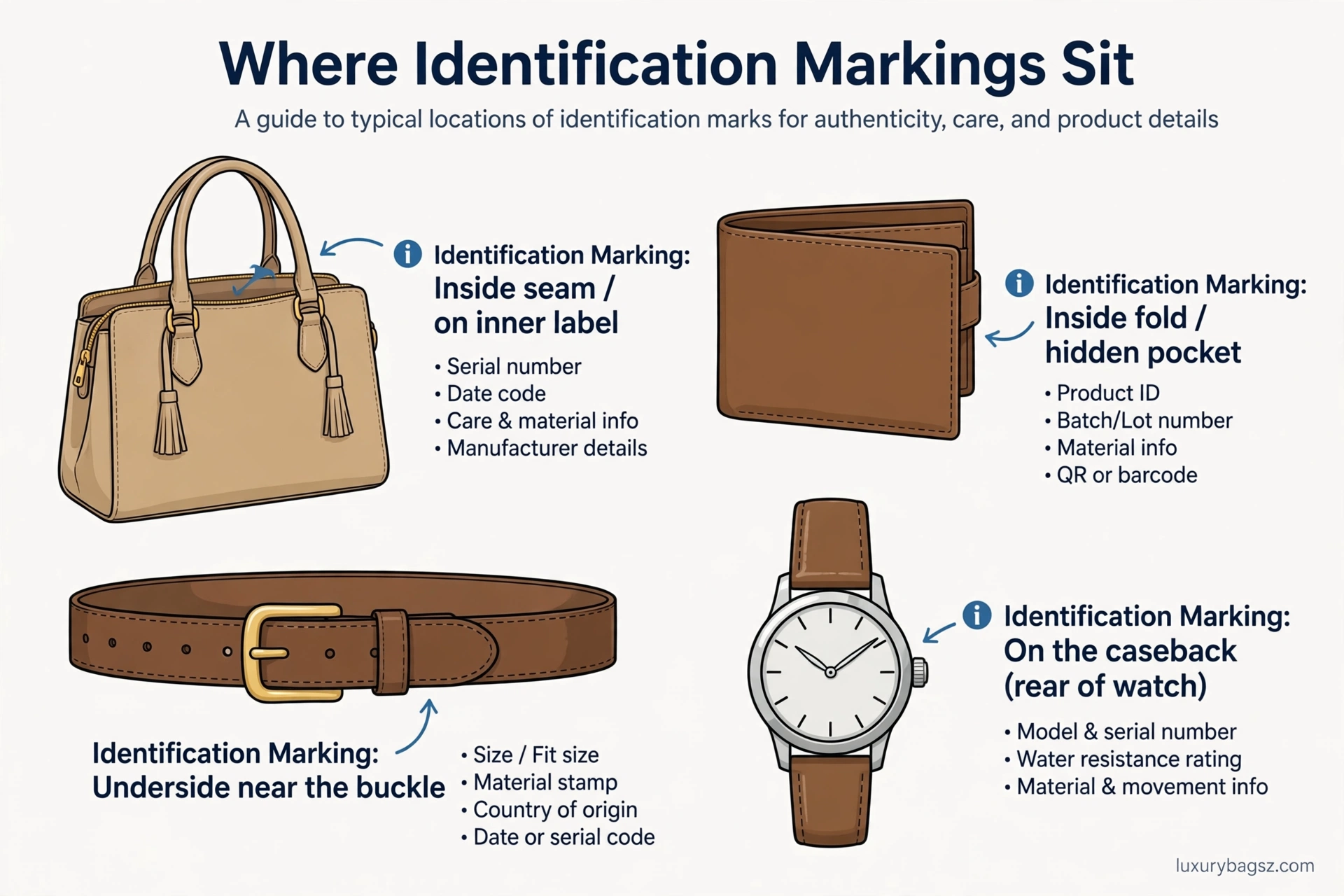
Most serial guides cover bags only, but LegitGrails covers the wider range, and this guide follows it. Wallets and small leather goods may be stamped directly near the card slots rather than carrying a separate leather tag, and their codes follow the same style-and-supplier logic as bag tags, without a separate year code.
Worked Examples: Reading Three Real Tags
Example one: a leather tag reading 449661 on top and 525040 on the bottom. The top row is the style number, which should match the bag's model in Gucci's listings and on any receipt. The bottom row is the supplier code, shared by bags from the same batch. Neither row gives a year, and neither row alone proves the bag real.
Missing, Faded or Mismatched Numbers
Missing numbers have innocent explanations as well as suspicious ones. Pre-1994 bags may have no serial tag at all, vintage tags fade and peel, and small leather goods may be stamped so lightly that the code is hard to read. A missing number on a bag whose era says one should be there is suspicious; a missing number on a bag whose era says none is expected.
Checkers: What They Can and Cannot Do
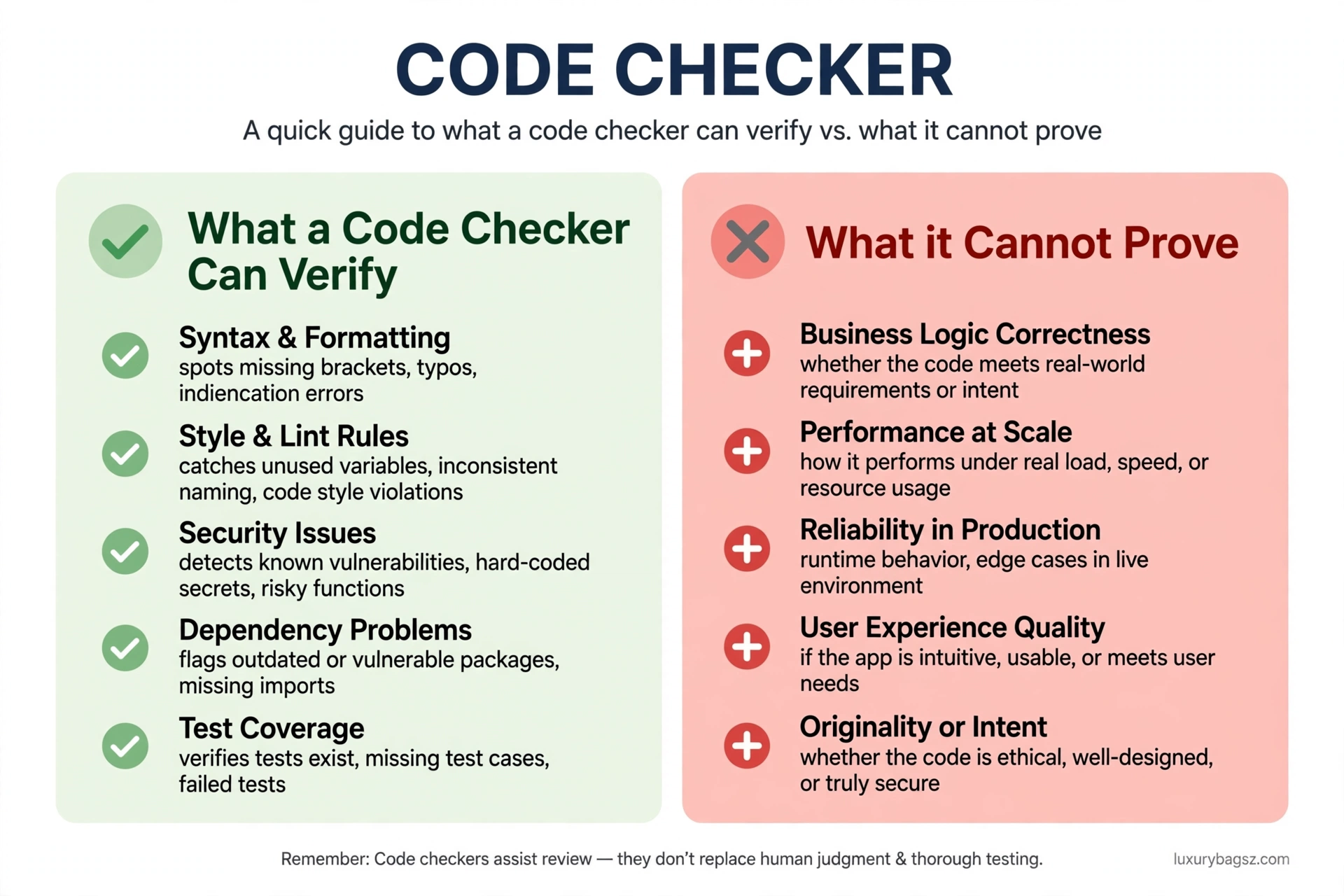
Online checkers, including those from LuxeDetect and LegitGrails, offer a useful but limited service. They can check that a serial's format matches its claimed era, that its digit count is plausible, and that its style number matches a known Gucci model. Those are real, useful checks, and they catch many fakes with impossible formats or mismatched styles.
Checker databases also vary in coverage, which is why two checkers can disagree on the same serial. One may cover a style that the other does not, or one may have updated its format rules while the other has not. A disagreement between checkers is a reason to seek a human opinion, not to pick the answer you prefer. Paid checkers are not automatically better; prefer services that give a written, reasoned opinion over those that give only a pass or fail.
The Practical Workflow Before You Pay
Photograph both tags before you pay: the leather tag front and back, and the black fabric label with its QR code and number. Photograph them in good light, straight on, and at an angle, since angled light reveals stamping depth that flat light hides.
Judge the bag itself on hardware, stitching, materials and canvas or quilting, following the same pattern approach as our guide on how to spot a fake Hermes Kelly bag, where no single detail is treated as proof alone.
Common Serial Myths, Corrected
Myth one: a Gucci serial is unique to your bag. It is not. It identifies a style and supplier, and many authentic bags share it. A seller who claims your serial is unique is either mistaken or misleading you.
Frequently Asked Questions
Where is the Gucci serial number?
On the back of the interior leather tag, inside the bag near the zipped pocket, sewn into the top seam or beside a zip, never on a side seam. The black fabric label with its QR code sits separately, in a pocket or along a seam.
What do the two rows of a Gucci serial mean?
The top row, usually six digits, is the style or model number. The bottom row, usually four to six digits, is the supplier or batch code. Neither row gives a year or identifies an individual bag.
Does a Gucci serial number give the year?
The leather serial does not. The black fabric label beside the QR code is said to give a year from its first three digits, from 2014 to 2024, but that chart is third-party, not Gucci's, and its 2023 and 2024 readings are disputed.
What does black label code 031 mean?
On LuxeDetect's chart, 031 maps to 2020, as part of the 031 to 032 pair for that year. Treat it as a supporting hint, check that the bag's other features agree with 2020, and never use it alone as a verdict.
Are letters allowed in a Gucci serial number?
No. Authentic Gucci serials are numbers only, and any letter on a serial tag means the tag is fake, whatever the rest of the bag looks like.
Is there an official Gucci serial number lookup?
No. Gucci publishes no public serial database. Online checkers can check format and style match, but they cannot confirm authenticity, give a year from the leather tag, or identify a country.
How do you scan a Gucci QR code?
In the official Gucci App only, under My Gucci and then Gucci Tag. A QR code that reads in a standard phone scanner, or leads to a generic website, is not a Gucci QR check.
What if my Gucci bag has no serial number?
Judge it by era. Pre-1994 bags may have none, vintage tags fade and peel, and small goods are stamped differently. A missing serial on a bag whose era says one should be there is suspicious; on an older bag it may be expected.
Do Gucci belts and wallets have serial numbers?
Belts are stamped on the reverse toward the buckle, and wallets may be stamped directly near the card slots rather than carrying a separate tag. Their codes follow the same style-and-supplier logic as bag tags.
Should I trust a serial checker result?
Only for what it can do: format check, style-number match, and era plausibility. A checker pass does not prove a bag real, and a checker fail does not prove a genuine vintage bag fake. Judge the bag itself on its full set of features.
Final Verdict
Gucci serial numbers are useful precisely because they are limited. The leather tag tells you a style and a supplier, the black label hints at a year with a disputed tail, and neither tells you whether the bag in your hand is real. That limit is not a flaw in this guide; it is the truth about Gucci's system, and guides that promise more are selling you a check that does not exist.






