Dior Date Codes: How to Read the Stamp Inside Your Bag
Dior Date Codes: How to Read the Stamp Inside Your Bag
The Quickest Way to Find and Read Your Code
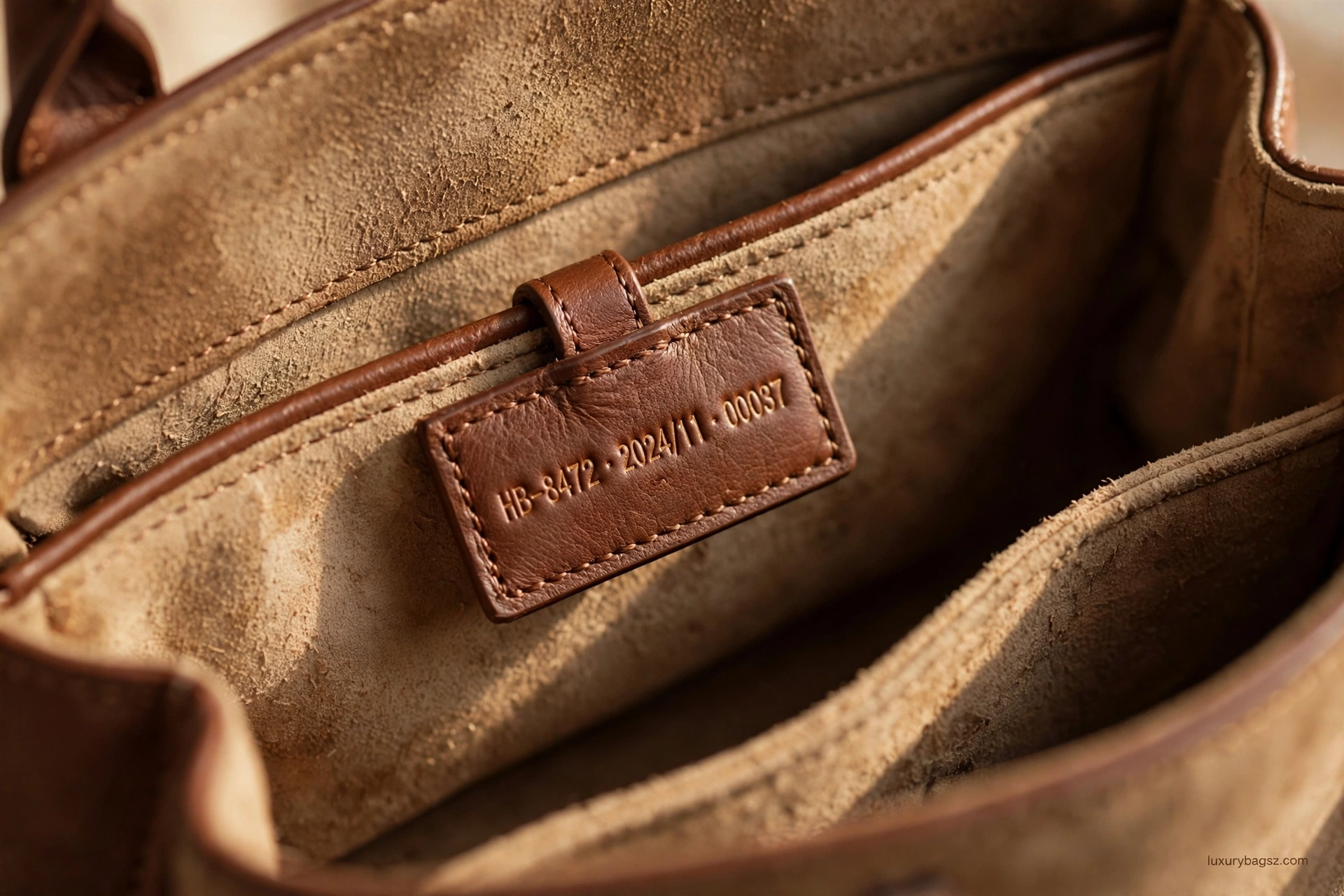
Turn the small leather tag inside your Dior bag over. On most modern bags the date code is heat-stamped on its reverse, in a pattern of two digits, two letters and four digits, such as 01-BO-0129.
Read only the last four digits for the date. The first and third digits give the month, and the second and fourth give the year, so 0129 reads as February 2019. The letters point to the factory.
Key Takeaways
- The code sits on the reverse of the interior leather tag on most bags, or on a fabric label inside the Book Tote.
- Modern format: two digits, two letters, four digits. Ignore the first pair for dating; it is described as a control number.
- Letters name the factory and country, commonly MA and BO for Italy and MC for Spain, as reputable guides describe them.
- In the last four digits, digits one and three make the month and digits two and four make the year.
- A correct code never proves a bag is genuine on its own. Fakes copy plausible codes every day.
- Bags from before about 1997 may have no code at all, and that absence alone is not a fault.
Where the Code Hides, Model by Model
Start with the interior tag. Its front usually carries the Christian Dior and PARIS stamp, sometimes with the made-in line beneath it. The code is normally on the back, so you must lift or turn the tag to see it.
Lady Dior
On a Lady Dior, look inside the zipped pocket or just beside it. The tag is stitched neatly in place, often on all four sides, and the code sits on its reverse. Photograph it in angled light if the stamp looks faint.
Saddle Bag
On a Saddle bag, check the tag inside the main compartment and any small tab tucked near a seam or pocket. Vintage and reissue bags differ in lining and closure, so match the tag style to the era the seller claims.
Book Tote
The Book Tote is the exception many buyers miss. Because it is largely canvas and embroidery, the code is often printed on a fabric label inside rather than stamped into leather. Search along the interior seams carefully.
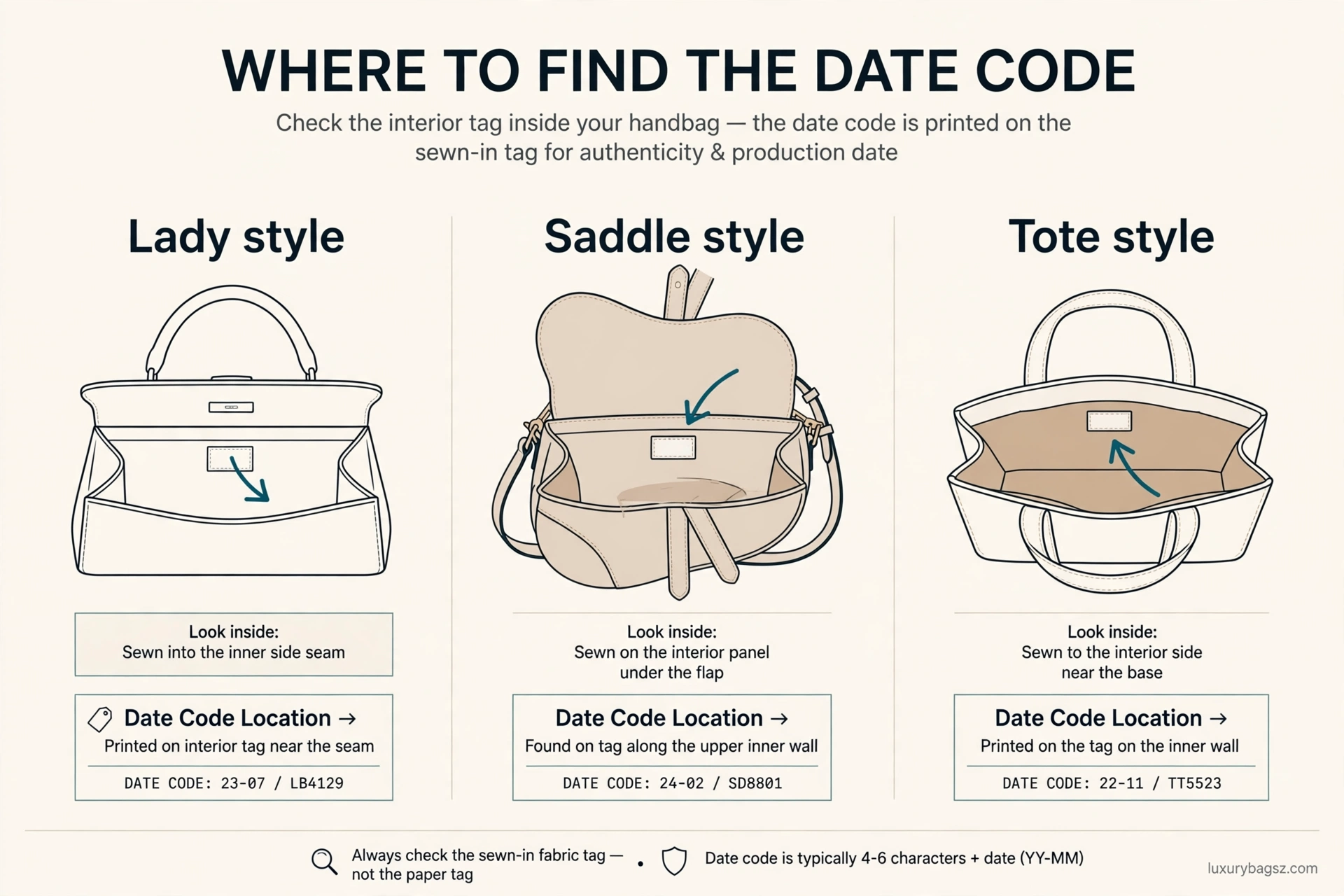
If you cannot find a code straight away, do not panic. Some pieces carry it on a separate small tab, and some are stamped directly into the leather or lining. Good light and a slow, fingertip search help most.
The code is never on the outside of the bag, on the dust bag or on the authenticity card. The card carries a separate style reference and a boutique stamp, and cards are copied easily and can move between bags.
If a seller sends only a card photograph as proof of the code, ask for the tag itself, front and back. A card can support a listing, but it can never stand in for the stamp inside the bag.
A modern bag can also lose a readable code through use. Stamps can wear faint over many years of handling, and a tag can be lost when a bag is relined or repaired, leaving no code to find.
Search gently and never unpick stitching or lining to hunt for a hidden tab. If a recent bag has no code and no repair story explains it, treat that gap as a question to resolve before you pay.
How to Read a Modern Dior Date Code
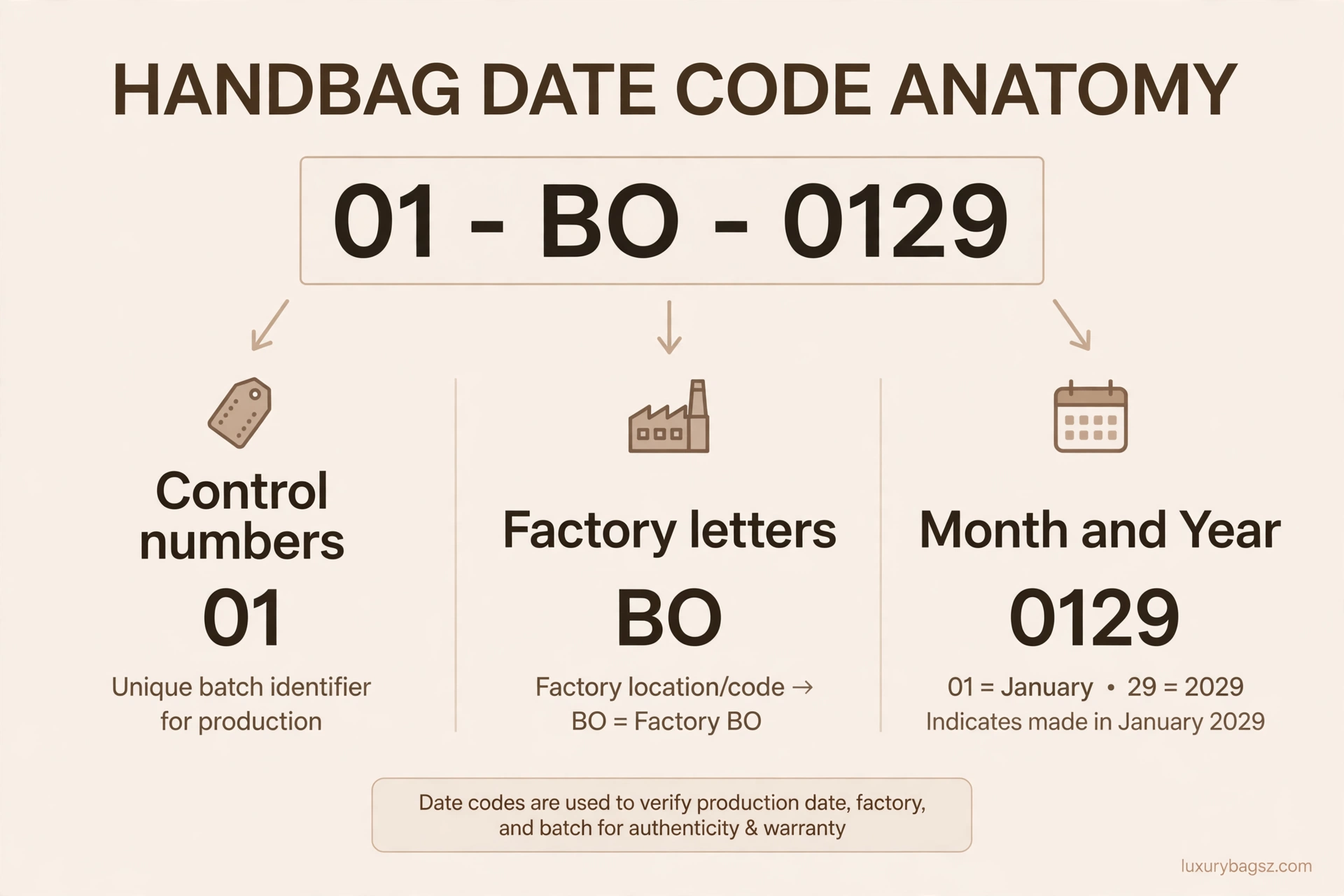
Take 01-BO-0129 as a worked example. Split it into three parts: 01, BO and 0129. The first pair is not the date, the letters are not the date, and only the final group of four digits carries the month and year.
| Part of code | Example | What reputable guides say it means |
| First two digits | 01 | A control or batch number; not used for dating |
| Two letters | BO | Factory and country; BO is widely linked to Italy |
| Last four digits | 0129 | Month from digits one and three; year from two and four |
| Full reading | 01-BO-0129 | Made in Italy, February 2019 |
Try another example to fix the method. In 02-MA-0253, the letters MA point to Italy. In 0253, digits one and three make 05, and digits two and four make 23, so the reading is May 2023.
The leading pair catches more buyers out than any other part. It often runs above 12, as in 16-BO-0133, so it cannot be a month. Treating 16 as a month makes a genuine code look impossible at first glance.
Reading left to right causes the opposite error. A seller may read 01-BO-0129 as January 2029, creating a future date from a sound code. Always isolate the last four digits before you judge the date.
Dior does not publish an official key or lookup for these codes. The reading above is the convention authenticators have built from dated pieces, so treat a decoded date as a useful clue, not a brand confirmation.
What the Factory Letters Tell You
The two letters are widely described as a factory or workshop code, linked to the country of manufacture. MA, BO and RU are commonly linked to Italy, MC to Spain and ID to France, though lists vary between sources.
Always compare the letters with the made-in line on the tag. If the letters suggest one country and the stamp names another, that mismatch needs explaining. It is a prompt to look harder, not an instant verdict.
The letters do not name the model, the season in a fashion sense, or the buyer. They also do not make the code unique. Many bags made in the same place and month can share exactly the same code.
How the Format Changed Over the Years
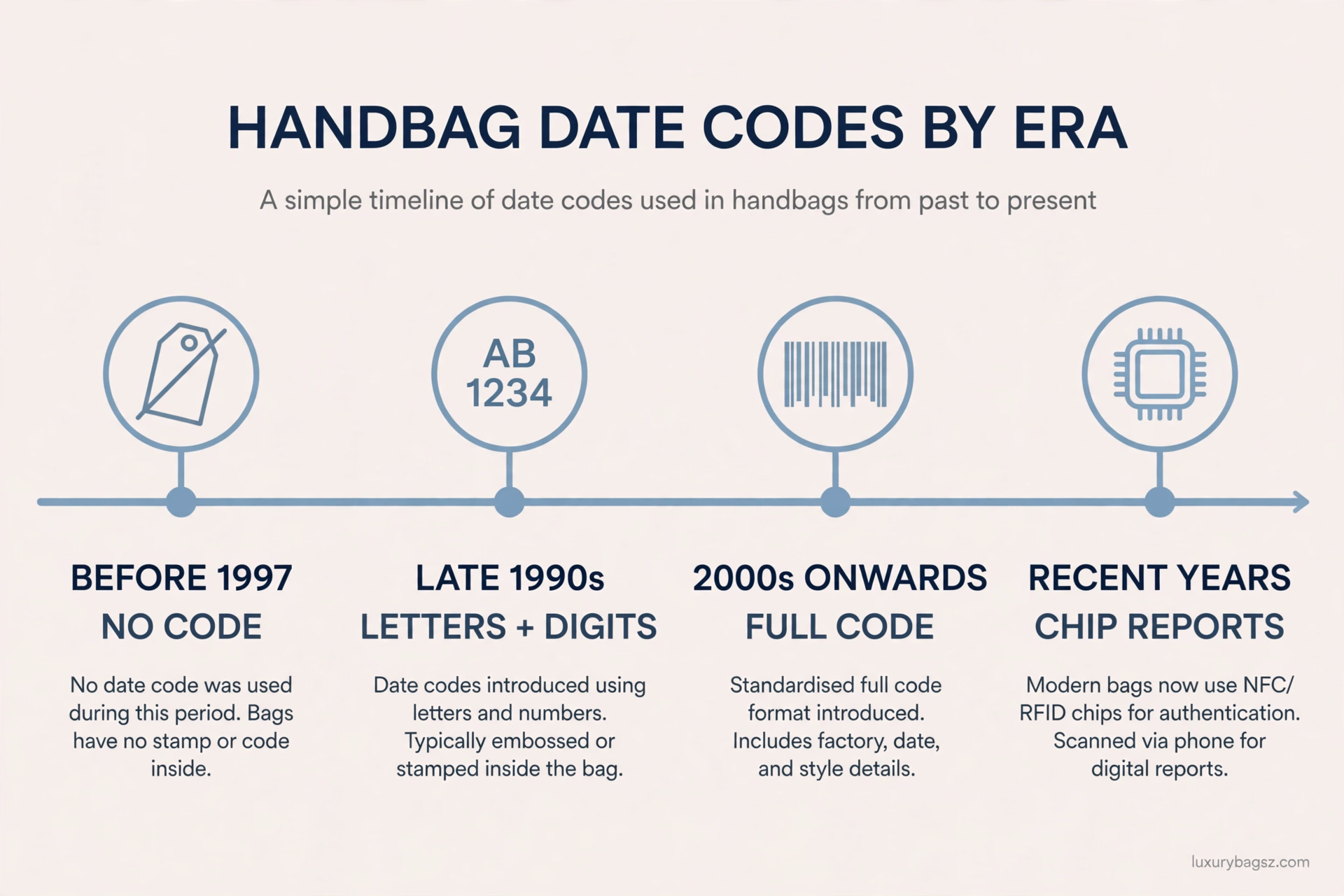
Reputable authentication sources place the start of Dior date codes at around 1997, in the late 1990s. Earlier bags, including the first Lady Dior bags, can be genuine with no code at all. Judge those pieces on construction.
Late-1990s codes are shorter: two letters and four digits, with no leading pair, such as MA-0959. That reads as May 1999. The same crosswise reading applies, with digits one and three giving the month.
From the early 2000s onwards, most bags use the longer form, with the leading pair added in front of the letters. The date group stayed the same, which is why one reading method covers both formats.
Use the era as a cross-check. A Book Tote, launched in 2018, cannot carry a genuine code reading 2009. A code that predates its model, material or hardware style is one of the clearest warnings you can find.
Use the shape of the code as an era check in itself. A bag claimed as late-1990s should carry the short letters-first form, not the modern three-part form. A modern form on a claimed 1990s bag needs a clear explanation.
The Heat Stamp: Look, Font and Placement
A genuine code is heat-stamped or debossed into the leather, without ink sitting on the surface. The characters should sit at an even depth, with clean edges and spacing that suits the factory and period of the bag.
On many Italian-made pieces, authenticators note that digit shapes vary a little in height and weight. That is normal, because factories used different die sets. Perfectly uniform, printed-looking digits deserve extra care.
Check the front of the tag too. The Christian Dior lettering should be centred, crisp and evenly spaced, with PARIS beneath it. Blurred letters, wonky spacing or a stamp that feels painted on are all warning signs.

Price context helps here as well. Before paying a strong asking price, compare it with current Dior handbag prices so a coded date is not the only thing guiding your decision.
Microchips and Digital IDs on Newer Bags
You may read that newer Dior bags carry embedded chips instead of a visible code. Treat that claim with care. As of 2026, sources I trust report chip use on some recent pieces, but no clear, brand-confirmed universal programme for handbags.
Dior’s confirmed use of NFC technology is narrower, including a limited-edition trainer in 2023 with a chip linked to a digital certificate. That footwear story does not prove every recent Lady Dior or Book Tote is chipped.
The shift is real elsewhere in luxury, though. Our guide to Chanel serial numbers and microchips shows how one house replaced stickers with plates, and why buyers now expect a similar move.
For Dior, the practical rule is simple. Do not reject a newer bag only because you cannot scan a chip, and do not accept one only because a seller says a chip is present. Chips, where present, are not a public proof check.
What a Code Can and Cannot Prove
A code can tell you whether a story hangs together. It can suggest a factory and a production month, and it can expose a seller’s claimed year as impossible. That contradiction test is where the code earns its keep.
A code cannot prove authenticity, ownership or original purchase. It is not a unique serial number, there is no public Dior database to search, and the same code appears on every piece from the same batch and period.
I have examined more than 500 bags in over ten years in the bag industry, and the pattern is consistent. The bags that pass do so because code, stamp, stitching, hardware and materials all agree with each other.
Fake-Code Red Flags
- A month that reads as 00 or above 12, after checking for a misread digit in raking light.
- A decoded year before the model was launched, or after the hardware style was replaced.
- Factory letters that clash with the made-in country stamped on the same tag.
- Digits that look printed, inked, unevenly deep, or in a font wrong for the claimed era.
- A code on a loose, poorly stitched tag with rounded or square corners wrong for the model.
- A seller who treats a clean decode as proof and resists showing the rest of the bag.
One red flag rarely settles a bag on its own, apart from an impossible date for the model. Look for a pattern. Two or three small disagreements, all pointing the same way, matter far more than one odd detail.
How the Code Fits a Full Authentication
When I check a Dior bag personally, the code is one step among many. I read the heat stamp, Cannage or embroidery, leather, lining, edge work, hardware engraving and charms, then test whether the code’s date fits them all.
I also use Entrupy, including its microchip checks where they apply, alongside hands-on inspection. Technology supports the eye; it does not replace it. That layered method is set out in our authentication process.
My visits to leather factories in Spain and France taught me to feel for the small things: stamp depth, edge finish and stitch tension. A copied code takes seconds to print. That level of making is much harder to copy well.
If the bag is valuable, or the code and the construction disagree, get a professional opinion before you pay. Clear photos of the tag front, the code, the hardware and the whole bag will speed up any review.
Frequently Asked Questions
Where is the date code on a Lady Dior bag?
Look on the reverse of the interior leather tag, usually inside or beside the zipped pocket. Turn the tag over in good light. The front carries the brand stamp, and the code is normally stamped on the back.
Is a Dior date code the same as a serial number?
No. It is a production code, not a unique number for one bag. Many bags from the same factory and month share the same code, so it cannot be searched like a serial number or used to trace an owner.
What if my Dior bag has no date code?
It may still be genuine, especially if it was made before about 1997, or if it is a small or canvas piece with a label you have missed. Search seams and pockets again, then judge the bag on its construction.
Can a fake bag have a correct date code?
Yes, easily. Counterfeiters copy plausible codes from genuine bags, so a code that decodes cleanly proves only that the numbers are consistent. The stamp quality and the rest of the bag matter just as much.
How do I read the month and year correctly?
Use only the last four digits. Digits one and three together make the month, and digits two and four together make the year. So a code ending 1019 reads as November 2009, not October 2019.
Do newer Dior bags have microchips instead of codes?
Some recent pieces are reported to carry embedded chips, but there is no clear, brand-confirmed universal handbag programme that sources agree on. Do not treat a chip’s presence or absence as proof either way.
Final Verdict
Read the code crosswise, check the letters against the made-in stamp, and test the date against the model’s real history. Done that way, the small stamp inside your bag becomes a sharp, honest clue.
Never let it work alone, though. A Dior bag earns trust when its code, stamp, stitching, hardware and materials all tell the same story. If they do not, pause, photograph everything, and seek expert help.